Watermelon tourmaline as a seam of two colors
The season has an appetite for a stone that will not pick one hue. Green tourmaline keeps a saturated green and spends it as one weather. Rubellite keeps a pink and spends that as one weather. Paraíba keeps a neon and lets the neon be the whole sentence. Watermelon tourmaline keeps two. A pink and a green share a crystal, and the jewel is the place they meet. The meeting has a direction. Sometimes the pink sits inside and the green is the rind. Sometimes the color travels the length of the stone, one end warming into the other. Sometimes a slice still shows the rings the crystal grew, and the pink is the outside. You read the seam before you ask the stone to be only green, or only pink.
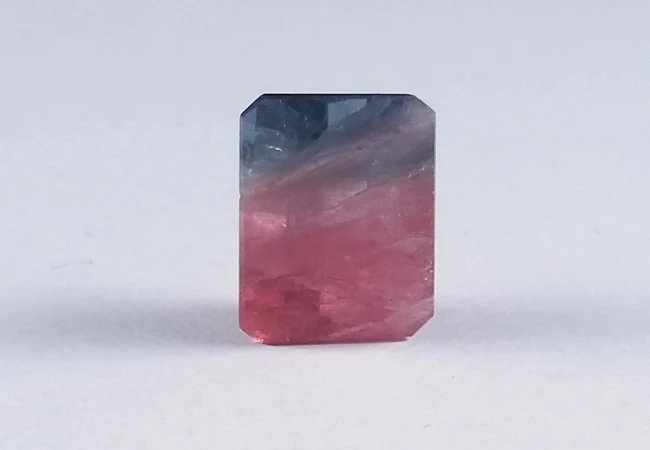
A pink with a green around it
One round, 6.75 carats, from Brazil, sits on a white ground and spends the two colors as a window. Pink through the table. Green at the rim, where the girdle takes the light. The seam is a circle. You would pick the stone out of a tray by that circle, before you asked which mine had grown it. A green tourmaline of this outline would have been one saturated weather, no second hue waiting at the edge. A rubellite would have held the pink and stopped. A Paraíba would have switched the whole pane on, one neon, no rind. This round is tourmaline asked to wear both, and to let you see which one is inside.
Daylight is enough. A darker cloth this fall does not have to argue with it. It gives the pink a chair and lets the green read as a shore. The size is not the argument. The argument is that the pane is one crystal, and the two colors did not have to be set beside each other to meet. They grew that way. A foil under a paler stone can fake a hue. Nothing here is painted on the back. The pavilion returns a pink, and the rim keeps the green, and the white ground does the kindness of staying out of it.
You would know the stone from across a cloth by the way the green seems to hold the pink in place. That is the manners of this gem when the months want two colors and refuse a pair of different species. One body. A seam you can point to. The round lets the seam be a rind.
The same two colors, run as a length
A second crystal spends the meeting the long way. Cut elbaite from the Cruzeiro mine, in Minas Gerais, about 4.14 carats, a narrow stone a little over a centimeter along its length. The color does not sit as a circle around a center. It travels. A pale green at one reach of the stone warms toward a pink as the eye moves along it. The seam is a path. You could follow it with a fingertip and still be in one gem.
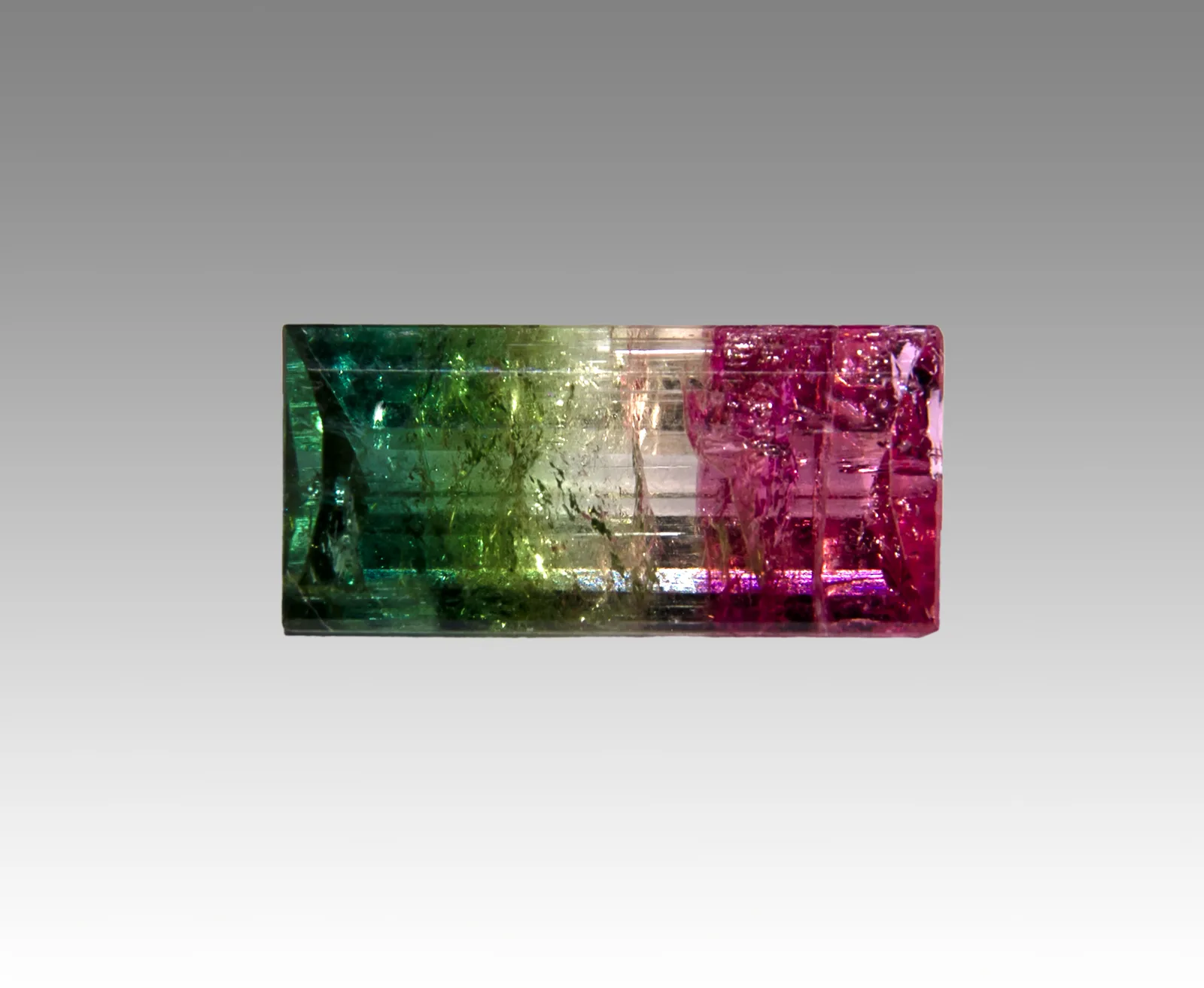
This is not a second angle of the round. It is another stone, and the direction of the seam has changed. The Brazilian round let you look down into a pink held by green. This length lets you look along a crystal that changed its mind as it grew, one end a cool green, the other already turning toward the pink. A jeweler can set either of them. The appetite they answer is the same: two colors, one body, the join left visible. A saturated green in this chair would have been even from end to end. A rubellite would have been even in the other direction. The length refuses the evenness, and the refusal is the jewel.
The scale stays a jewel’s ordinary scale. A white ground, no mount, no hand. Nothing in the still is a finger. The stone is the color as a fact you could fasten later, and the fastening is not required for the seam to be whole. You would still name it from the path of the hue, before you asked how many carats had been written on the paper. The round was a window. This one is a road.
The rings the cut came from
A slice shows the decision before a pavilion has softened it. Liddicoatite from the Valozoro deposits in Madagascar, a piece about a centimeter thick, polished on both faces, 3.6 by 3.3 centimeters. The center is a light green. The rind is pink. The watermelon, in this crystal, has turned its colors over: the pink is the outside, the green is the room inside. Triangles of the growth are still in the slice, a geometry a brilliant cut will later blur into a window. You are looking at the reason the two stones above can disagree about which color sits in the middle. The crystal decides. The cut only opens the decision.
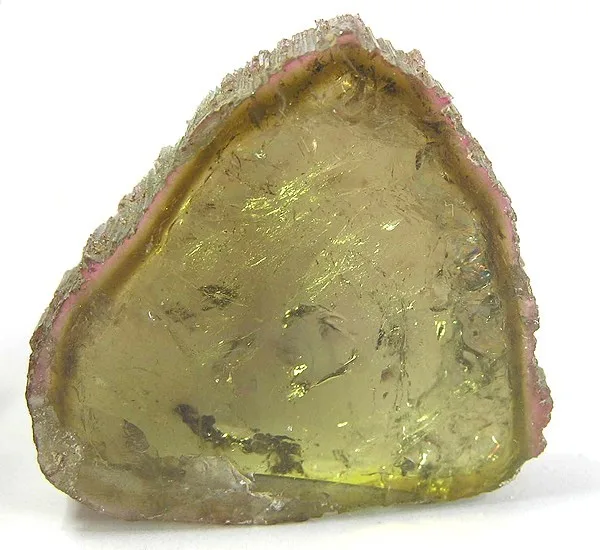
Stand close and the slice is a map. Bands, a pink shore, a greener interior, the polish letting you see through a centimeter of tourmaline as if it were a pane. Step back and it is still a stone, not a diagram. A green tourmaline cut from a crystal this zoned would have had to ignore half of what the crystal offered. A rubellite would have had to ignore the other half. Watermelon tourmaline is the name for keeping both, and for letting the seam remain a thing you can find with your eye.
The care is ordinary and worth saying once. Tourmaline is hard enough for a jewel and still not a stone you knock against a sink. The seam is color, not a crack, and a cloth is enough to keep the polish clear. A harsh buff is asking a map to become a shine. The slice, especially, is a picture of growth. It wants its own soft place. The two cut stones want the same kindness at a smaller scale: a pouch, a separate tray, a finger that knows the pink and the green are the point.
A green can still be the saturated tourmaline. A pink can still be rubellite. A neon can still be Paraíba. This fall’s tourmaline is the one that keeps both colors and lets you see where they meet — as a rind around a pink, as a length that warms from green toward pink, or as the rings a slice still shows, pink on the outside this time, green in the room.
That is the sit. Watermelon tourmaline as a seam of two colors. The crystal grew the meeting. The cut only has to leave it where you can find it.
Educational only · Not jewelry, insurance, or legal advice