Sphene as a scattered light
Sphene is this season’s scattered light. The mineral is titanite, and the gem is the one in which a yellow-green, or a gold, agrees to break white light into a spectrum. The dispersion is stronger than a diamond’s, so a facet does not merely brighten. It sorts the light. Demantoid can be a garnet of small green sparks, many lights set together. Zircon can be an icy blue with a crisp flash inside the ice. Peridot can be a lime, clear and acid. Heliodor can be a golden beryl. Citrine can be a quartz honey. Tourmaline can be a saturated green. Tsavorite can be a green field that sits. Sphene arrives as a body the light is willing to leave in colors. The hue is the chair. The scatter is the fact.
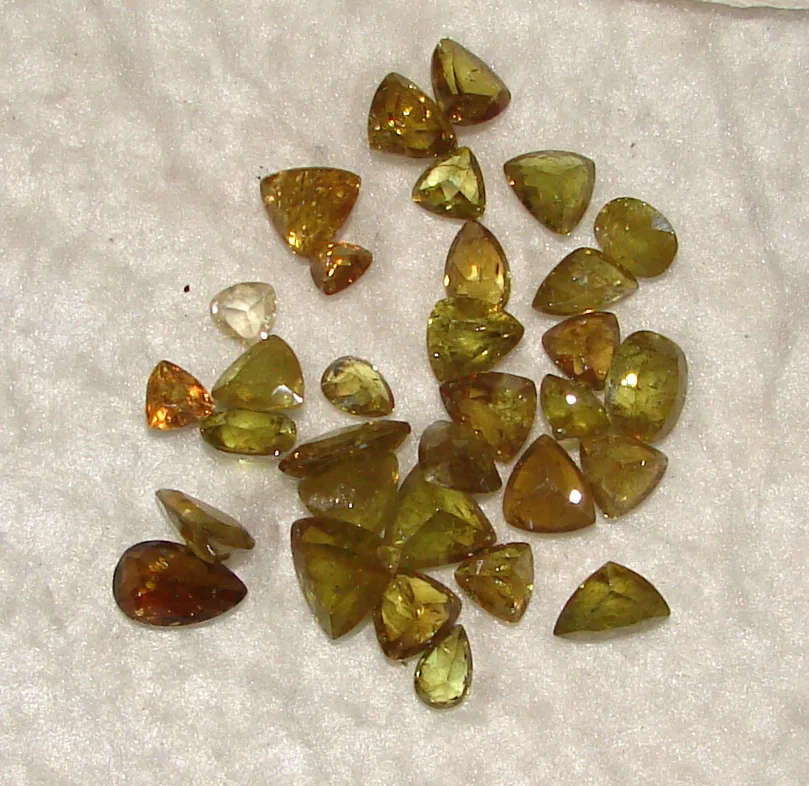
A cut that spends the spectrum
Two faceted stones from Capelinha, in Minas Gerais, spend the scatter as jewels. One is an oval, one a step-cut rectangle, both a yellow-green that leans toward gold, on a white ground, the tables open. You meet the color before you ask the carat. Then the facets ask something further. Light enters and comes back sorted: a small spectrum along an edge, a flash that is not the body color repeating itself. A lime of this outline would have stayed a single green. A honey would have stayed a single gold. These windows keep the yellow-green and let the light leave it.
The pleasure is how quiet the body stays while the scatter works. The stones are not a crowd of sparks. Each is one pane, large enough that the yellow-green reads as a field, and the spectrum is an event inside that field. A saturated green tourmaline would have held its color as a block. A tsavorite would have sat as a green you look into. A golden beryl would have been heliodor’s gold, another mineral’s pane. This pair is titanite asked to be worn, the dispersion already in the species, the wheel only giving it faces to break against.
Hold the two outlines as one lesson. The oval spends the color as a length. The step-cut spends it as a block of parallel facets, a window with steps. Neither outline is the subject. The subject is that both of them, cut by the same hand in Capelinha, return a spectrum from a yellow-green body. Autumn already knows a lime, a honey, a golden crystal, a green that sits. Sphene sits beside them as the stone that will not return the light in one piece.
A crystal already golden
A twinned titanite from the Shigar Valley, in Pakistan, spends the same mineral before a wheel. A wedge of a crystal, glassy, the color in this still a warm gold, a paler crystal grown against it. You meet the luster before you ask the valley. The faces are the mineral’s own. Light enters them and the gold deepens, and along a sharp edge the scatter is already willing, a glint that is not only brightness. No table has been cut. The spectrum is a promise the faces make.
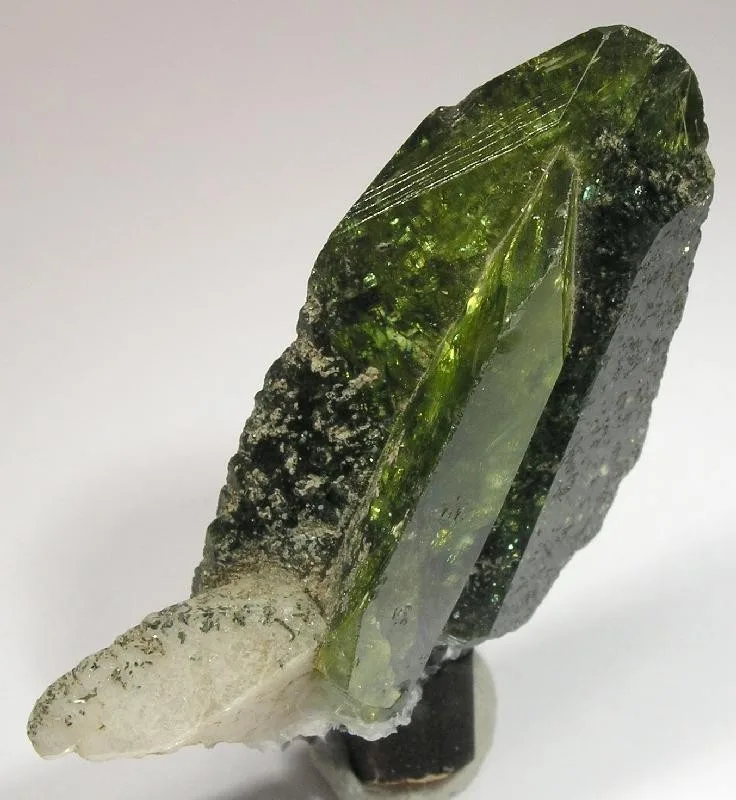
The golden reading is one end of the species. Sphene is known to run from a green into a gold, and this Shigar twin lets the gold have the chair. A citrine crystal of this warmth would have been quartz, a honey with no spectrum waiting in it. A heliodor of this warmth would have been beryl. This wedge is titanite: the same mineral the Capelinha pair was cut from, caught while it is still a crystal, the dispersion still living in the faces rather than in a pavilion. You would set the cut stones beside it and still be in one gem. They spent the yellow-green as panes. This spends the gold as a body.
The twin is the drawing. A golden wedge, and a paler crystal grown through the same piece, the gold a depth and the pale a second body. A garnet’s sparks would have needed many small stones to make a scatter. Here one crystal is enough for the light to enter, and the scatter is a property of that entrance. The season’s jewel is that agreement, already true in the rough.
The green of the same stone
A twinned titanite from the Campo do Boa mine, at Capelinha, spends the other end of the color. One crystal, flat and glassy, two wings of green meeting in a chevron, olive where the green deepens, yellowish where the light comes through. You meet the green before you ask the mine. The cut stones from the same district were yellow-green jewels, already panes. This is the green as a single twin, about nine centimeters across, the light moving inside the wings. The scatter is quieter here than in a faceted stone, because the faces are fewer and they are the mineral’s. It is still the same fact: a body that will not hold a light as one color only.
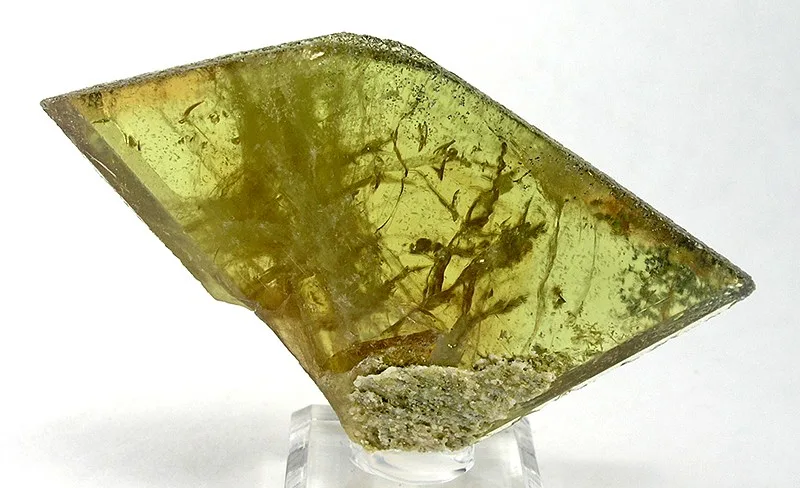
A peridot of this green would have stayed a lime, bright and single. A tourmaline of this green would have stayed a saturated block. A tsavorite would have sat as a field. A demantoid would have broken into small sparks and called that the event. This chevron stays one crystal, and the event it offers a lapidary is the dispersion already in the titanite: cut it, and the green will throw a spectrum. The Capelinha gems are that offer accepted, in a yellower stone. The Shigar wedge is the golden chair of the same offer. Campo do Boa is the green chair, still a twin, still glassy, still willing.
Three stills, one scatter. Capelinha lets sphene be two faceted panes, yellow-green, the spectrum spent as a jewel. Shigar lets it be a golden twin, the light already moving in a crystal. Campo do Boa lets it be the green of the species, a chevron the color can wear before a wheel. A lime can still be worn as peridot. A honey can still be worn as citrine. A golden beryl can still be worn as heliodor. A saturated green can still be worn as tourmaline, or as tsavorite. An icy blue can still flash as zircon. A garnet can still spark as demantoid. This season’s stone is the one that scatters: sphene, yellow-green to golden, the light returned as a spectrum.
That is the sit. Sphene as a scattered light. A cut pair, a golden crystal, a green twin — titanite, worn when the months want a color that breaks.
Educational only · Not jewelry, insurance, or legal advice