Seamaster, a wave that dives
Omega Seamaster is a wave that dives, worn as jewelry. On the Diver 300M the dial is engraved with a wave, a texture of the sea set into the face, and the bezel is a scalloped ceramic ring, an ornament you can read as a border. The whole watch wears like polished jewelry of the sea. A Submariner opens on a circle that dives, a round bezel and a round case, the minute track as the fact. A Speedmaster opens on a chronograph that went to the moon. A Constellation opens on a star, claws holding the bezel. A Nautilus opens on a porthole, an ellipse on the cuff. A Royal Oak opens on an octagon, screws at the corners. The Seamaster opens where a wave has agreed to be the ornament.
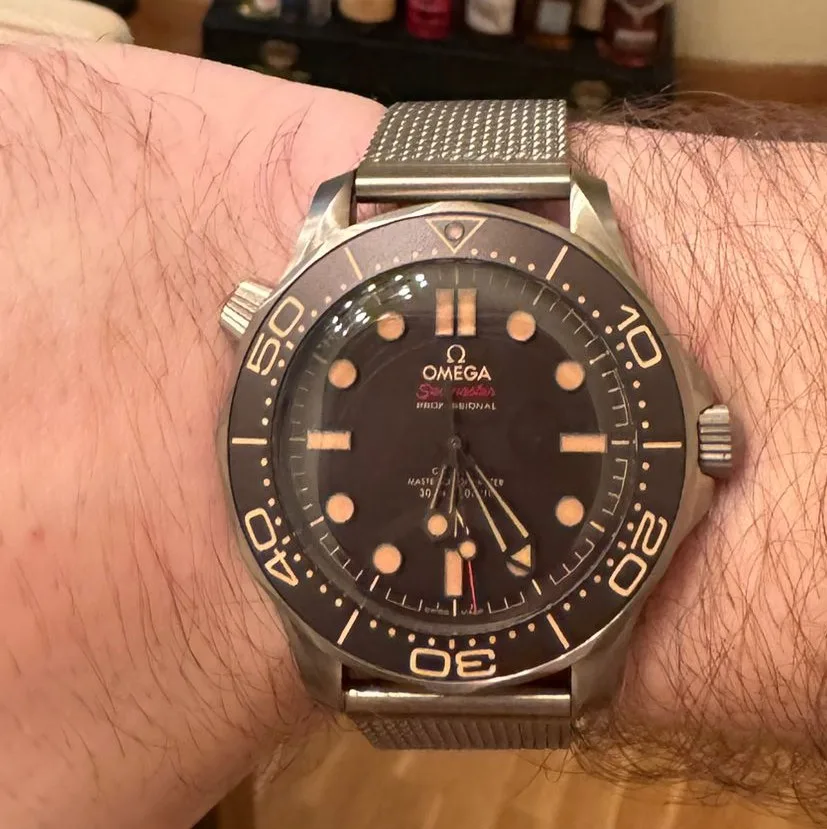
A dial written as water
A Seamaster with a blue wave dial is the meeting in one face. The engraving runs across the blue, a sea you can see rather than a flat wash, a ceramic bezel of numerals with a scalloped edge, broad hands, a date window keeping its place. You would feel that water before you asked for a reference. Off the wrist, the watch still reads as a jewel. The wave is the fact the case was built to hold. A diving circle would have begun with a plain round. A star would have begun with claws. This face begins as a sea, and the hour agrees to live inside it.
The bezel only circles that dial. A scalloped edge, ceramic, a border that also counts a depth. You would read it the way you would read a chased rim: close, continuous, a decoration that also dives. The numerals are the ornament’s measure. The wave underneath is the ornament’s weather. The first fact stays the wave. A moon chronograph would have asked for a different instrument. A porthole would have asked for a rounded rectangle. This bezel asks you to walk a ceramic edge and come back to water.
An orange border, still the sea
A Planet Ocean chronograph, reference 2210.51.00, spends the diver as a bezel. An orange ceramic ring, a dark dial with a brushed field, three registers, the case broad and polished, a helium valve at ten. You would meet that orange before you asked which depth. The wave, on the blue face, was the dial’s ornament. Here the ornament moves to the rim: a ceramic border in a warm color, a diver’s edge worn as jewelry. Off the wrist, on a pale ground, the watch still reads as a jewel that knows the sea.
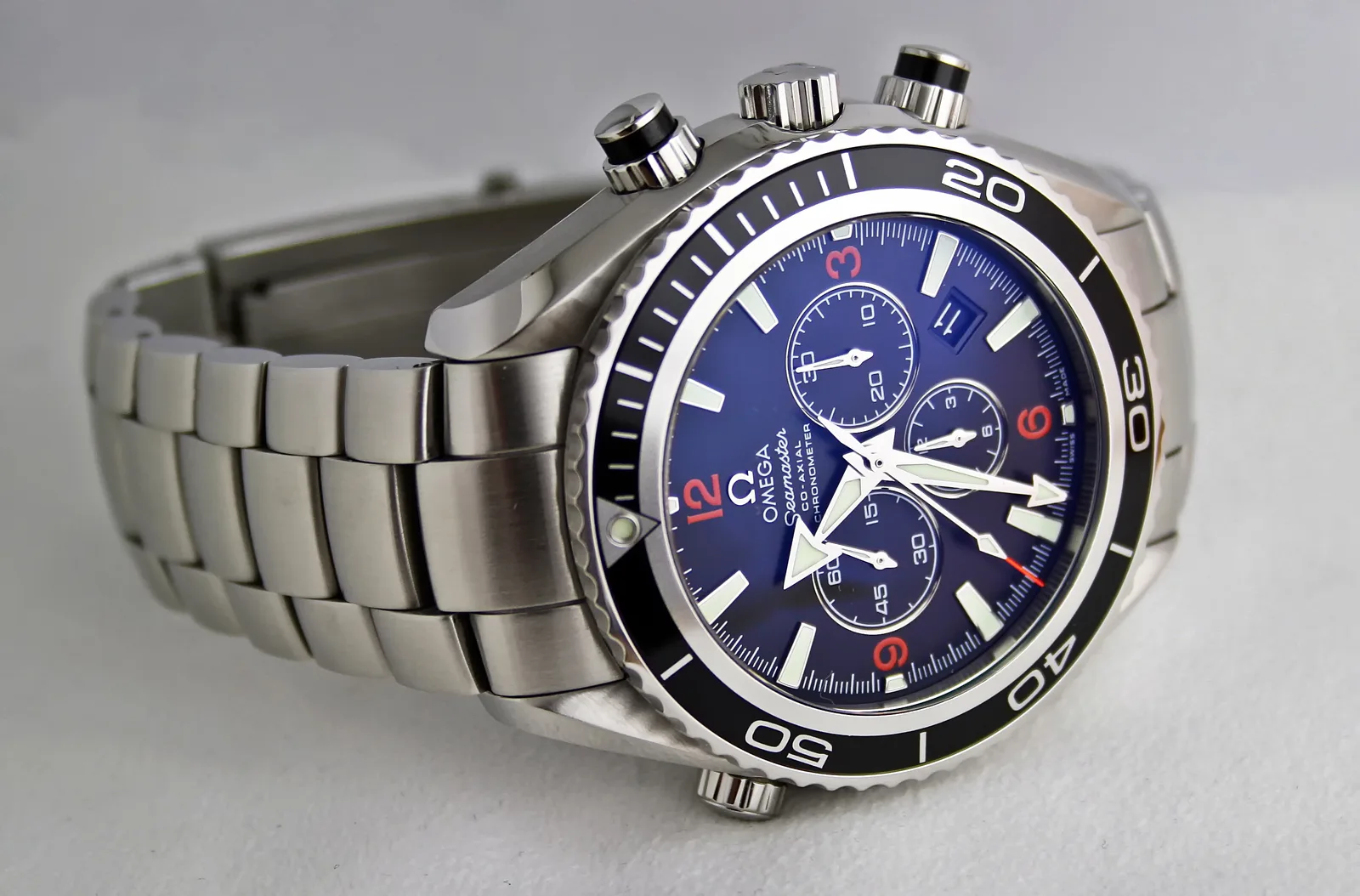
A racing scale would still be a race. An octagon would still ask for a flat on every side. This case asks you to walk an orange rim and come back to an hour a diver has already agreed to hold. The registers sit in the dark field the way small stones sit in a chased ground: present, ordered, never the first thing you name. You name the orange, then the sea the color is standing for, then the hour.
Two faces, two ways of saying the water. The blue diver shows the wave as a cool field with a ceramic border of figures. The Planet Ocean shows a ceramic border that has taken the color of a signal, larger, still a Seamaster, still a diver that has learned to be worn as a jewel. A Submariner would still be a circle. These two are the sea.
Black, and the wave still reads
A Planet Ocean in a small edition spends the wave as a black face. The dial is dark, the engraving still there, the bezel a black ring with a clear edge, the hands broad and filled with light. You would read the wave before you read a logo. Off the wrist, the watch still reads as jewelry of the sea. The black makes the water show. The hour is what the wave was willing to frame. A star on the bezel would have caught the eye at the claws. This bezel stays a diver’s ring, and the dial does the ornamental work.
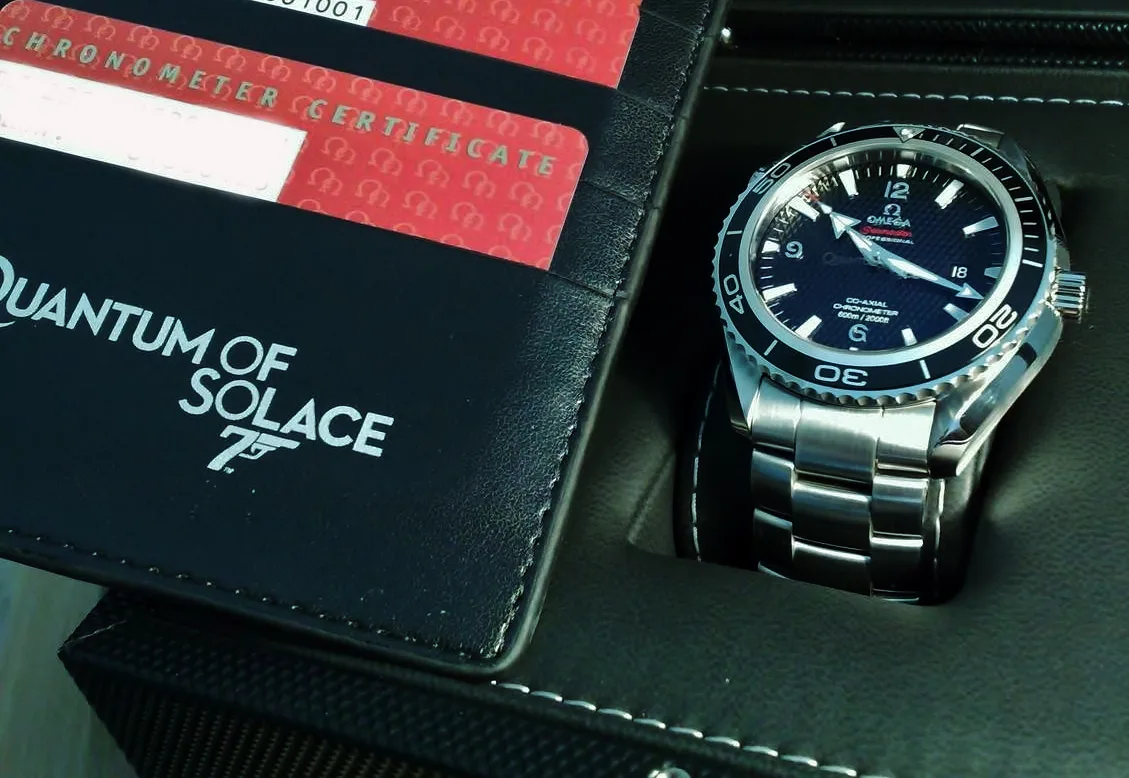
You would turn the case and the wave would still be the wave. The black is the chair. It leaves the engraving as it is: a texture, a sea, a face that sparkles a little where the light crosses the lines. A Constellation would still be a star. A Nautilus would still be a porthole. A Royal Oak would still be an octagon on the cuff. This reference offers one reading — a wave, a bezel that borders it, a case you meet before the hour.
Off the wrist, nothing has to be worn for the face to read. A dial of water. A scalloped or ceramic edge that agrees to circle it. A wave that learned to dive and kept the lesson as jewelry.
That is the icon. Seamaster, a wave that dives. The blue face with the wave as architecture and the ceramic bezel as a chased border. The orange ring that wears the diver as a warmer border. The black edition that lets the engraving read — a diver you meet as a jewel of the sea.
Educational only · Not jewelry, insurance, or legal advice