Repoussé is a push from the back
Turn a gold jewel and the picture may have been pushed. The front is a relief because the back was worked: the metal was driven forward from behind, and the drawing stood up. Chasing comes afterward, or alongside, a tool refining the front of what the push began. Engraving takes a line away, a groove cut into a surface that stays flat. Granulation sets spheres. Filigree draws a wire into a lace. Niello fuses a black into a cut. Repoussé is the push. The sheet thins where it rises. The picture is a volume you could feel.
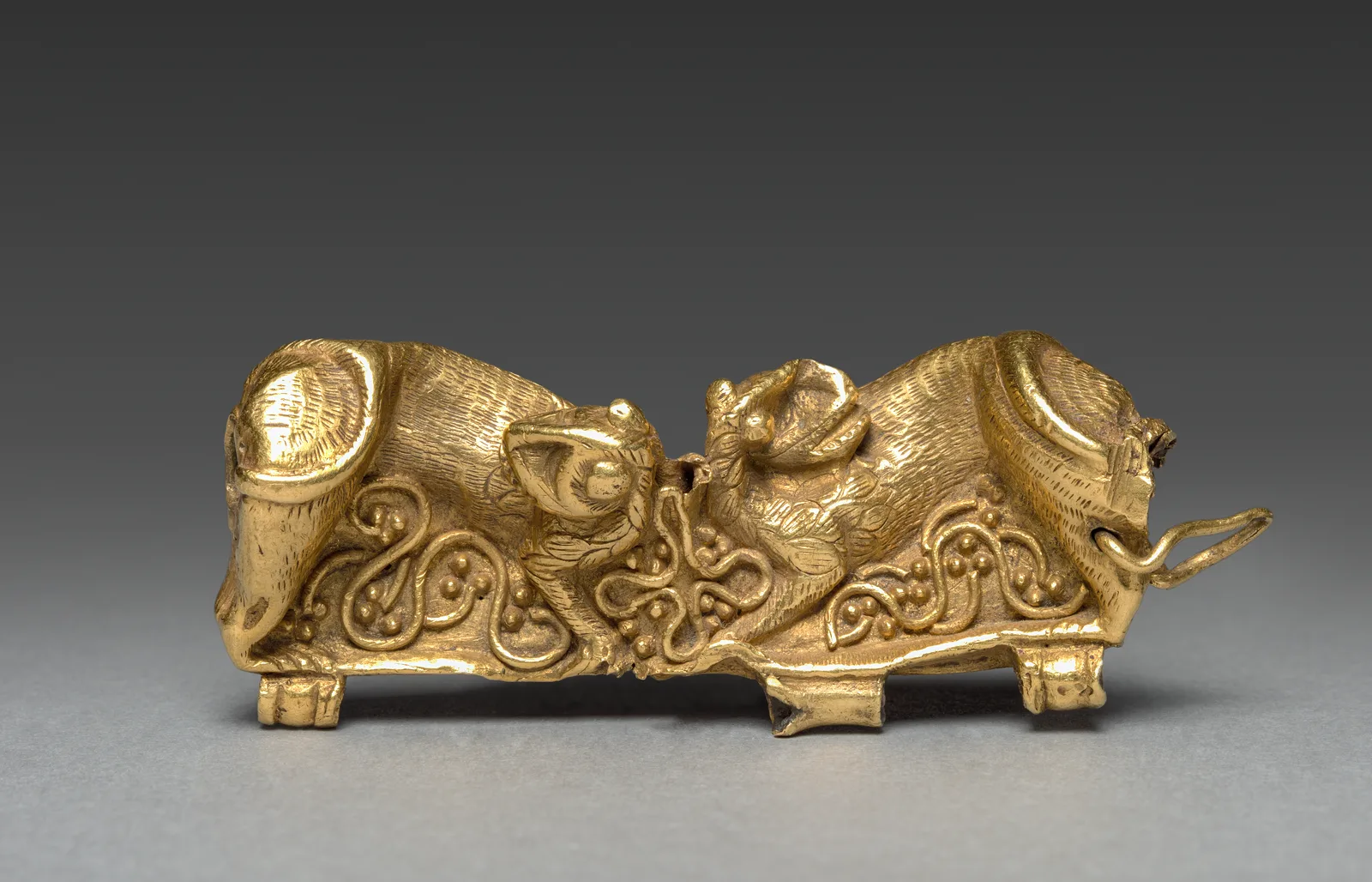
A clasp the hand would feel
A clasp in the Cleveland Museum of Art spends the push at the scale of a fastening. Europe, the thirteenth century, accession 1948.19, a gift of the Grace Rainey Rogers Fund, about 7.7 centimeters. The museum’s own word for it is repoussé gold. Leaves and a scrolling plant stand up from the sheet. You meet the relief before you ask the century. A clasp is a join, and this join was given a picture by being pushed. The high parts catch the light. The low parts rest. The gold is the whole material. There is no enamel doing the color, and no wire doing the drawing. The drawing is the metal, moved.
A chased line on a flat disc would have left the gold in one plane, handsome and level. Here the plane has been given up. What you see is a small landscape of leaf and scroll, tall enough that a fingertip would learn it. The back, which the photograph keeps to itself, is the hollow the push left behind — the other side of every hill. That hollow is the lesson, even when you are looking at the front. Repoussé announces itself as volume. The clasp can close a band or a robe. The technique is what you remember after the fastening has been understood.
The scale stays a jewel’s scale. Seven centimeters is a thing a hand can cover, and the ornament inside that measure is dense: curve against curve, a plant that had to be pushed into place one passage at a time. You would know the method before you knew the fund that brought it to Cleveland. The dark ground of the still is only a ground. The gold does the work. One clasp, and the push is already whole. The next object shows that the same decision can become an animal.
The same push, as a panther
A gold panther from the Kelermes kurgans, late in the seventh century BC, spends the relief as a body. About 32.6 centimeters, the State Hermitage Museum, a plaque the museum keeps among its jewelry. The gold was pushed — sbalzo, repoussé — and then chased, so the front was finished after the back had done the rising. The animal curls, the tail comes around, the legs tuck. An inlaid eye, and small colored pieces set into the gold, give the surface a second voice. The volume is still the fact. A panther drawn only as engraved lines would have stayed a sketch on a sheet. This one stands up.
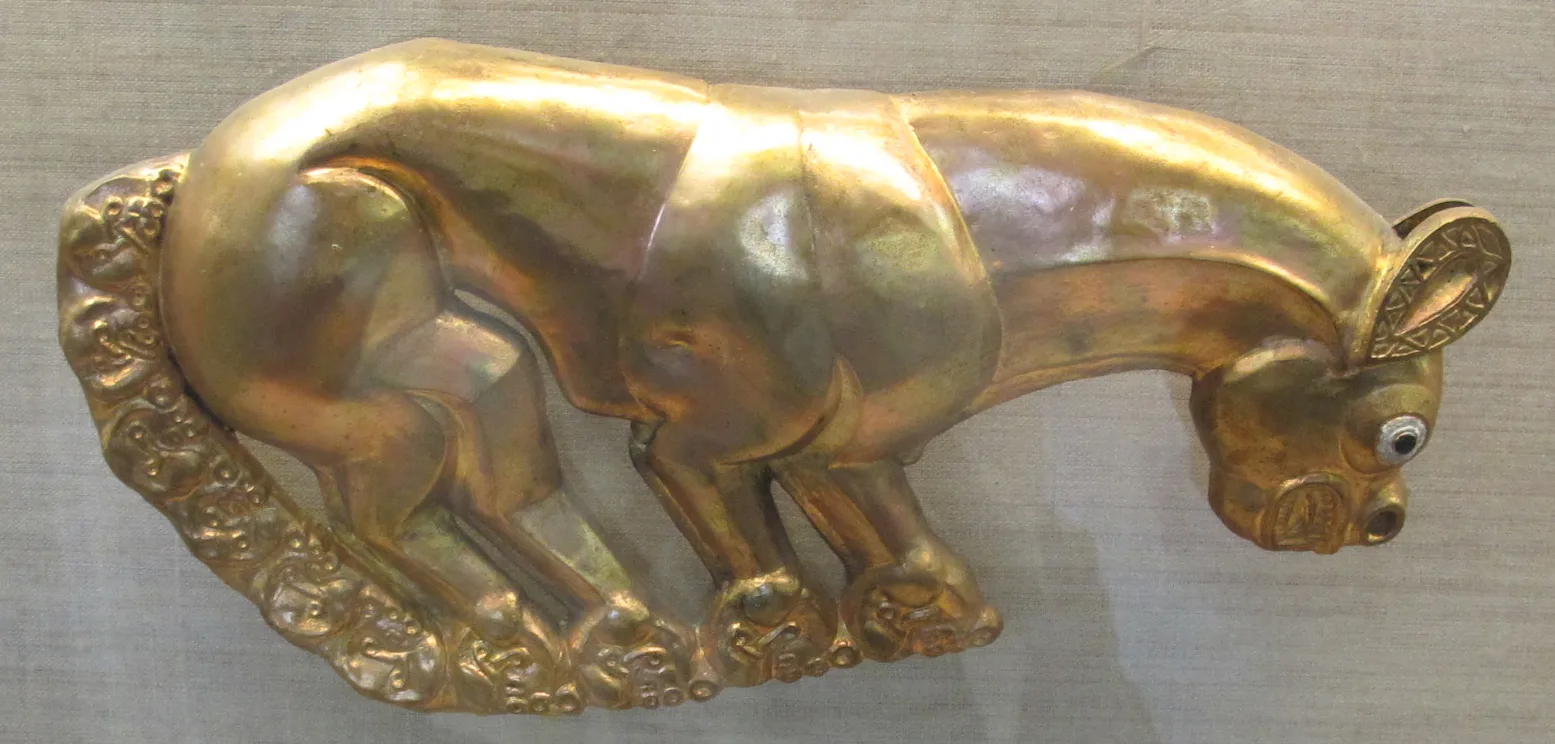
The size is a kindness to the word. A clasp of eight centimeters can be misread as cast, the relief looking poured. A panther this long, the body a continuous sheet of risen gold, is harder to mistake. You can follow the spine as a hill. The inlays sit in the hills. They are guests. The host is the push. Chasing keeps the edges crisp, the way a final tool keeps a leaf from going soft, and chasing does not replace the fact that the metal came forward from behind. Two objects, a medieval clasp and a Scythian animal, and the relief is one sentence. A thousand years sit between them. The method crossed the years by staying simple: work the back, and the front becomes a picture you can feel.
The care follows from the thinness. Where the gold rose, the sheet is thinner than the metal it started as. A pressure that would leave a flat disc unbothered is a pressure on a hill. The high points want no neighbor stacked against them, no hard point set into a leaf or into the panther’s spine. A cloth with no grit keeps the surface. Between wearings, a box with a soft nest, the relief free to stand. The care is only that the push remain a push: the hills unbroken, the picture still in front of the hollow.
Two stills, one push. Cleveland lets the relief be a clasp, a plant in gold, a fastening you could close. Kelermes lets the same decision be a panther, longer, inlaid, chased along a body that was raised from behind. A line cut out remains engraving. A sphere fused on remains granulation. A wire drawn into lace remains filigree. A black fused into a groove remains niello. Work that only refines the front remains chasing. Repoussé is the push from the back — a clasp, a panther — gold, risen, and the picture on the face you meet.
That is the note. The sheet is worked from behind. The front stands up. Repoussé is what you feel when the metal has agreed to be a relief.
Educational only · Not jewelry, insurance, or legal advice