Plique-à-jour is an open window
Hold a wing to the daylight and the green becomes a room. On the table it was a color. Against the window it is a color you can see through, the day arriving inside the jewel. That is plique-à-jour before it is a word. Enamel, a glass, has been fired into a cell of metal, and the cell has no floor. Cloisonné builds a wire wall and fills it, and leaves a metal back behind the glass, so the color is a skin you look at. Painted enamel is a picture laid on a ground. Filigree draws a lace and leaves the openings empty, air where a glass might have been. Niello fuses a black line into a cut. Guilloché turns a field with an engine. Plique-à-jour keeps the glass and gives away the back. Light is part of the color.
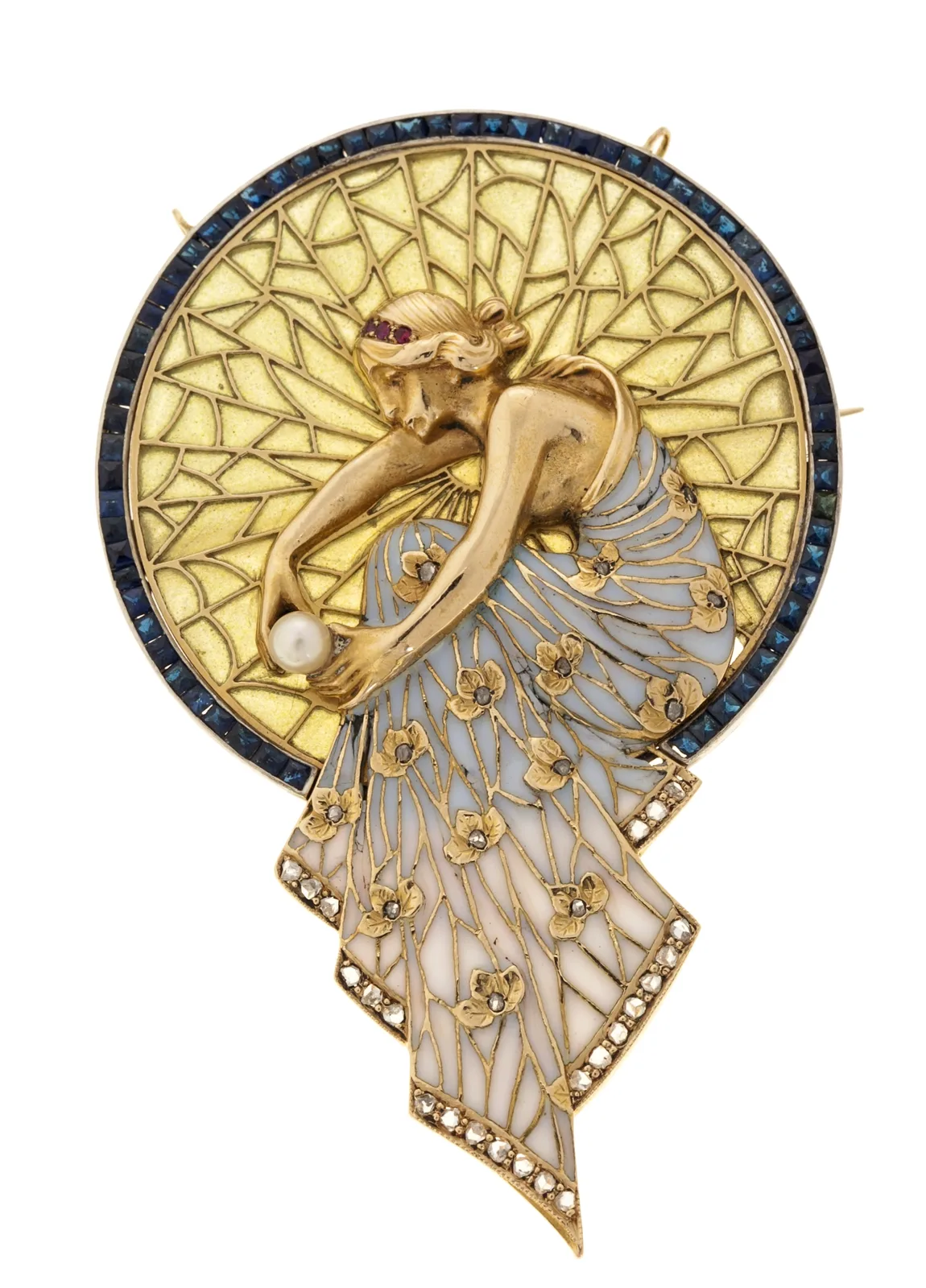
A wing with the day inside it
A nymph pendant by Lluís Masriera spends the window at the scale of a jewel you could pin. Gold, a small figure, rose-cut diamonds, rubies, a pearl, and the wings in plique-à-jour: green, a blue, a violet, each cell a pane. The wings are the first meeting. They are not a paint on gold. They are color with daylight available behind them, which is why even on a pale ground the wings look lit from somewhere past the metal. The figure is the host. The wings are the fact.
A backed cloisonné of this appetite would have given the same wires and a solid floor, the green a surface, handsome and opaque. These wings have no floor. What you see in the green is not a picture the enamel is hiding. It is light, admitted. The metal is a frame the way a window’s frame is a frame, and the enamel is the glass. A fingertip learns a thinness. The cell is a wall around a color, not a cup that holds it from below.
The pendant is also where the window shows its manners. It can be a small pane in a wing, repeated, and it stays translucent in every cell. Diamond does the work of a white point. The pearl does the work of a soft circle. Plique-à-jour does the work of the color you can see through. The firing can stay a mystery. The eye only has to learn that the enamel has no back, and that the gold around it was meant as a frame rather than as a ground. One nymph. The lesson is already whole, and the next jewels show that it travels.
The same window, in a flower
A wood-anemone pendant by René Lalique, about 1900, spends the pane as a petal. Eighteen-karat gold, diamonds, a green plique-à-jour filling the flower, the blossom a small lamp of enamel. The green is the first meeting. The gold is a vein and a border. The enamel is the petal, and it is green because the glass is green, not because a backing was painted green behind it. On a pale ground the flower still reads as something light can enter.
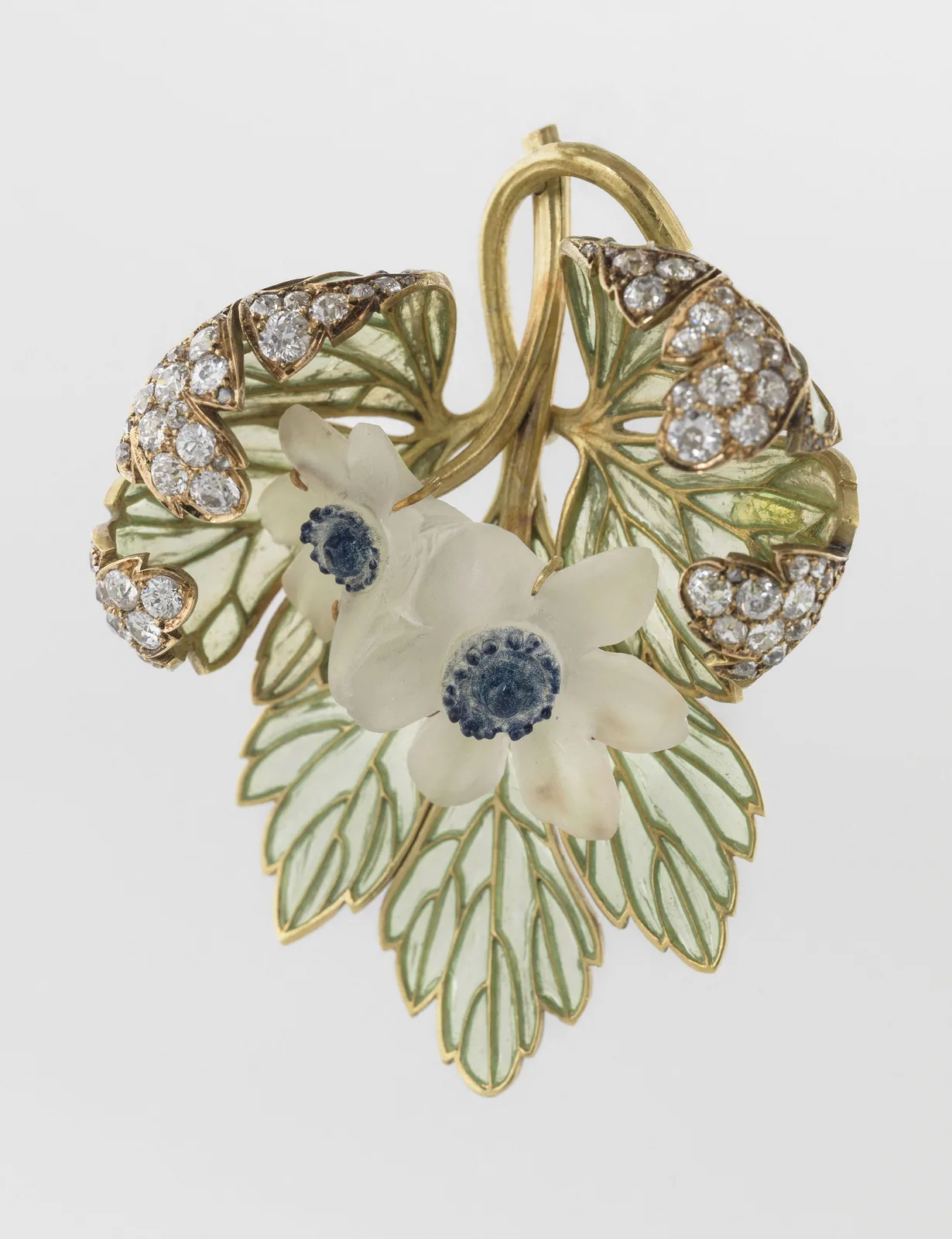
A petal this open is a kindness to the word. A wing can be misread as a painted insect, color as a picture of a wing. A flower of green glass in a gold casement is harder to mistake. The enamel sits in the metal the way a pane sits in a window, the same thinness all the way across. A filigree flower would have left those openings empty, gold as threads and air as the only color. This green is solid and still transparent. It filled the opening. It did not replace a floor, because a floor was never part of the idea. Plique-à-jour is added, and it stays, and you can see through what stayed.
The anemone and the nymph are two objects and one sentence. Wings in Barcelona, petals in Paris. The Petit Palais keeps the flower as ODUT1948. The light through the enamel is what makes the pair a single note: a glass fired into a cell, the back not there to stop the day. Diamond in both, a different drawing in each, the window unchanged. You could cover either jewel with a card and the color would go quiet. Take the card away and the color returns, because the color was waiting on the light.
A third pane, and the care it asks
A brooch by Marcus & Co., American, about 1900, shows the window as a habit rather than a single famous wing. Platinum and eighteen-karat gold, diamonds, a conch pearl, and plique-à-jour enamel in a spray around the pearl. The Metropolitan Museum of Art, number 2016.107, a gift of Jacqueline Loewe Fowler and Family in 2016. It is a third jewel, its own silhouette, its own pearl. The enamel does the same work. It lets the light through.
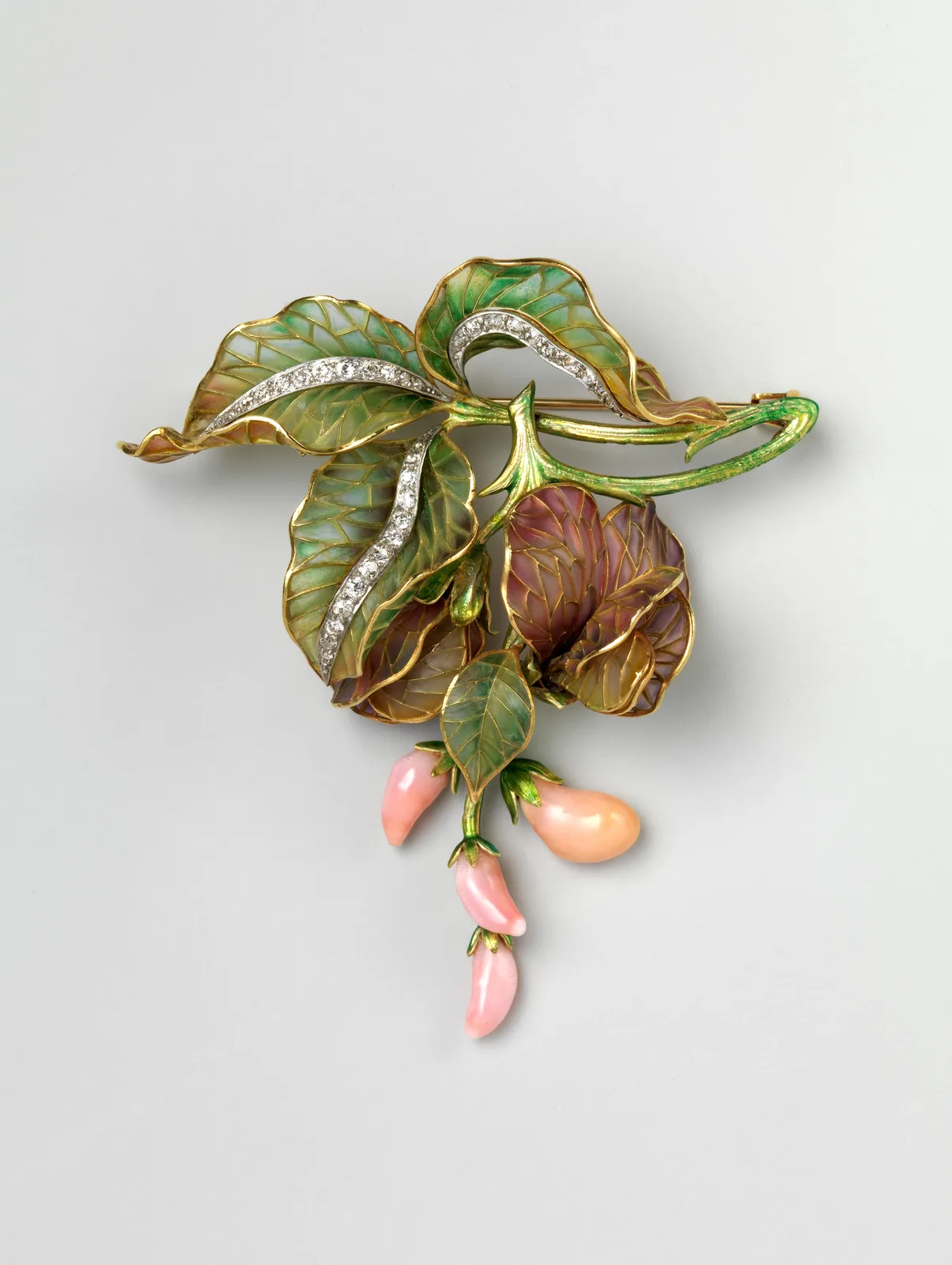
Three jewels, bright in the metal and colored in the panes, are enough to see that the color was placed as glass and then left open. An enamel with a backing would have stayed the same green in a dim room and in a bright one, a skin. These panes change their brightness when the light behind them changes, which is how the missing back announces itself. A wing, a petal, and a spray are one technique. The word is what keeps them from being three unrelated greens.
The care follows from the missing floor. The enamel is a thin glass held by a metal wall, and a pressure that would be nothing to a backed plaque is a pressure on a window. A hard knock, a bend in the frame, a point set against the pane, can crack a cell that has nothing underneath it to lean on. A soft cloth keeps the gold and the glass. Between wearings the pendant and the brooch want a box with a soft nest, and no stacking of metal against the pane. The care is only that the window remain a window: the glass unbroken, the light still able to come through.
Three stills, one window. The Masriera nymph lets the enamel be wings, color with a day behind it. The Lalique anemone lets the same glass be petals, a green you can see through. The Marcus brooch lets it be a habit, a third jewel, the pane placed again around a pearl. A backed cell remains cloisonné. A painted ground remains enamel as a skin. A lace of wire remains filigree. A black fused line remains niello. An engine-turned field remains guilloché. Plique-à-jour is the open window: enamel fired in a frame, no back, the light a part of the color.
That is the note. A cell is built. The floor is left out. Plique-à-jour is what you see through — a nymph’s wing, a wood anemone, a brooch — glass, framed, and daylight on the far side.
Educational only · Not jewelry, insurance, or legal advice