Piqué is gold in the shell
Piqué is gold in the shell. Small points of gold, and often of silver, are pressed into tortoiseshell while the shell will still yield, so the metal sits in the ground and the drawing is a field of dots. Cloisonné is a wire that holds a color. Niello is a black line laid in a trough. Vermeil is a coat of gold on a silver heart. Piqué is none of those. The dot is the line. The shell is the page. You meet the pattern first. The literacy is that the pattern was pressed in, and that it goes into the ground rather than sitting on a skin you could wear away.
A field of points
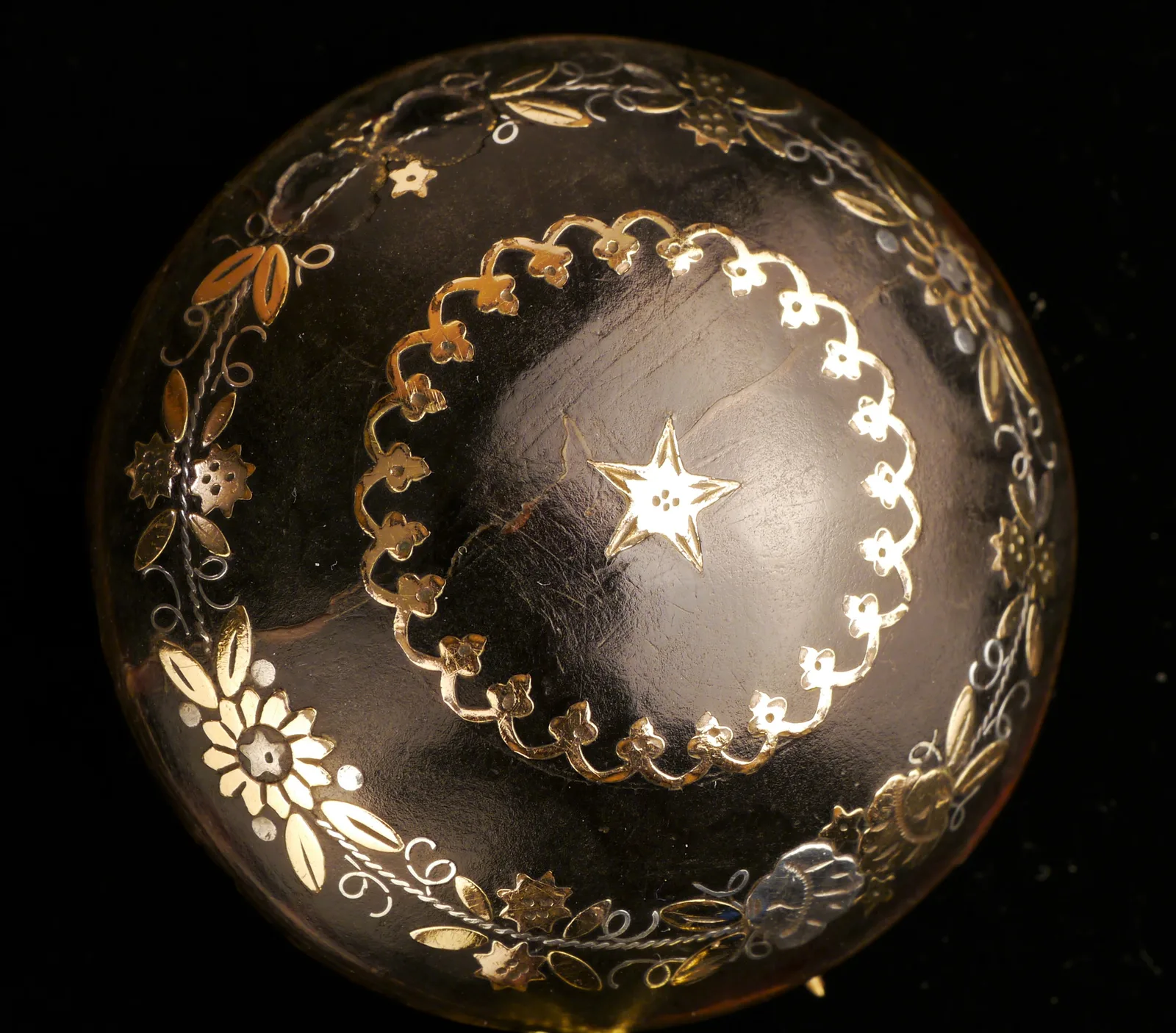
One round brooch, Victorian, keeps the lesson as a sky. Tortoiseshell, dark enough to read as night, a central cluster of gold and silver points, and a disciplined field of smaller points out to a scalloped edge. Nothing is plated over the whole face. The shell remains the ground you can see between the dots. A point that left its place would leave a small hole, which is the test: the gold is in, not on. You would know the brooch from across a cloth by the sparkle of a made constellation, and then, closer, by the fact that each sparkle has a seat in the shell.
The thinness of the work is the practical half. Pins of this scale are the drawing and the risk at once. They stand a hair proud of the surface. A jumble with a harder jewel will bend them, and a bent pin is a line that has lost its grammar. A soft cloth, dry, is the cleaning. The same warmth that let a goldsmith press the metal will let a careless heat loosen it. Tortoiseshell does not want a soak, and it does not want a dryer, and it does not want the sun on a windowsill. Perfume is a solvent’s cousin. Leave the bottle for another surface. The shell’s depth is the dark the points need. Polish it toward a mirror and you have asked a night to become a shine.
A vermeil brooch of this outline would have been a gold skin. Wear through the skin and another metal would show. This brooch cannot show another metal underneath the dots, because the dots are the metal, and the ground is shell. That is the reading, before any romance about Victorian taste: inlay, not a coat. The scalloped edge is shell as well as metal. Keep the edge. It is the frame the sky sits in.
Flowers in the same ground
A second brooch spends the points as stems. An oval, still Victorian, still tortoiseshell, still gold and silver pressed in, and the drawing has become three flower sprays with a bow, the edge scalloped again so the shell reads as a soft border. The ground is lighter here, a honey rather than a night, and the honey is the shell’s own color, not a stain. You could follow a stem with your eye and still be in one technique. A dot, another dot, a leaf that is only a row of them.
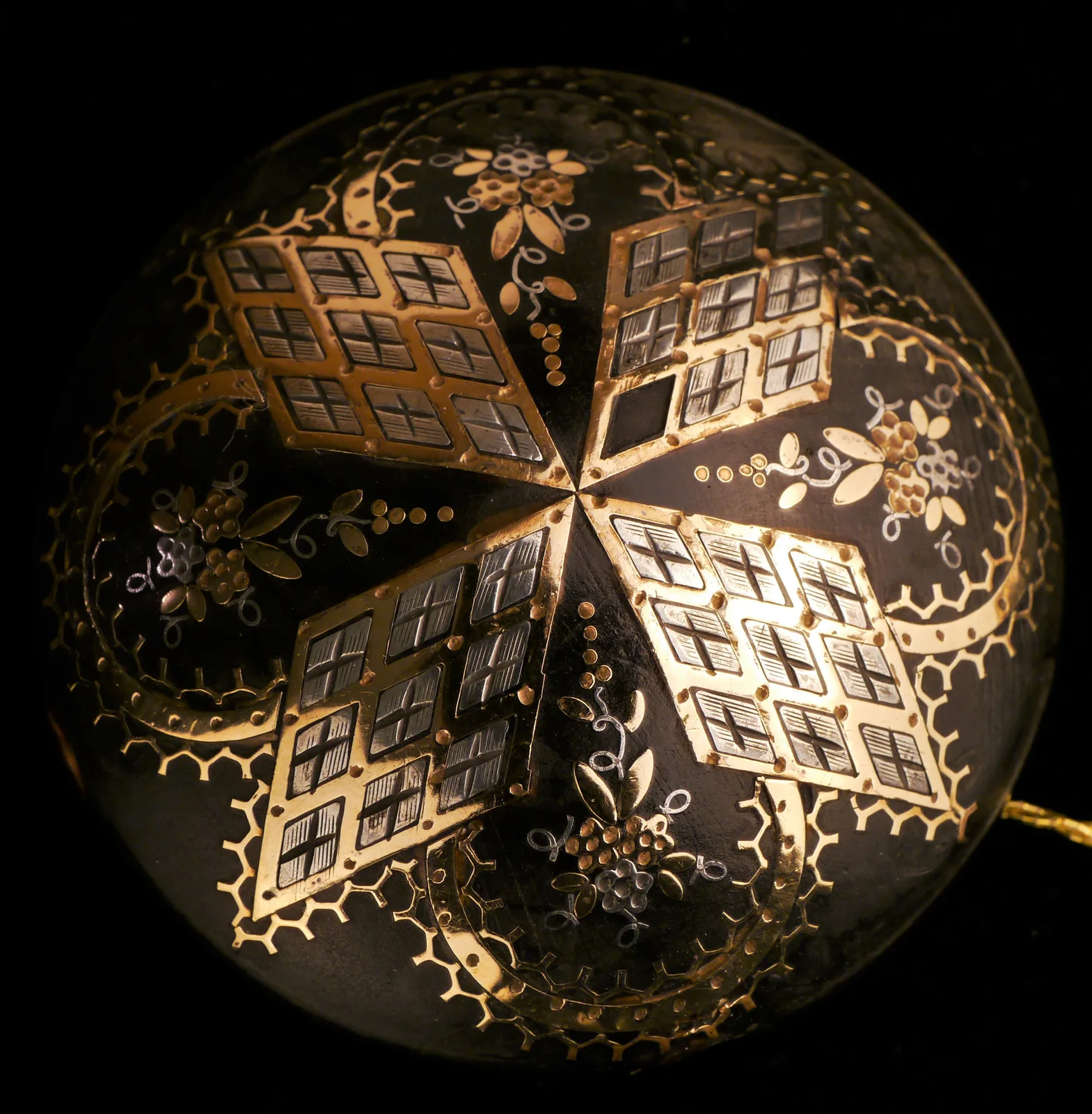
The round one let the points be a field, a sky with a cluster for a moon. This oval lets the points agree to depict something, flowers a room already knows how to see. The agreement does not change the test. The metal is still in the shell. A cloisonné flower would have been a wire cell filled with color. A niello flower would have been a dark line in metal. These flowers are the color of gold and of silver, and their background is the animal ground of the shell, warm, a little translucent at the edge if the light is low. You would know it from across a cloth by the three sprays and by the honey, and you would know it was piqué when you were close enough to see that a petal is made of points.
It is a different brooch from the round. The motif traveled. The ground was free to be a lighter shell. Set them side by side and the constant is the pressed dot. Care travels with it, and the flowers make the care more obvious, because a stem is a line of pins that a snag can lift one by one. Store the oval where a chain cannot rake it. The bow is the height as much as the blossoms are. Leave the ribbon its curve. A wet cloth that sits on tortoiseshell is already too much water. Dry, soft, brief, and then away.
A flower, and the field around it
A third brooch keeps both ideas in one face. Victorian again, gold and silver piqué on tortoiseshell, a single flower with a stem at the center and a field of points around it, the edge a quiet frame. The round brooch was the field. The oval was the flowers. This one lets a flower sit inside the field, so you can see the two uses of a pin at once: a dot as a star in the ground, and a dot as a stitch in a petal. The shell is dark enough that the flower reads, and busy enough with points that the flower is not lonely.
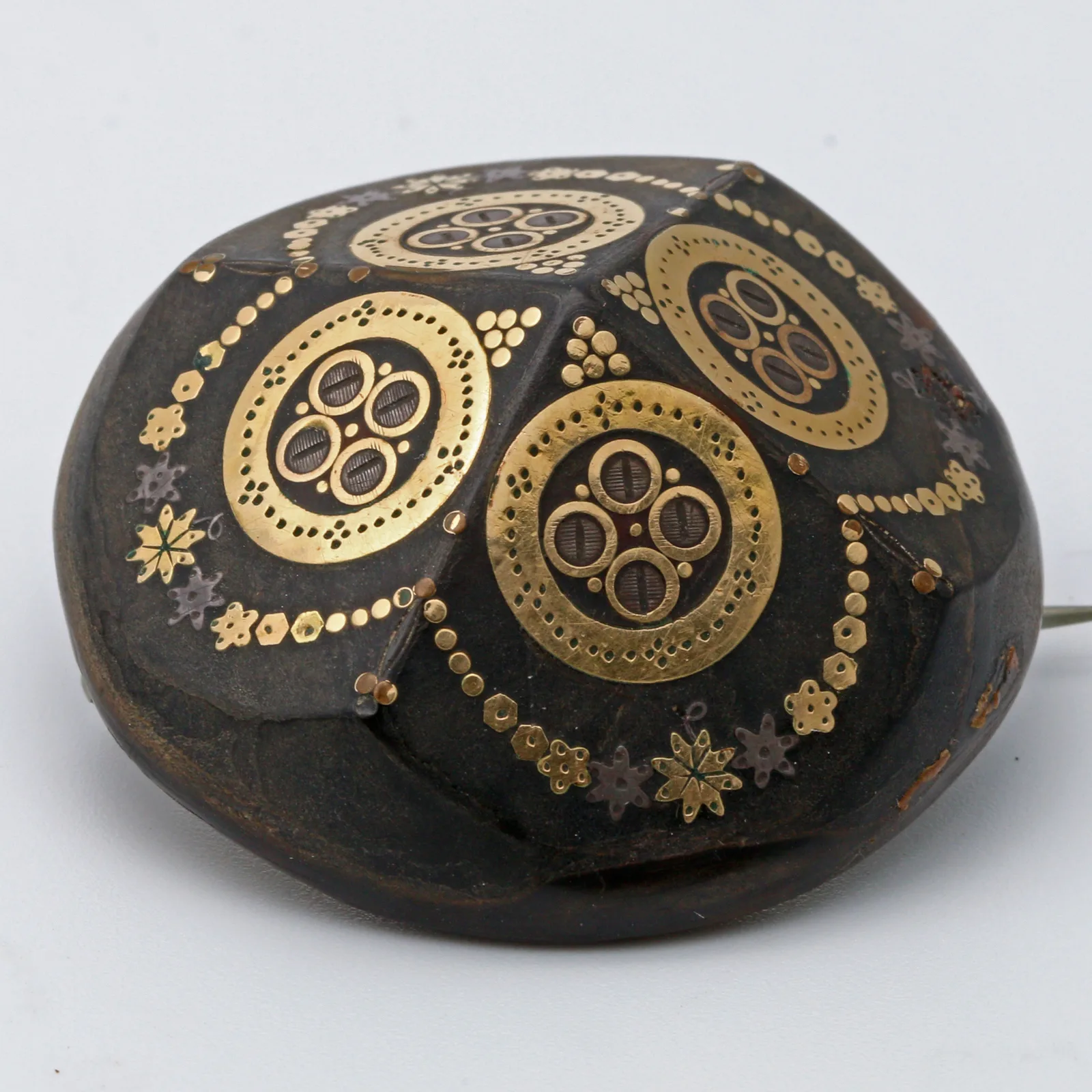
You would still name it from the shell and from the inlay, in that order. The flower is the drawing. The piqué is why the drawing looks planted in a night rather than laid on a metal. A gilt flower screwed to a shell would fail the broken-edge test: chip it, and you would meet a different substance under the gold. Chip a point here, and you meet the hole it left, and the shell continuing. That is worth knowing if you are the person who dusts it. No paste that wants a screaming yellow. No ultrasonic bath, which is a small storm, and a storm is exactly what a field of tiny pins does not want. The points are the picture. Level them and you have a smoother shell with a memory of a flower, which is a different object.
Store it alone, as the other two want to be stored alone. Tortoiseshell against a diamond takes the scratch on the shell. Gold points against a harder gold take the bend. Three brooches can sit in one sentence without sitting in one box. Each wants its own cloth. Each is already finished. The finishing was the pressing, and then the cooling of the shell around the metal.
Three brooches, one test. The round one lets piqué be a field of points, a sky built dot by dot. The oval lets the same dots become flowers and a bow, the line learning to depict. The third lets a single flower sit in that field, star and petal in one ground. Cloisonné remains a wire that holds a color. Niello remains a black line in metal. Vermeil remains a coat of gold on silver. Piqué is gold in the shell — the dot already the drawing when the shell has cooled.
That is the note. A coat can wear away. A wire can hold a fill. A piqué point is in the ground — round, floral, or both — and the shell is the page you have to keep cool, and dry.
Educational only · Not jewelry, insurance, or legal advice