Monaco, a square that races
The Monaco is a square that races, worn as jewelry. Heuer drew it, and TAG Heuer kept it: a square water-resistant case, a chronograph whose geometry you meet before you meet the hour. On the classic face the dial is a metallic blue and the registers are squares, a small architecture inside the larger one. On the original the crown sits on the left, a reversal that makes the square feel decided. A Daytona is a chronograph that sits, round, the registers inside a circle, a tachymeter on the rim. A Speedmaster is a chronograph that went to the moon. A Navitimer is a slide rule, a bezel of scales. A Santos is a square, and a Tank is a rectangle, both Cartier, both a dress of the case rather than a race. A Reverso is a face that flips. The Monaco opens where a square has agreed to be a racing chronograph, and the hour agrees to live inside that jewel.
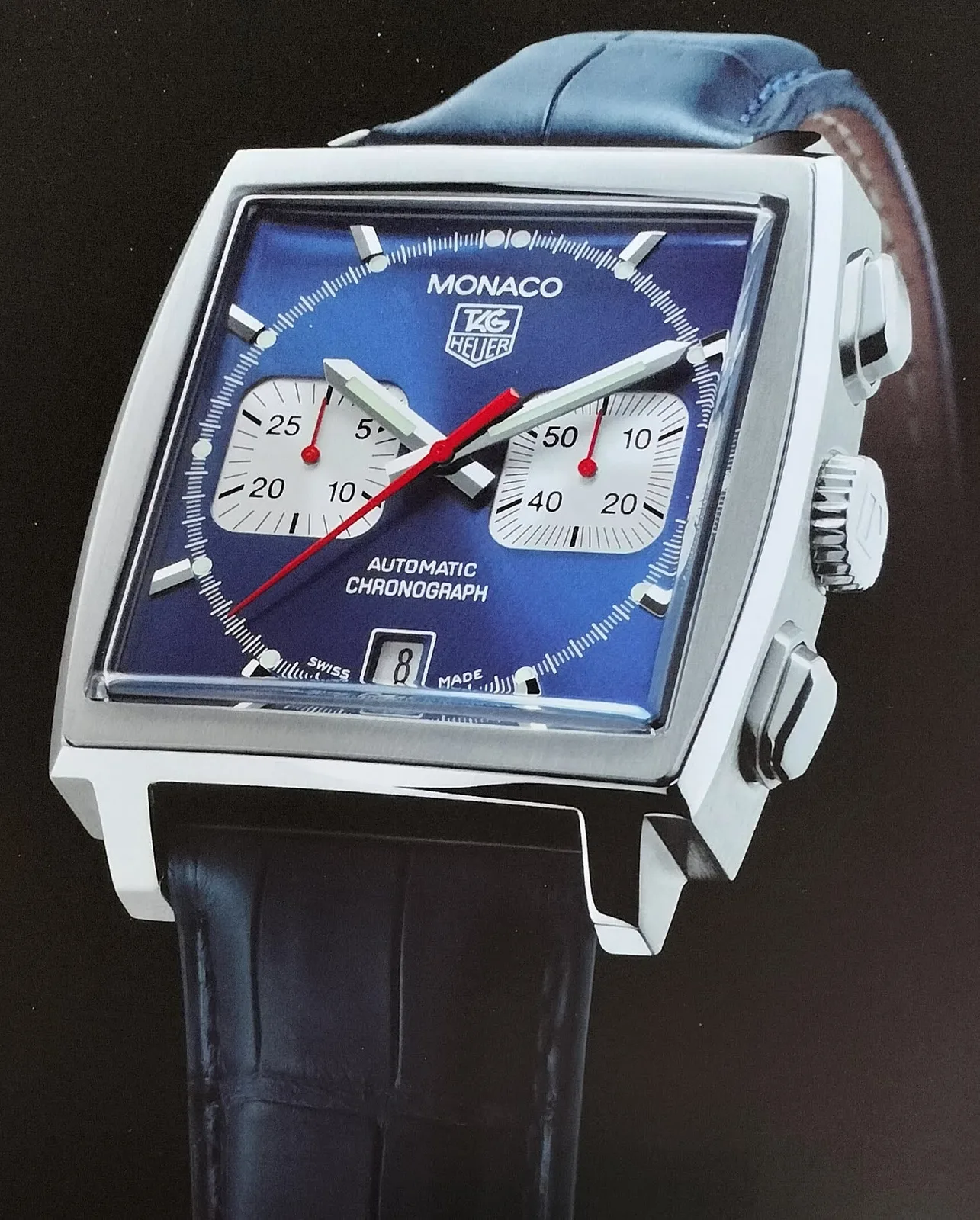
A blue square on a pale ground
A TAG Heuer Monaco of 2020 keeps the meeting in one face. A square case, polished, a metallic blue dial, applied markers, three round registers, a date at six, the crown on the right of this reference. Off the wrist, on a white ground, the watch still reads as a jewel. You would feel the square before you asked for a calibre. The registers here are round, set into the blue the way small stones sit in a field. The classic face used squares for that work. This one uses circles, and the case around them does not stop being a square. A Daytona would have begun with a round case and stayed there. A Santos would have begun with a square that dresses, screws at the bezel, a different quiet. This face begins as a race that has been cut square, and the blue is the color the square was willing to hold.
The bracelet only carries that block. Brushed and polished links, a geometry that continues the case without softening it. You would read the square the way you would read a cut stone: edge, then color, then the smaller marks inside. The crown on the right is this reference’s choice. The original put it on the left, and a later plate in this same family still does. The 2020 does not need that side to be a Monaco. It needs the square, the blue, and the chronograph’s pushers on the flank, where a dress watch would have left the case alone.
Square registers, crown on the left
A Monaco LS with Calibre 12 spends the classic arrangement as a blue face. Square registers in the dial, a square case around them, the crown on the left — the side the original chose, so the square feels as if it had been planned from the flank inward. You would meet that left crown before you asked which fair. The plate was made at Athina Fair in 2009, the watch on a cushion, other cases nearby, and the Monaco still the one the eye keeps. Off the wrist, it reads as a geometric jewel that knows it is a chronograph. The square registers are the fact the round ones, on the 2020, had set aside. Here the small dials repeat the case. A square, then squares. The hour lives inside a drawing.
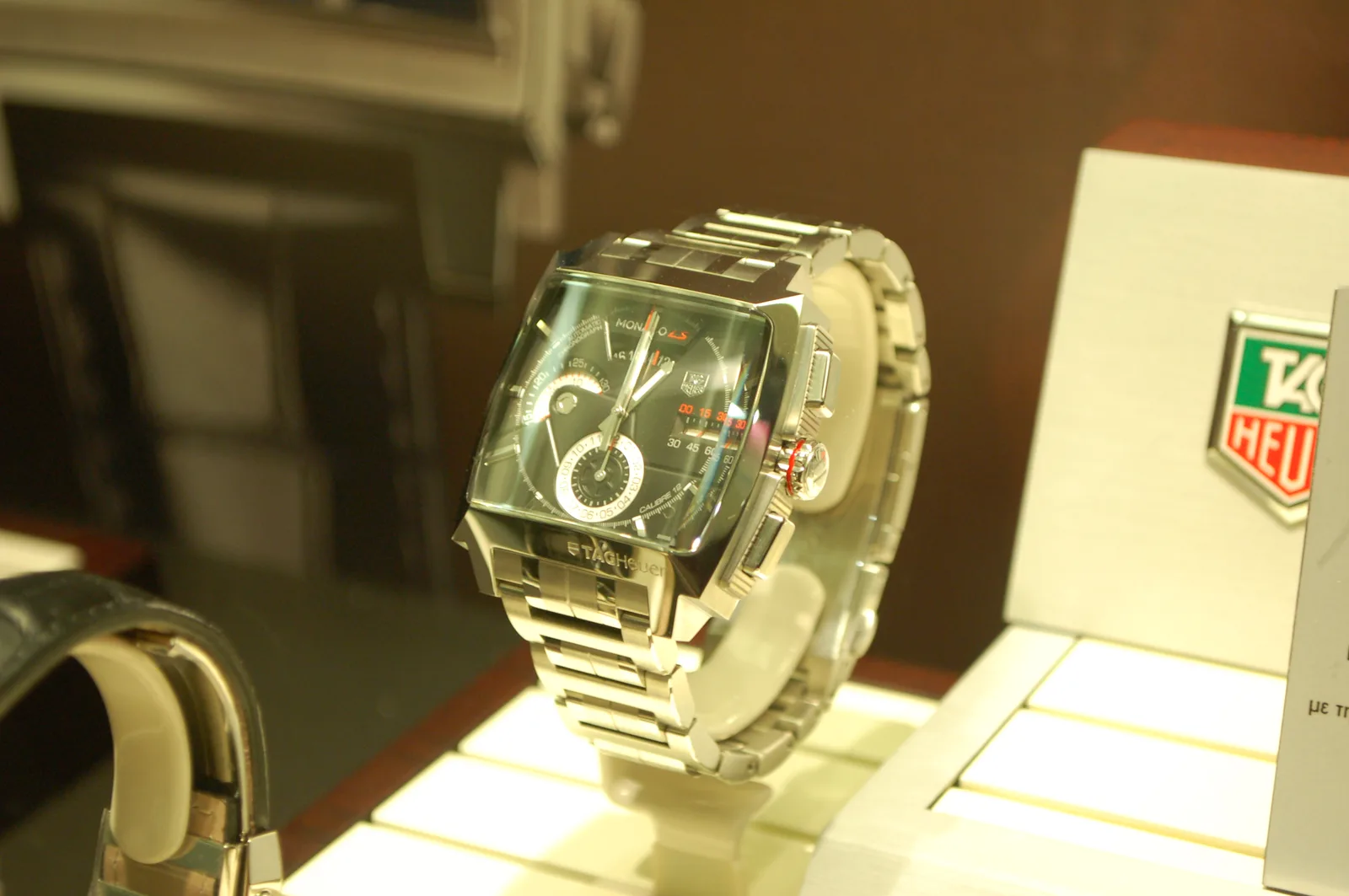
The blue is metallic, and the case is the sharp edge around it. A slide rule would have asked for a round of scales. A moon chronograph would have asked for a different instrument. A Tank would have asked for a rectangle and a quieter hour. This case asks you to walk four sides and come back to an hour a racing chronograph has already agreed to hold. The water-resistant square was the idea at the start: a case that could be a jewel and still be closed against weather. The LS keeps the lesson as a face you can name. Left crown. Square registers. Blue. The 2020 had set the registers round and the crown on the right. This plate puts both facts back where the original left them.
The square, opened
A Monaco 24, Calibre 36, spends the square as a case you can see into. The movement sits in a black square, bridges and wheels in view, the chronograph still the idea even when the dial has been opened. The crown on this one is on the right. The outline does not care. You would meet that square before you asked for a beat. Off the wrist, the watch still reads as a jewel that has let the race show. A Santos would still be a square with a different silence, screws and a bezel that dresses. A Reverso would still be a face that turns over, the case a door. This reference offers one reading — a square, an engine willing to be seen, a case you meet before the hour.
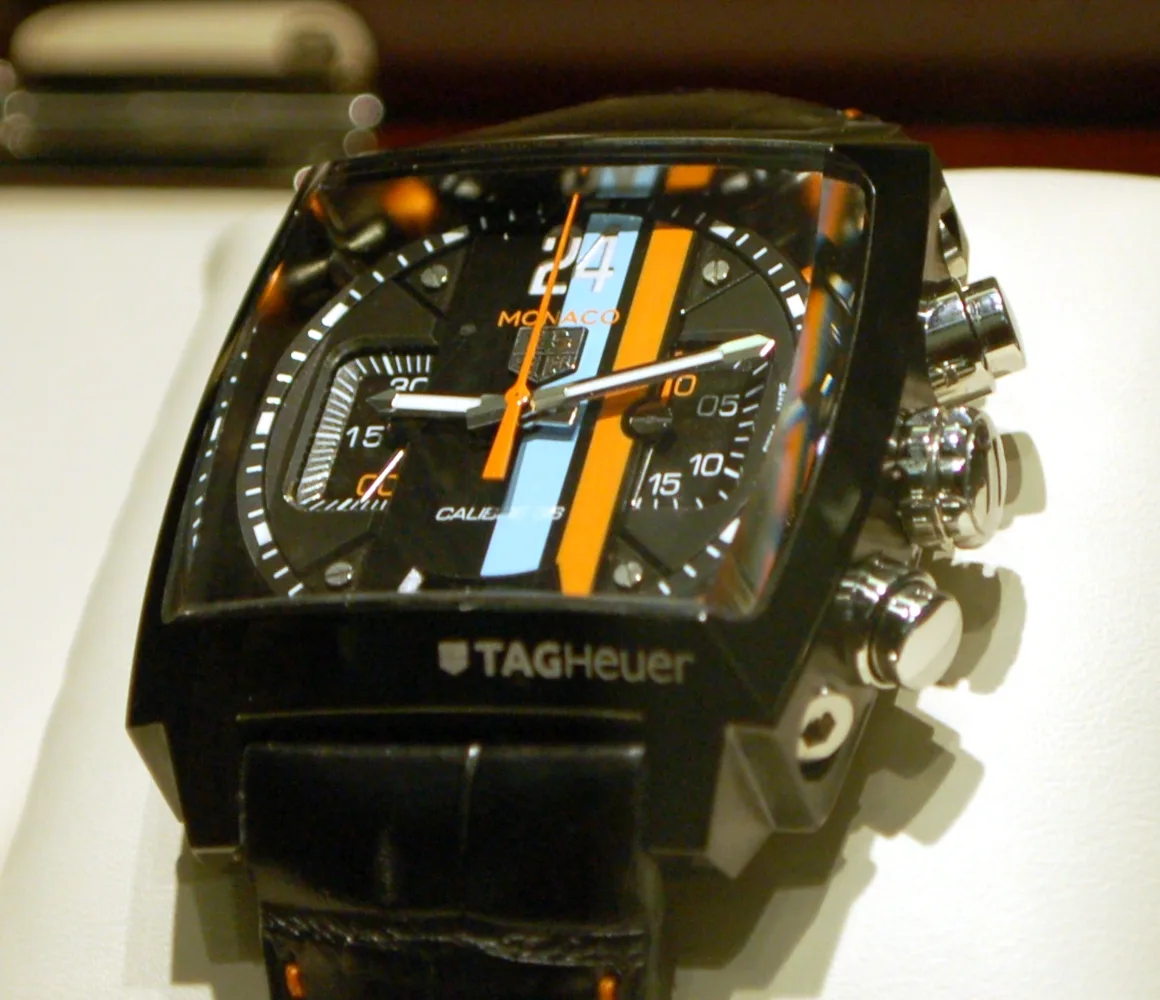
The open dial is a later chair, and it stays a Monaco because the case stayed square. A racing chronograph does not have to hide its wheels to be worn as jewelry. Here the wheels are the ornament. The square frame is what makes them a jewel rather than a mechanism left on a bench. You would cover the bridges with a look and still have the outline left over: four sides, a flank, a crown, a block that reads on a cuff as geometry.
You would turn from the opened case back to the blue faces and the family would still hold. One square with round registers, isolated, crown on the right. One square with square registers, crown on the left, the classic grammar. One square opened so the calibre can be the dial. A Speedmaster would still be a moon. A Navitimer would still be a slide rule. A Tank would still be a rectangle. A Reverso would still flip. The Monaco keeps the square, and the square keeps the race.
That is the icon. Monaco, a square that races. The 2020 blue, a geometric jewel on a pale ground. The LS, square registers and the crown on the left. The Monaco 24, the same outline opened onto its engine — a racing chronograph you meet as a sharp stone for the cuff.
Educational only · Not jewelry, insurance, or legal advice