Milgauss, a lightning hand
Rolex Milgauss keeps the seconds as a lightning hand. An orange bolt across the dial, a small stroke of weather where another watch would have put a straight line. The Explorer opens on a black that climbs, numerals at three, six, and nine. The Submariner opens on a circle that dives. A Datejust opens on a fluted bezel and a date. A Daytona opens on a chronograph that sits. A Day-Date opens on a day that reads. A Cellini opens on a gold hour in dress. The Milgauss opens on the hand. The name remembers a thousand gauss, a resistance the movement was built to keep. What you meet first, off the wrist, is the bolt. The jewel is a seconds hand that has agreed to be lightning.
A honeycomb, and the first bolt
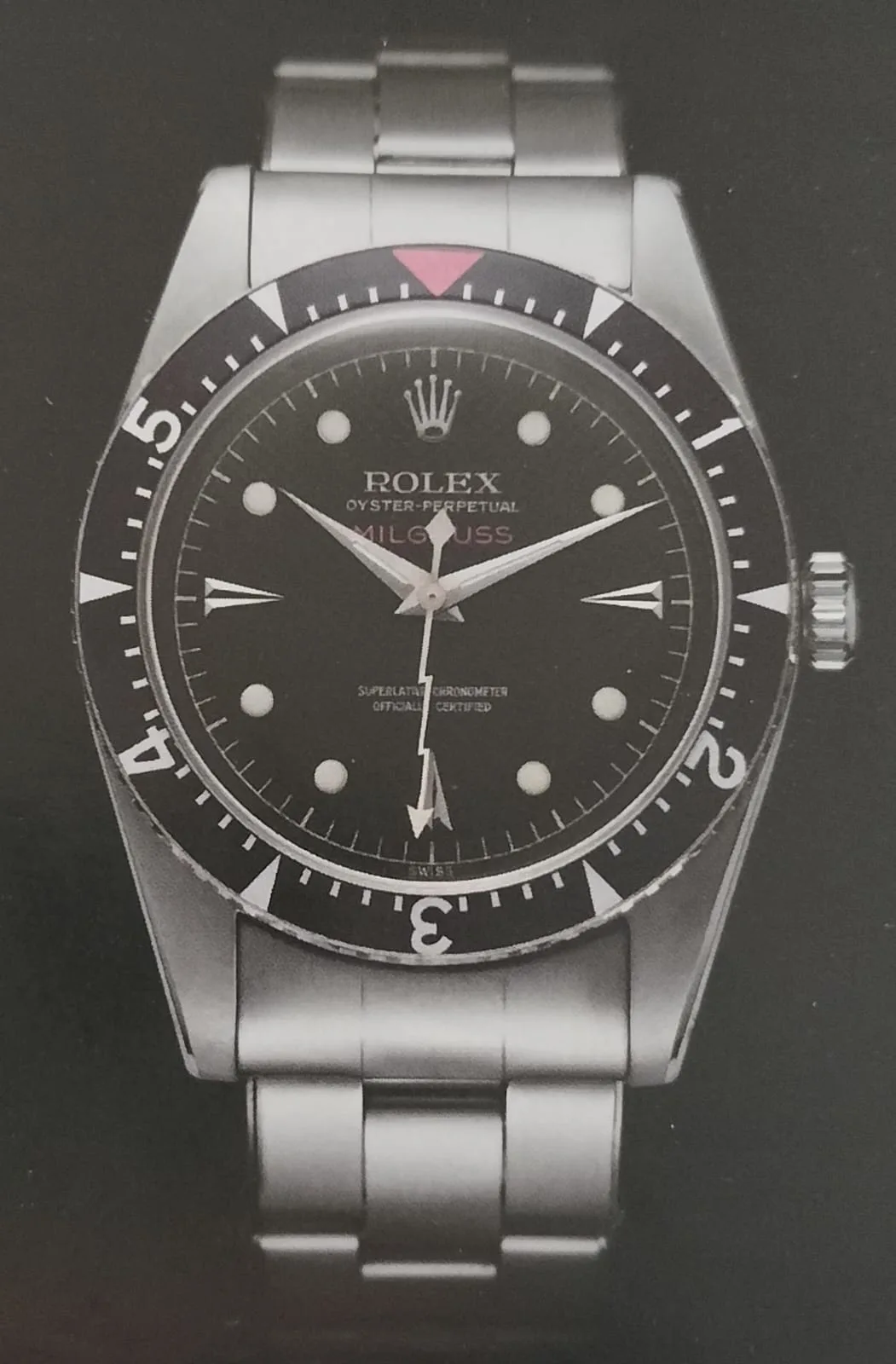
A Milgauss ref. 6541, about 1956, off the wrist. The dial is black and honeycombed, a small texture of cells under the markers. The hour and minute hands are the usual bright shapes. The seconds hand is not. It is orange, and it is a lightning bolt, a jagged stroke from the center toward the track. You meet that stroke before you ask the year. The case is steel. Nothing in the plate is a wrist. Take the name away and the dial still says the same thing: the seconds have been drawn as weather.
The honeycomb keeps the bolt company. A flat black would have let the hand be the only event, which is already enough. The cells give the ground a grain, so the orange has a texture to cross. The bezel is reeded, a coin edge, a frame that stays a frame. You would know the hand from across a table. That is the manners of this icon. A climbing dial would have put numerals on the field and let the night be the subject. Here the field is a dark grain, and the subject is a hand. The hour is told. The lightning is what you remember.
Hold the scale of the stroke. It is still a seconds hand, thin, doing the work a seconds hand does. The jewel is the shape, not a complication asking to be read. No slide rule. No day. No date window breaking the honeycomb. The bolt crosses a dial that has agreed to stay a field, and the field makes the lightning easier to see. Steel does the work of a mount. The orange does the work of a stone.
A black dial under a green glass
A Milgauss GV spends the same bolt on a smooth black dial, and puts a green sapphire over it. Off the wrist, steel, a polished bezel, applied markers, the orange lightning still the hand that moves. Glace Verte is the glass: a sapphire crystal with a green in it, so the hour is read through a colored pane. You meet the bolt, and then you meet the pane it travels under. The dial stayed black. The crystal took on a hue.
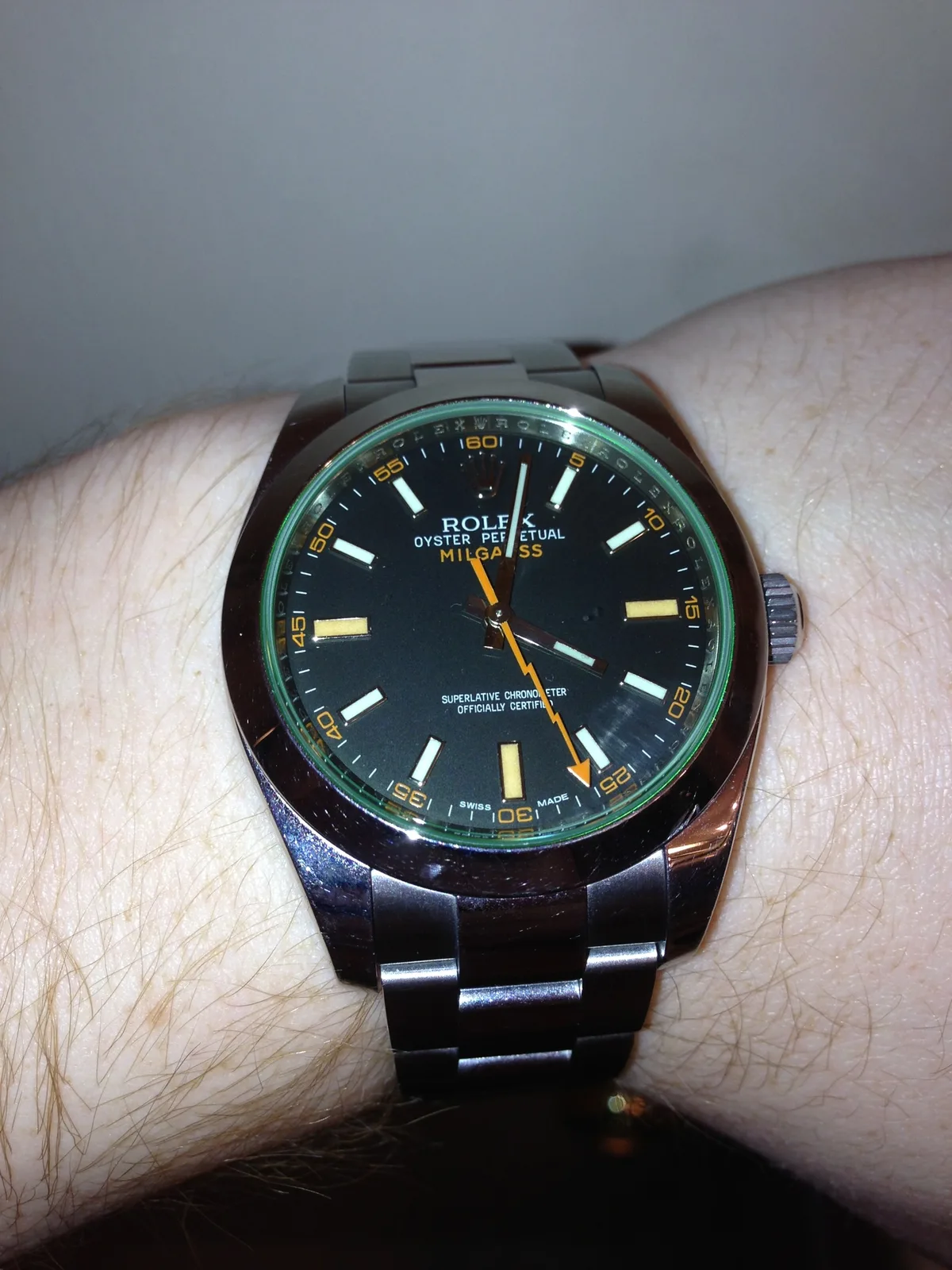
The pleasure is the pair. One is the bolt’s orange against black, the lightning you already knew from the honeycomb. The other is the crystal, a quiet green across the whole face, present as a pane rather than as a marker. A fluted bezel would have made the ring the first fact. A diving bezel would have made the ring a count of minutes. This ring stays smooth, and the color that is not the dial is kept in the glass. You look through a green to see a black, and across the black an orange bolt. That is a strange and complete piece of jewelry, and it asks nothing of a cuff to be finished.
The 6541 gave the bolt a grain to cross. This GV gives the bolt a colored window. The hand did not resign when the honeycomb went away. The lightning is the icon’s constant. The glass is what this generation adds, a sapphire that has agreed to be green, the hour still perfectly told underneath it. Off the wrist, on a light ground, the watch is simply sitting, which is how a dial becomes a jewel: you are allowed to look at the hand for its shape.
A blue read through the same glass
A Milgauss ref. 116400GV keeps the green crystal and changes the dial to a saturated blue. Off the wrist, the markers bright, the orange bolt still lightning, the blue so full that it becomes the chair the bolt crosses. The Glace Verte is still the glass, a green sapphire quieter once the dial is this blue, and still the pane the hour is read through. You would know it as a Milgauss from the hand alone. The bolt is the same sentence, written this time across a color that wants to be looked at for its own sake.
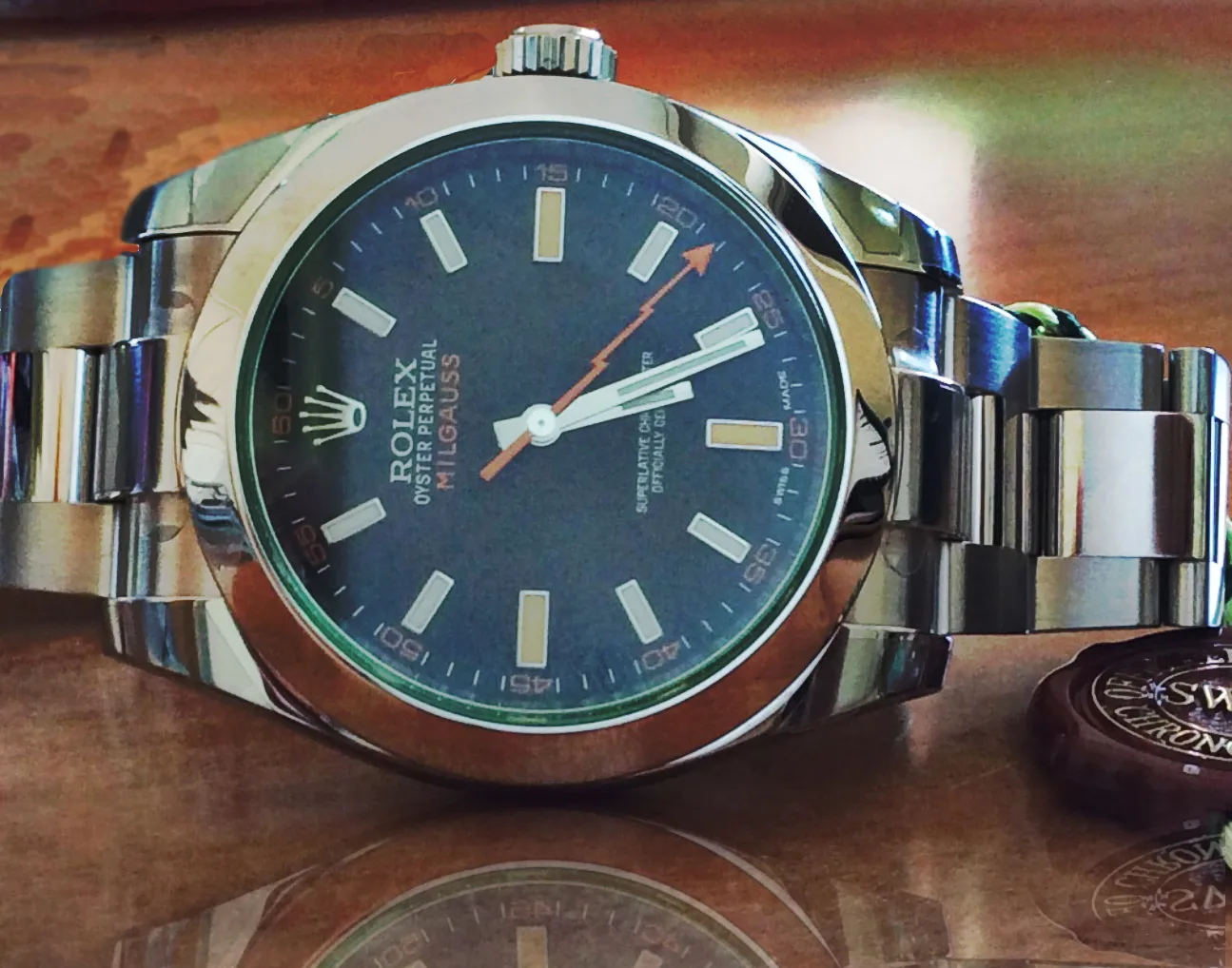
A gold dress case would have made the metal the luxury. A day at twelve would have made the word the event. A chronograph would have made the counters the map. This watch puts a lightning hand on a blue field and lets that hand be the luxury, the green sapphire a quiet pane over a color that is already complete. The bracelet is steel, a line of links, and nothing in the still is a wrist. Wider attention goes to the dial. The dial sends it to the bolt.
Three stills, one hand. The 6541 lets the lightning cross a honeycomb, the first bolt, orange on a dark grain. The black GV lets the same bolt travel under a green sapphire, the glass become a pane. The 116400GV lets the dial turn blue and leaves the hand a lightning, the hour read through that glass. A black can climb. A circle can dive. A fluted ring can date. A chronograph can count. A day can read. A gold case can dress. On a Milgauss, the seconds are kept by a lightning hand.
That is the icon. Milgauss, a lightning hand. A honeycomb, a black under green glass, a blue through the same glass — the bolt, already the first thing you meet.
Educational only · Not jewelry, insurance, or legal advice