Micromosaic is a picture in pieces
Lean in, and the picture breaks into pieces. A bunch of fruit, a dog, a horse in a field: each of them is a crowd of tiny ends, glass cut short and set side by side until the eye, stepping back, agrees to see a scene. That is micromosaic before it is a word. Cloisonné builds a wall out of wire and fills the little room with enamel fired in. Champlevé takes the hollow from the metal itself and fires the color level with the wall that remained. Plique-à-jour keeps a cell and gives away the back, so the color is a window. Painted enamel lays a picture on a ground in brushstrokes of glass that melt into one skin. Pietra dura sets stones into stone, a picture of minerals. Granulation sets spheres, a field of gold beads with no picture required. Micromosaic sets the ends of rods. The drawing is the crowd. Step back, and the crowd becomes fruit.
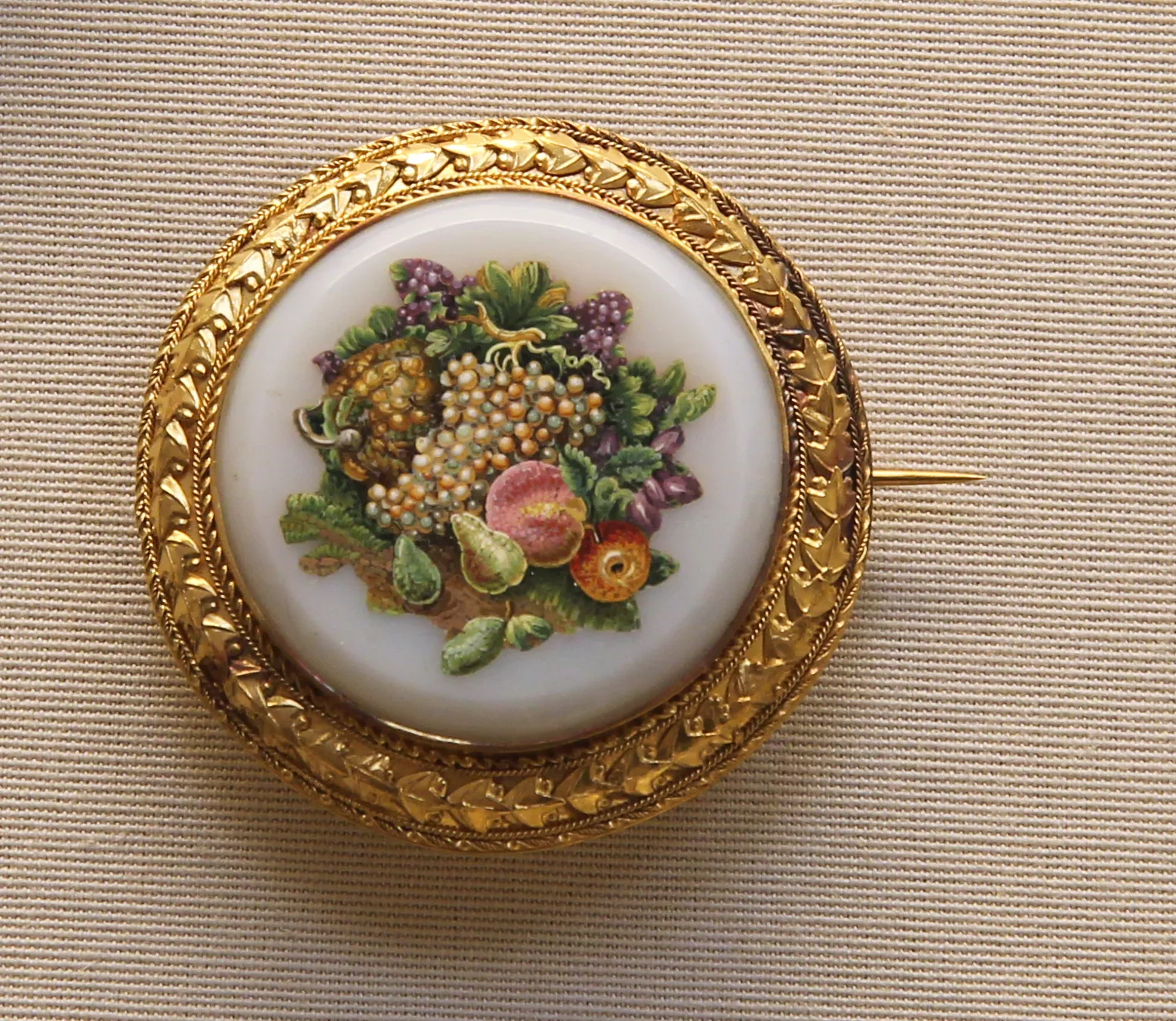
Fruit, made of ends
A gold brooch from Rome, about 1850, spends the pieces at the scale of a jewel you could pin. Gioacchino Barberi signed it on the back. The British Museum keeps it. The face is a bunch of fruit in a white opaline glass surround, the gold the frame. The fruit is the first meeting. It is not a paint laid over a plaque. It is many ends of glass, each one a dot of color, grouped until a grape reads as a grape and a leaf reads as a leaf. The white surround is a rest for the eye. It was not a wire fence. It is a pale ground the picture sits in, and the gold is what holds the whole round to a pin.
A cloisonné of this appetite would have given the same colors and a fence of metal, the wall a thing attached, the enamel a pool inside each room. These colors have no fence between the grape and the grape. They have only the edge where one end of glass meets the next. What you see, leaning in, is not a thread. It is a tessera, a short rod seen from its cut face, set into a ground that disappears when you step back. A fingertip learns a skin that is really a crowd. The cell is not a trough. The picture is an assembly.
The brooch is also where the method shows its manners. It can be a small pane of fruit, dense, and it stays a picture in every inch. The firing of an enamel can stay a different mystery. The eye only has to learn that the scene was built from pieces, and that the gold around it was meant as a frame rather than as a ground the paint covers. One brooch. The lesson is already whole, and the next objects show that it travels.
The round is a kindness to the word. A plaque seen only as a rectangle can be misread as a painting, color as a picture brushed on. A brooch of fruit, the grapes breaking into dots when you come close, is harder to mistake. Each end is a decision about hue. Set enough of them and the decisions become a bunch. You could cover one grape with a look and still have the method left over: glass, cut short, placed, and then trusted to the distance of the eye.
The same pieces, on a box
A seated dog, glass micromosaic, Rome, about 1800, spends the crowd as a figure rather than a still life. It sits on a gold and tortoiseshell box made in Austria in 1805, so the picture and the box are not the same year and not the same city, and the join is the jewel. The British Museum keeps this one too. The dog is the first meeting. The body is not a wash. It is ends of glass, a white and a brown and a ground, the tortoiseshell a warm frame the mosaic never tries to imitate. You read an animal. Lean in, and you read a pavement.
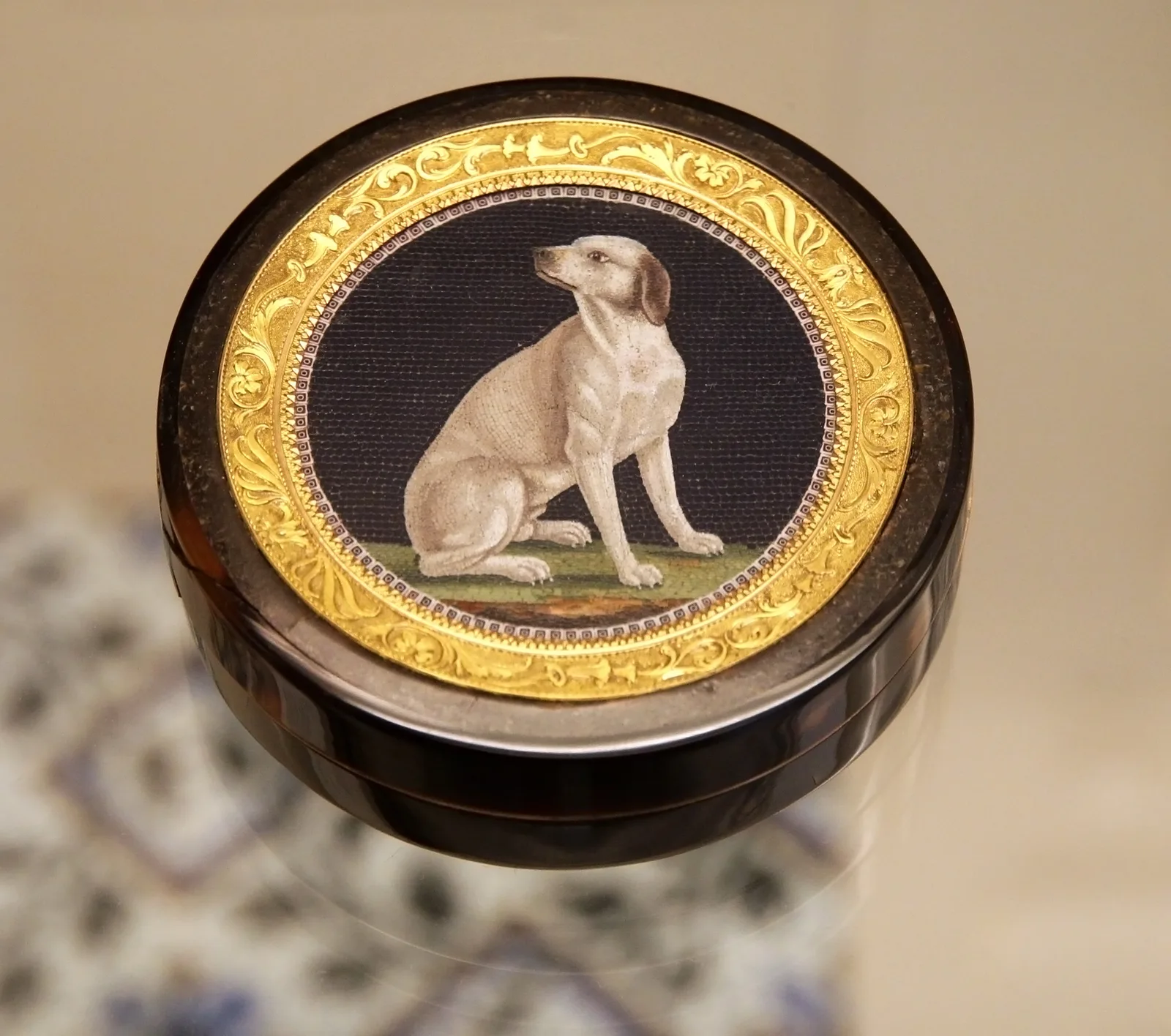
A box is a kindness of another kind. A brooch can be loved as a brooch, the technique hiding in the fruit. A lid asks you to read a surface you might open, the dog a medallion, the tortoiseshell the material that is not glass. A plique-à-jour of this drawing would have let the day through the color, and no day is coming through this dog. The pieces are backed. The ground is behind them. The back is the reason the picture can be a skin you look at, and the ends are the reason the skin, up close, is a mosaic and not a paint. An empty lace would have left openings. These openings were filled with the cut faces of rods.
The fruit and the dog are two objects and one sentence. A brooch of grapes, a box with an animal. Rome in the glass of both, a different drawing in each, the pieces unchanged. You could think either one down to the gold and the picture would remain a crowd, because the picture was never the metal. It was the guest set into the face. The surround is the light around it. The opaline ring of the brooch, the tortoiseshell of the box: both agree to stop, so the glass can have a shore.
A horse, and what the face asks
A horse in a landscape, signed by Antonio Aguatti, about 1820, shows the pieces as a place rather than a bunch of fruit or a single animal at rest. The British Museum keeps it, a round micromosaic, its own sky, its own field. It is a third object, its own drawing, its own distance. The glass does the same work. It sits as ends, packed until a horse appears, the landscape a matter of how many blues and greens were willing to stand next to each other. Step back and you are in a small country. Step close and you are counting.
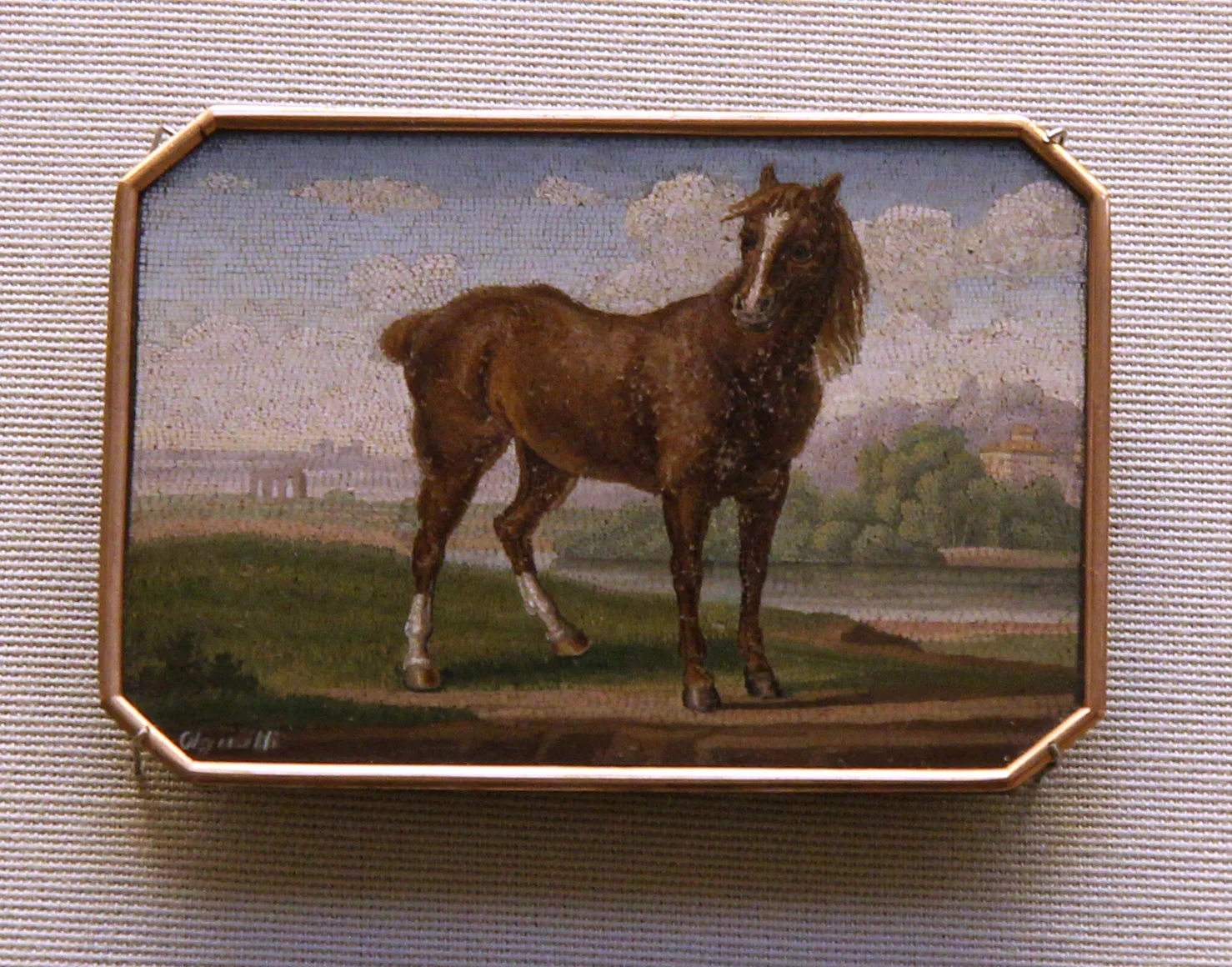
Three objects, bright in their frames and dotted in their pictures, are enough to see that the scene was placed as glass ends and then trusted to the eye’s distance. An enamel with wires would have shown you the fence. A window enamel would have changed its brightness when a light moved behind it. A painted enamel would have melted the strokes into a skin with no dots left to count. These pictures stay a pavement. The light falls on the ends. It does not come through them. A brooch, a box, and a horse are one technique. The word is what keeps them from being three unrelated scenes.
The care follows from that pavement. The ends are set, often into a ground that is not the same hard glass all the way through, and water left to sit can worry the bed they stand in. An ultrasonic bath is a crowd of small blows, and a tessera that was patient for two centuries can loosen in a minute. A press is the other risk. The face is a skin of many pieces, and a weight that would only dull a plain metal can push an end below its neighbors or pop one free. A soft dry cloth keeps the gold and the glass. Between keepings, the brooch and the box and the round want a nest that does not bear on the picture, and no stacking of metal against the mosaic. If an end is already proud or missing, the care is to leave it for a restorer. A fingertip that tries to push it home is how a small loss becomes a scar. The care is only that the picture remain a picture: the ends unbroken, the ground still holding, the two of them still one face at the distance you wear it.
Three stills, one crowd. The fruit lets the glass be a still life, ends grouped until grapes appear, a brooch signed by Barberi. The dog lets the same pieces be an animal on a box, Rome’s mosaic and Austria’s tortoiseshell agreeing to share a lid. The horse lets them be a landscape, Aguatti’s round, a third object, the ends packed again until a place appears. A wire wall remains cloisonné. A trough in the metal remains champlevé. A missing back remains plique-à-jour. A melted brushstroke remains painted enamel. Stones set in stone remain pietra dura. A field of spheres remains granulation. Micromosaic is the picture in pieces: glass cut short, set side by side, and trusted to the eye.
That is the note. The ends are set. The scene appears when you step back. Micromosaic is what the pieces become — fruit, a dog, a horse — a picture, made of glass, and held together by the ground you do not see.
Educational only · Not jewelry, insurance, or legal advice