King Seiko, a rank on the dial
Before a finish, a sentence. King Seiko writes its rank where the hour is, and lets you read the rank first. A Grand Seiko opens on a skin, a field the eye could almost touch, the boast kept in the surface. A Tudor opens on a shield at twelve. A Chronomat opens on four tabs a hand could hold. An Accutron opens on a fork. A Day-Date opens on a day you can read in a window. A Calatrava opens on a circle and lets the circle be plain. King Seiko opens on the words. Diashock. Chronometer. King Quartz. The hour is still told. The rank is what you remember.
Twenty-five jewels, and the name
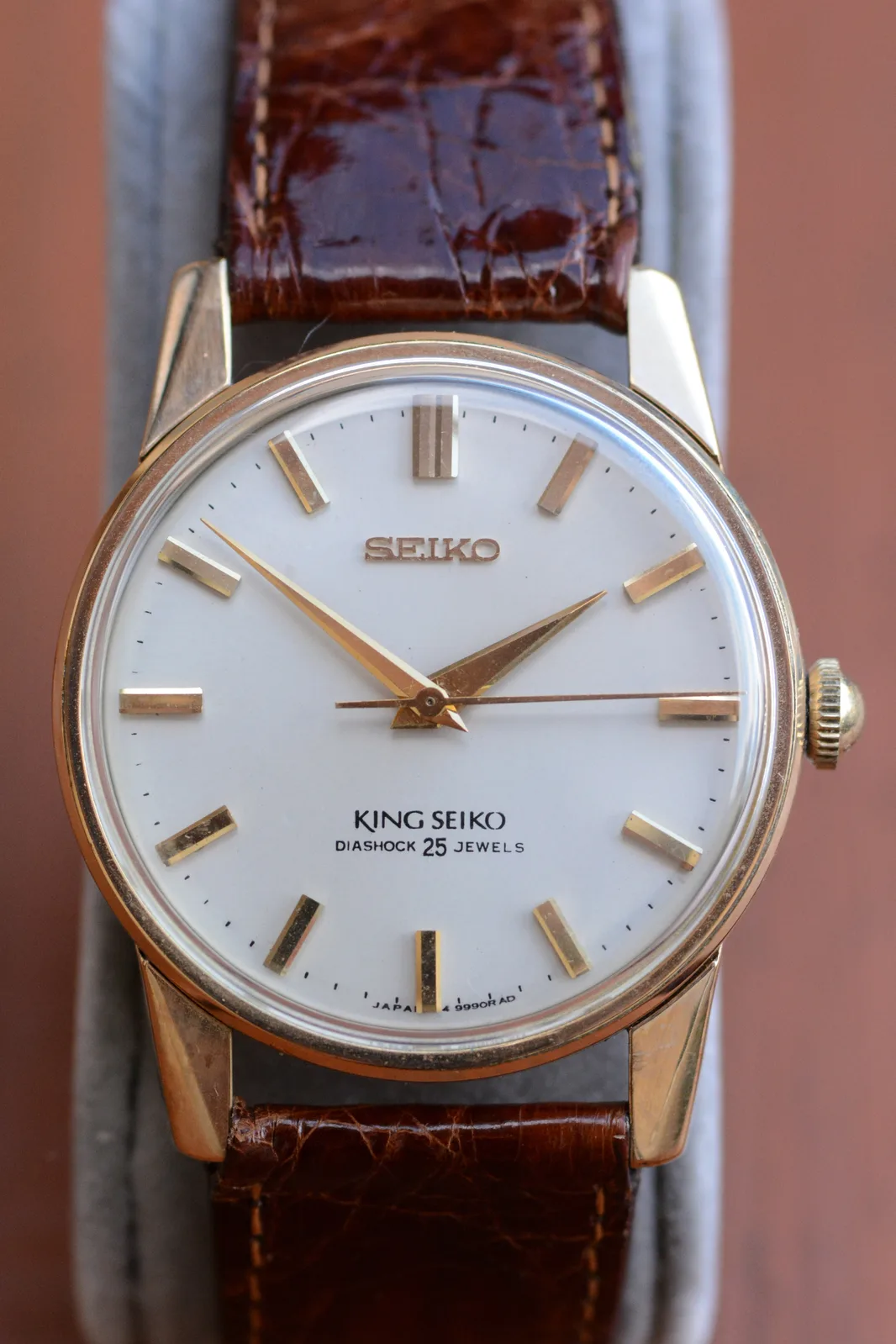
A manual of 1967, the second model, off the wrist, on a white ground. Silver dial, applied indexes, dauphine hands, and the words doing the work of a signature: King Seiko, Diashock, twenty-five jewels. Along the lower dial the case code is printed too, 4420-9990, a small honesty under the hands. The sentence is the first meeting. Nothing in the plate is a wrist. Cover the bracelet in your mind and the dial would still say its rank. The shock protection is named. The count of jewels is named. The house’s king is named. Another watch might have left all of that inside the case and let a texture be the jewel. Here the texture is a quiet radial brush, and the jewel is the decision to print the rank where you cannot miss it.
The scale of that decision stays a jewel’s scale. The watch is still a round on a bracelet, still a thing arranged to be fastened, and the words do not turn it into a certificate laid out on a bench. Off the wrist, the picture is complete. You are looking at a sentence that has agreed to tell the time. The hands cross a dial that has already decided the words are the point. A shield would have asked to be a coat of arms. A fork left open would have asked to be a mechanism. These letters ask to be read, the way a title asks to be read, and then they give you the hour.
Diashock is a word about a shock, and on this dial it is also a piece of jewelry. It sits where a logo might have sat alone, and it keeps company with the count of jewels, so the face is a small page. You would name the watch from the sentence and from the applied marks, before you asked which year had been printed on the file. The case does the work of a mount. The printing does the work of a clasp you do not close: a line the eye understands. A plain circle would have made the emptiness the first fact. This emptiness is written on, on purpose. The writing is the icon.
The same rank, certified
A Hi-Beat, reference 5246-6000, spends the sentence as a chronometer. Off the wrist, the dial still silver, a small gold medallion now at six, and the words a longer claim: King Seiko, Special, Chronometer, Officially Certified. A day and a date sit at three, honest and small. The certification is the first change. Where the 1967 watch named a shock protection and a count of jewels, this one names a standard it was willing to be tested against. The hour is told. The rank is the fact, and the rank has gone up a step without leaving the dial.
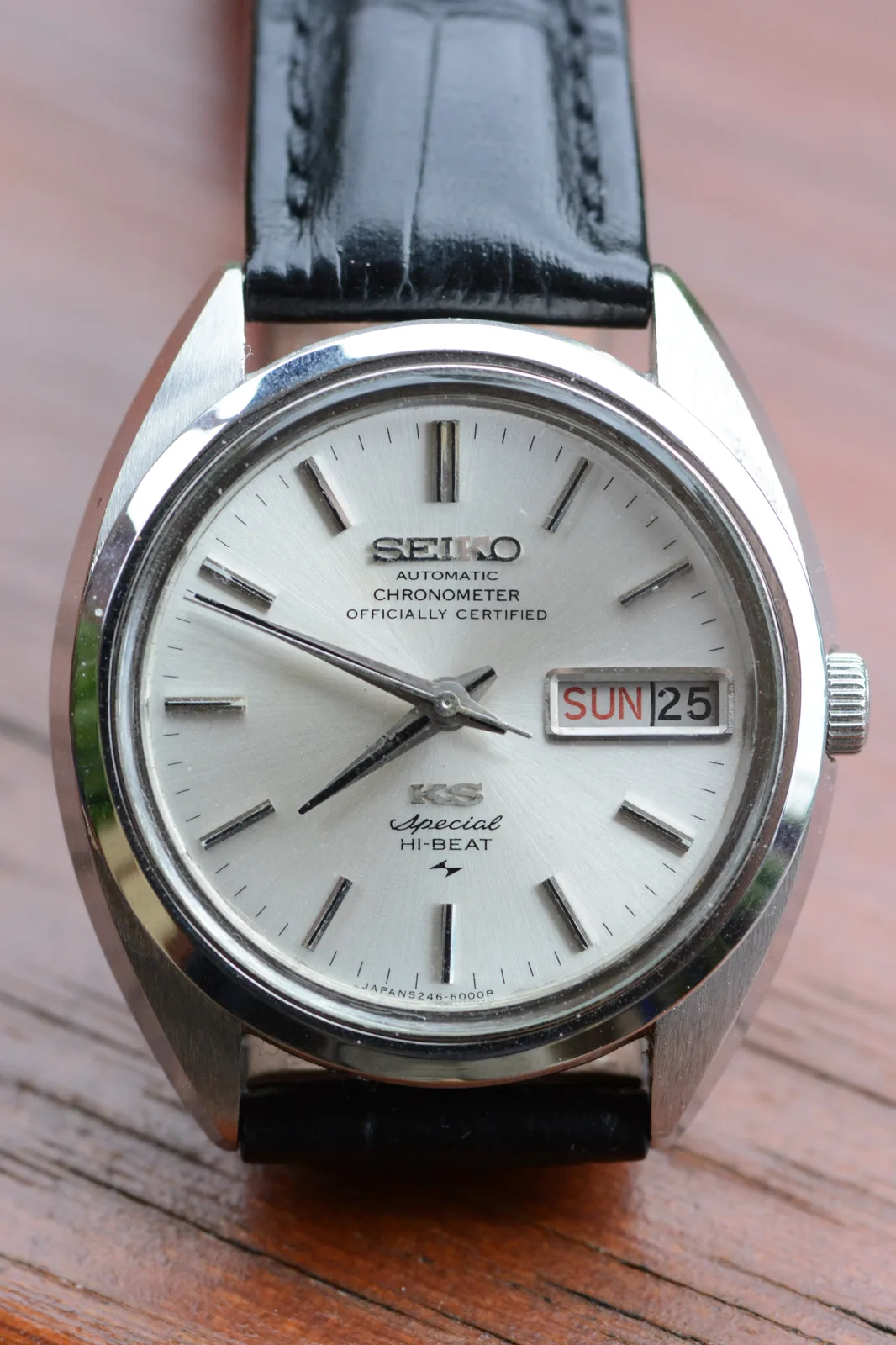
The manual gave the name a quiet page. The Hi-Beat gives it a certificate you can see, so the word Chronometer reads as the center of the sentence. Two watches, and the written rank is the icon’s constant. A skin of texture would have made the dial a surface you meet before any letter. A shield would have made twelve a coat of arms. This dial is almost plain between the words, which is the point: the plainness is what makes the sentence a rhythm. On a white ground, with no wrist in the picture, the watch is simply a face you are allowed to read, and the reading ends at the rank. The shape is enough. The words are the memory the shape keeps.
Set the 1967 beside this Hi-Beat and you are still reading one line. The dial has a rank. On one, the rank is Diashock and twenty-five jewels, a manual, a bracelet of links under it. On the other, the rank is a chronometer at a high beat, the same appetite for saying so, a later confidence. Attention goes to the printing, and the printing does not send you into the finish yet. It keeps you on the words. A day window on the Hi-Beat is a small honesty, and it is not the reason the dial was printed this way. You stayed for the rank. A day that reads is another watch’s event. Here the event is the standard, written out.
The silver ground is a kindness to that lesson. A black face can be loved as a night, the letters hiding in the polish. A silver face, the black type sitting in the metal color, is harder to mistake. Each word is a short claim. The medallion at six is a small seal under the hands, and it is not the sentence. You could cover it with a look and still have the method left over: a dial, a rank, a face that agreed to announce itself. The day window keeps its own little word, a weekday, and even that stays a guest. The host is Chronometer.
King, and then quartz
A King Quartz, reference 5856-5010, from 1977, spends the same idea in another way of keeping time. Off the wrist, a silver dial, the name now King Quartz, a date, applied marks, the sentence still the first architecture. This is not the manual and not the Hi-Beat. It is a third piece, met by the rank it keeps. The word Quartz is the first meeting after the name. It is not a certificate and not a count of jewels. It is the same appetite: a dial finished until the eye would know what it is before the eye knows the hour.
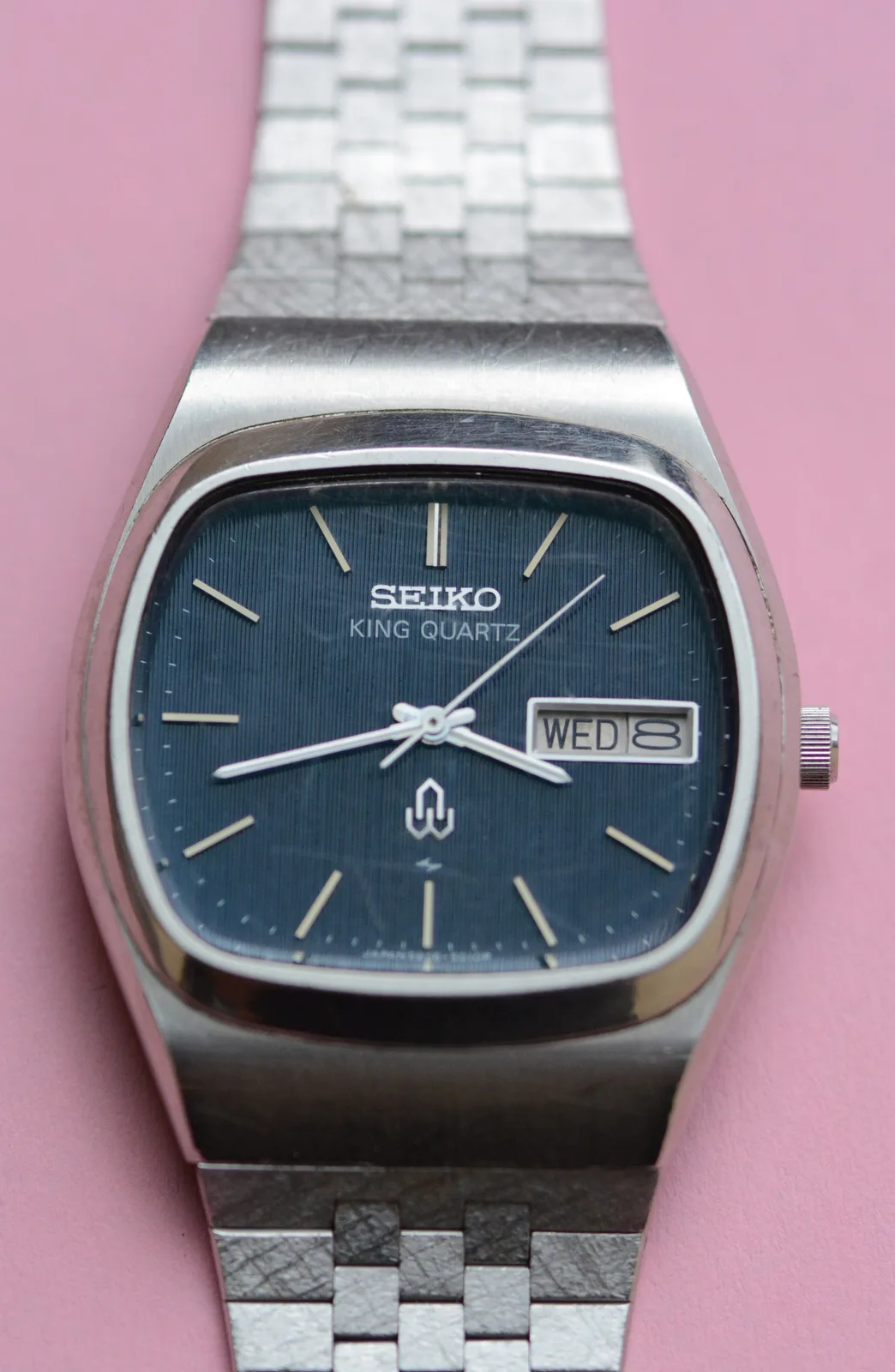
The manual lets you wear the rank as a page of jewels and a shock protection. The Hi-Beat lets you wear it as a chronometer, the high beat named. This one lets you wear it as a quartz that did not give up the king. A fork left open would have made a mechanism the jewel by leaving it bare. Here the mechanism stays inside, and the outside has been dressed with a sentence: King Quartz, a date, a dial asked to be legible and calm. You would know the finishing before you timed a second. Nothing in the still is a wrist. The watch is simply a round you are allowed to read, and the reading ends at the rank.
That dressing is why the ways of keeping time can change and the icon does not. A manual can stay a manual, a hi-beat can stay a chronometer, a quartz can stay a quartz, because the fact did not all have to happen in the mechanism. Some of it was saved for the dial. You meet the words first, which is the icon’s order. Then the hands offer the hour, and the hour is free to be kept however the watch keeps it. The time was never the only thing being finished. The face was finished to say its rank.
Three stills, one sentence. The 1967 lets the rank be Diashock and twenty-five jewels, a manual on a bracelet. The 5246-6000 lets the same appetite become a chronometer you can read, Hi-Beat, officially certified. The King Quartz lets the name hold in 1977, a third watch, the words unchanged in their manners. A skin can still be a Grand Seiko. A shield can still sit at twelve. Four tabs can still ask to be held. A fork can still hum. A day can still read in a window. A circle can still dress and stay plain. On a King Seiko, you meet a rank on the dial.
That is the icon. King Seiko, a rank on the dial. A manual of 1967, a Hi-Beat chronometer, a King Quartz — the sentence, already the thing you read.
Educational only · Not jewelry, insurance, or legal advice