Guilloché is an engine-turned field
Guilloché is an engine-turned field. Fine lines, cut in a repeating wave or a basket or a moiré by a rose engine, until the metal itself is a pattern. Enamel, when it comes, is often translucent, a skin that lets the turning show. Engraving cuts a groove a graver drew by hand, a line you can follow as a drawing. Filigree draws a lace in wire and leaves the air in. Granulation covers a surface in spheres. Guilloché turns. The unit is a line. The jewel is the field those lines agreed to become, and the light that moves across them.
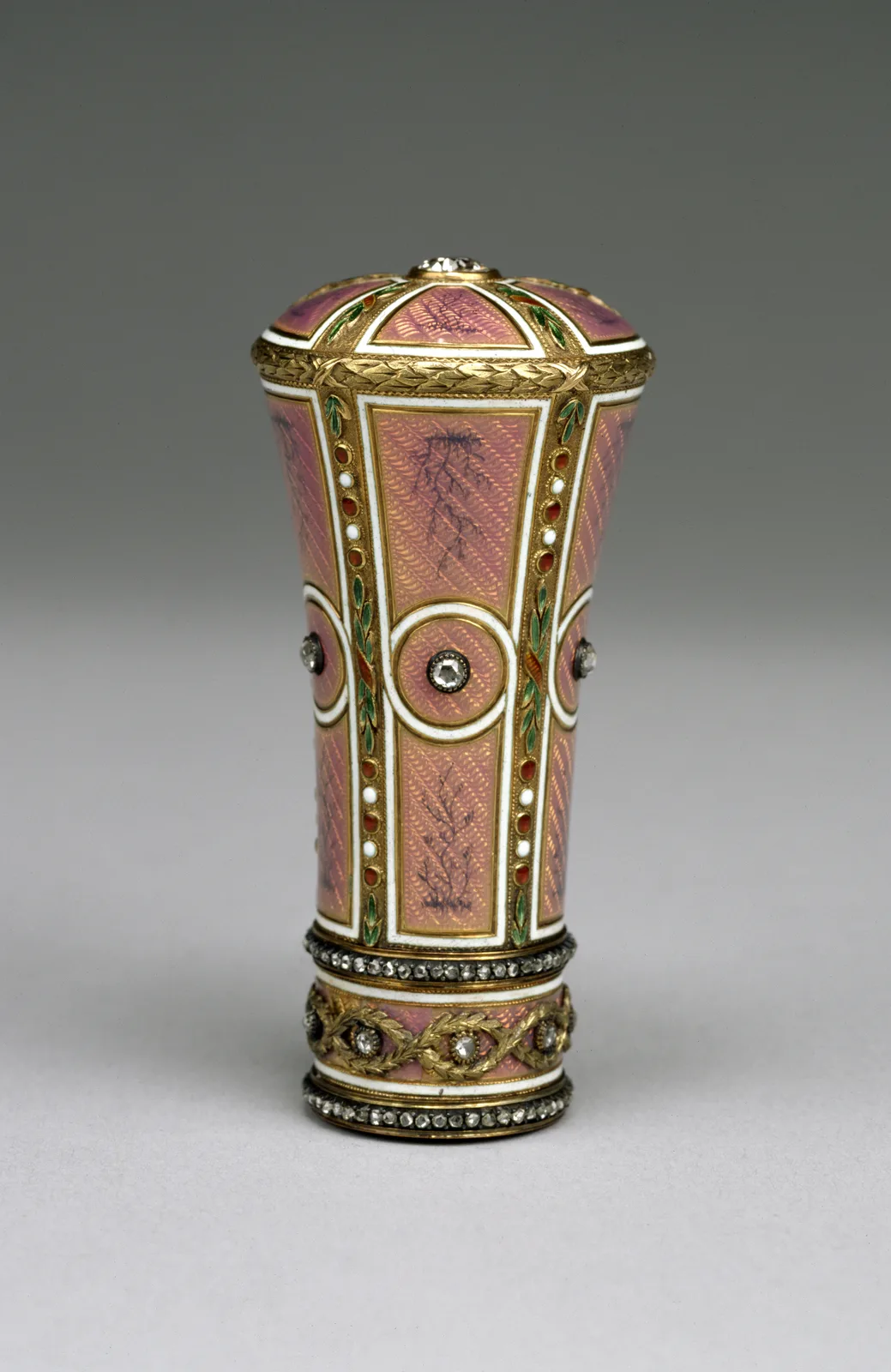
Pink over gold
A Fabergé parasol handle, about 1900, keeps the field as something a hand would close on. Pink enamel on guilloché gold, diamonds, eight centimeters, the Walters Art Museum, 44.621. The turning is the ground. The enamel is the skin. You see a wave because the gold was engine-turned before the color went on, and the color was willing to be clear enough to confess it.
A painted enamel would have hidden the metal under a picture. This pink does not hide the metal. It dresses it. The lines stay, a fine wave under the pink, and the diamonds at the head are a separate brightness, hard points above a soft moving field. That is the literacy. The pattern is not drawn on top. It is turned into the gold, and then allowed to remain visible, which is why the surface seems to shift when the handle turns in the light.
The care follows the skin. The enamel is thin, and the turning is what the thinness is for. A buff that wants a higher shine asks the pink to become a flat and the wave to go quiet. A soft cloth keeps both. The diamonds can take a gentler wipe. The field wants to be left at the depth it was given. Eight centimeters of gold, already a jewel in the hand, already a lesson in what engine-turning is for: a light that moves because the lines are there, under the color, on purpose.
Waves in a pale blue
A Fabergé matchsafe in the Cooper Hewitt spends the same turning as a wave you can name. Late nineteenth century. Silver gilt, translucent pale blue enamel over an engine-turned ground, the lines repeating, vertical, and wavy. An acanthus border in pink and yellow gold. A cabochon at the side releases the lid. Accession 1978-146-482. The object is a small case. The jewel is the face of it.
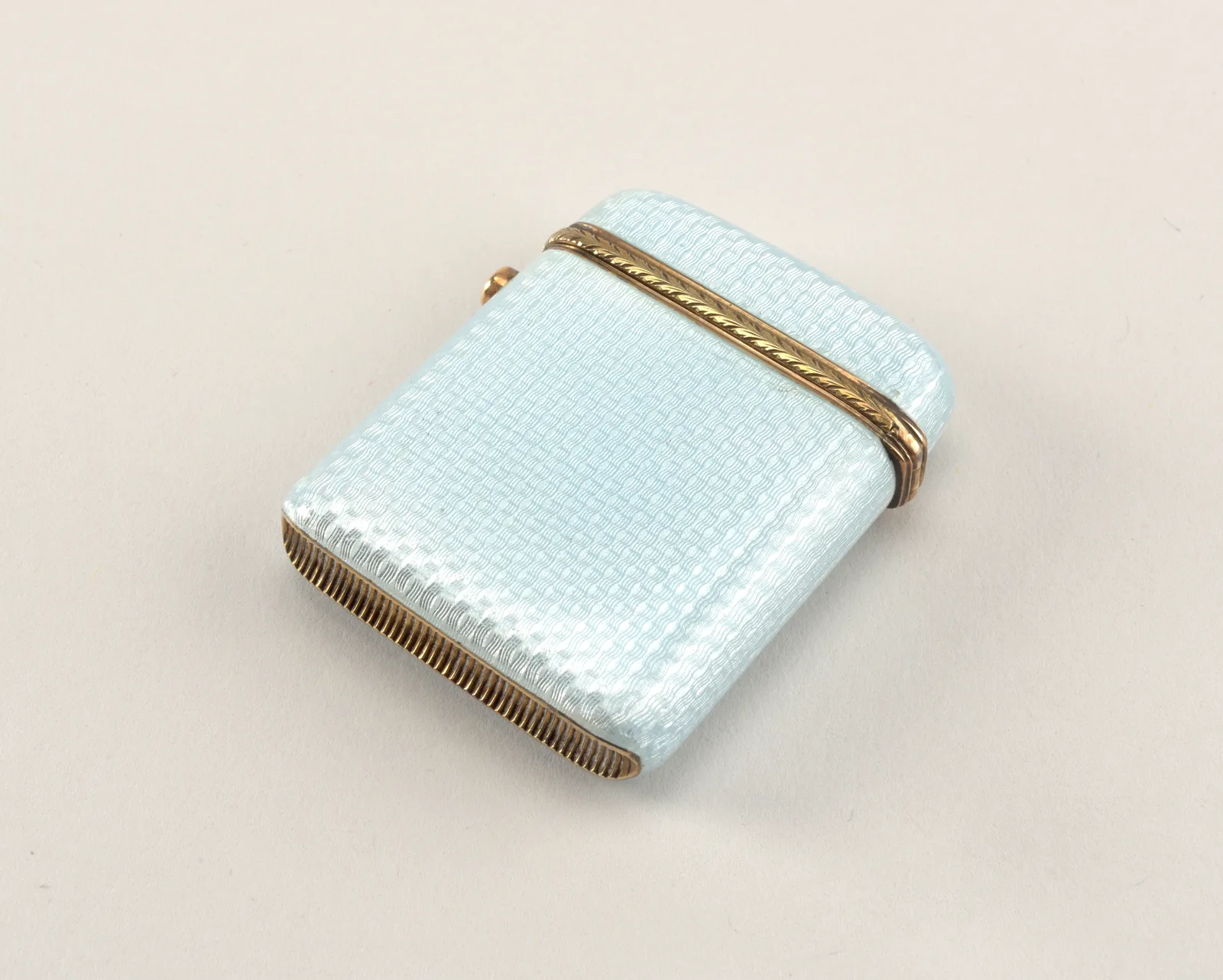
Here the pattern is willing to be read at a glance. Vertical waves, one after another, the enamel pale enough that the metal’s rhythm shows through as a ripple. Guilloché can be a secret moiré, visible when the piece is tipped. It can also be this: a field with a direction, a tide, a surface that has already decided to be water. The acanthus is a different sentence, a modeled border, and it frames the waves without becoming them. Engraving would have cut those leaves as lines you feel as grooves. These leaves are gold relief. The center is the turned field.
The lid, the hinge, the striker in its recessed groove: they do a job. The blue face does the other job, which is to be looked at until the waves resolve into separate lines and then merge again. A polish that levels the enamel would merge them for good, into a plain blue with a memory of texture, which is a different object. The one in the photograph is still the first object: lines, turned, covered, and left visible.
A brooch that wears the field
An Oskar Pihl brooch for Fabergé brings the turning back to a jewel you could pin. Nineteenth century, gold and guilloché enamel, a rectangular outline with a rococo scroll. The matchsafe showed the technique as a surface you can count. This brooch shows it as a thing worn. The outline scrolls, a white edge against a pale blue center, and the center carries the waves. The engine-turning is the ground under that color, visible as a ripple, the reason the brooch is a field and not a painted scene.
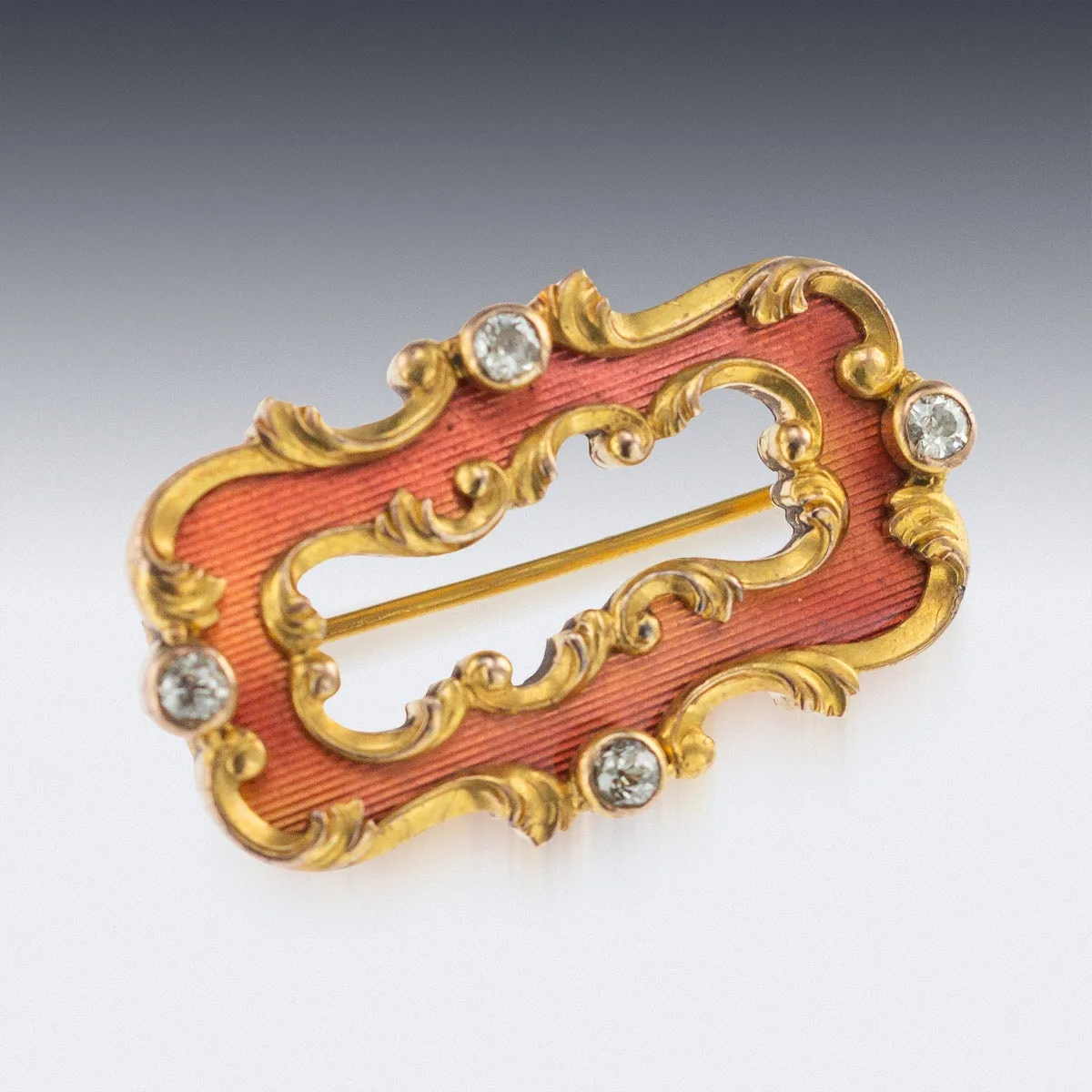
A painted skin of enamel can carry a figure, a flower, a whole miniature, and that is another literacy, the one that treats enamel as pigment. Guilloché treats enamel as a window onto a turned ground. The brooch can be small. The habit is the one the handle taught at the scale of a palm and the case taught at the scale of a pocket. One field of lines. A little gold scroll to introduce it. The color is the light’s climate. The lines are why the light will not sit still.
Three objects, one turning. The parasol handle lets the pattern be a wave under pink, a thing the hand encloses. The matchsafe lets it be a wave under pale blue, a tide you can count. The brooch lets it be a jewel, the field reduced to a pin. A groove cut by a graver remains a drawing. A lace of wire remains a lace. A field of spheres remains a granulation. Guilloché is the turned field: metal that agreed to be many lines, and then, often, agreed to wear a translucent color so the lines could keep their light.
That is the note. An engraving is a line you drew. A filigree is a lace. A guilloché is an engine-turned field — a moiré, a wave, or a brooch — already the surface when the enamel begins.
Educational only · Not jewelry, insurance, or legal advice