Granulation is a field of spheres
Granulation is a field of spheres. Tiny grains of gold, fused to a surface until the surface itself is a weather of balls. Milgrain keeps a row of beads along an edge, a border you can count. Filigree draws a lace in wire, a line that learned to leave air. Granulation covers. The unit is a sphere. The jewel is how many of them, and how small, and what they agreed to depict.
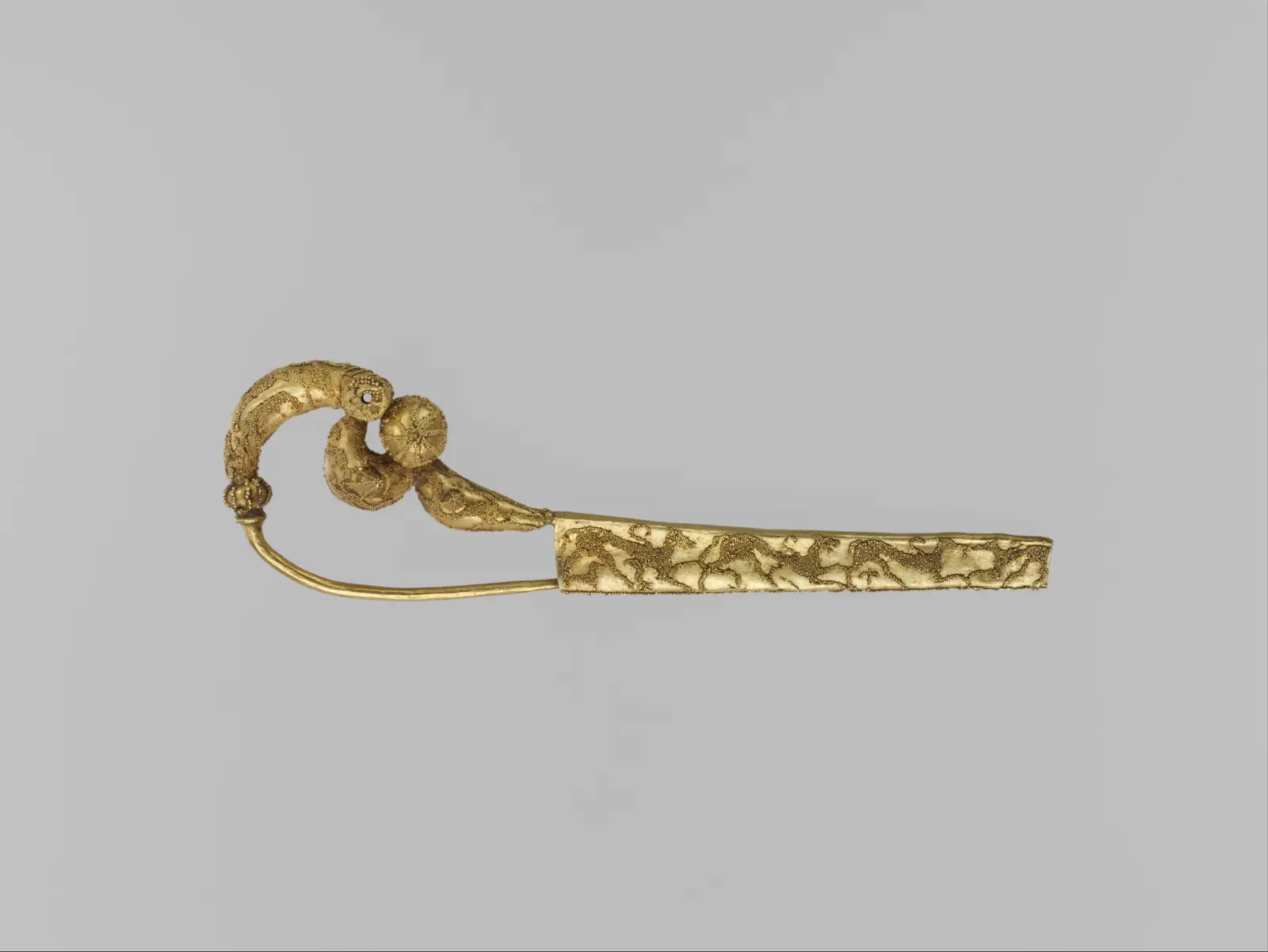
Animals made of grains
An Etruscan fibula of the seventh century BCE keeps the field as a drawing of creatures. A long serpentine bow, gold, the arc worked in granulation: waterbirds along the length, each one a gathering of grains, the eye and the beak still readable because the spheres have agreed to a direction. The Metropolitan Museum of Art, 95.15.198. The pin is a functional spine. The jewel is the weather along it.
A graver would have cut those birds as lines. A wire would have drawn them as filigree, open and airy, more hole than body. These birds are solid with grains. Stand close and a wing is a pavement of balls. Step back and the pavement becomes a creature in flight, repeated, a procession you can follow from the spring of the pin toward the catch. That is the literacy. The sphere is small enough to be a mark, and numerous enough to be a surface.
The catch and the pin can be plain. They do a job. The bow does the other job, which is to be looked at until the birds resolve. A soft cloth will keep the grains clear of dust. A polish that wants them flat is asking the birds to become a sheet. The field is the point of the gold. Leave the spheres their height, and the fibula remains a picture you can read with a fingertip as well as with an eye.
Pyramids of the same unit
A Roman earring, second to third century CE, spends the sphere as architecture. Clustered balls and pyramids of granulation, each pyramid a stack that rises to a point, the cones marching along a triangular frame. The Metropolitan Museum of Art, 74.51.3258. A single grain is almost nothing. A pyramid is the grain repeated until it has a summit.
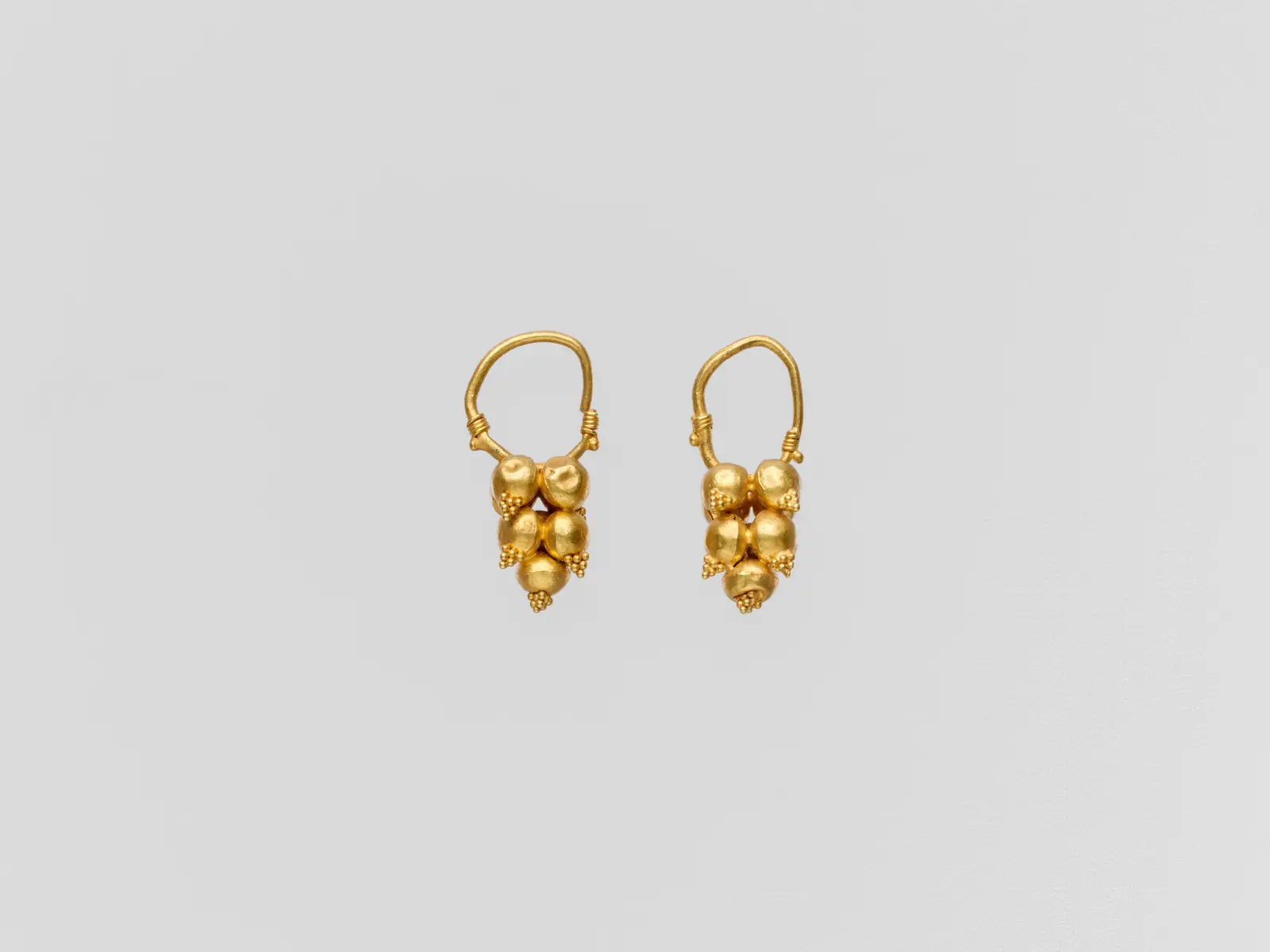
Milgrain would have set one row along the rim and stopped, a beaded edge with a clear outside. Here the beads leave the edge and build. The courses are visible, the way courses are visible in masonry, except every stone is a sphere and every sphere is gold. The hollow of the earring is the quiet part, a dark interior. The ornament is the accumulation, proud of its points, a small city of summits on a frame you could lose in a palm.
This is the know-how in the hand as well as in the eye. Granulation catches on a knit and on a careless chain. It wants its own soft place in a box, and it wants a cloth rather than a buff. The pyramids are the jewel’s height. Level them and the earring becomes a smoother gold with a memory of texture, which is a different object. The one in the photograph is still the first object: height, repeated, fused, and left alone.
A dust
An Etruscan bowl in the Walters Art Museum takes the field as far as it will go. Seventh century BCE, gold, pulviscolo granulation: grains so fine they read as a dust, and yet the dust still draws. Geometric bands, a register of birds in flight, a rosette at the center that opens like a flower made of powder. Walters 57.372. The birds on the fibula were grains you could imagine counting. These are grains you accept as a tone, and then, looking longer, as a picture that never quite gives the unit back.
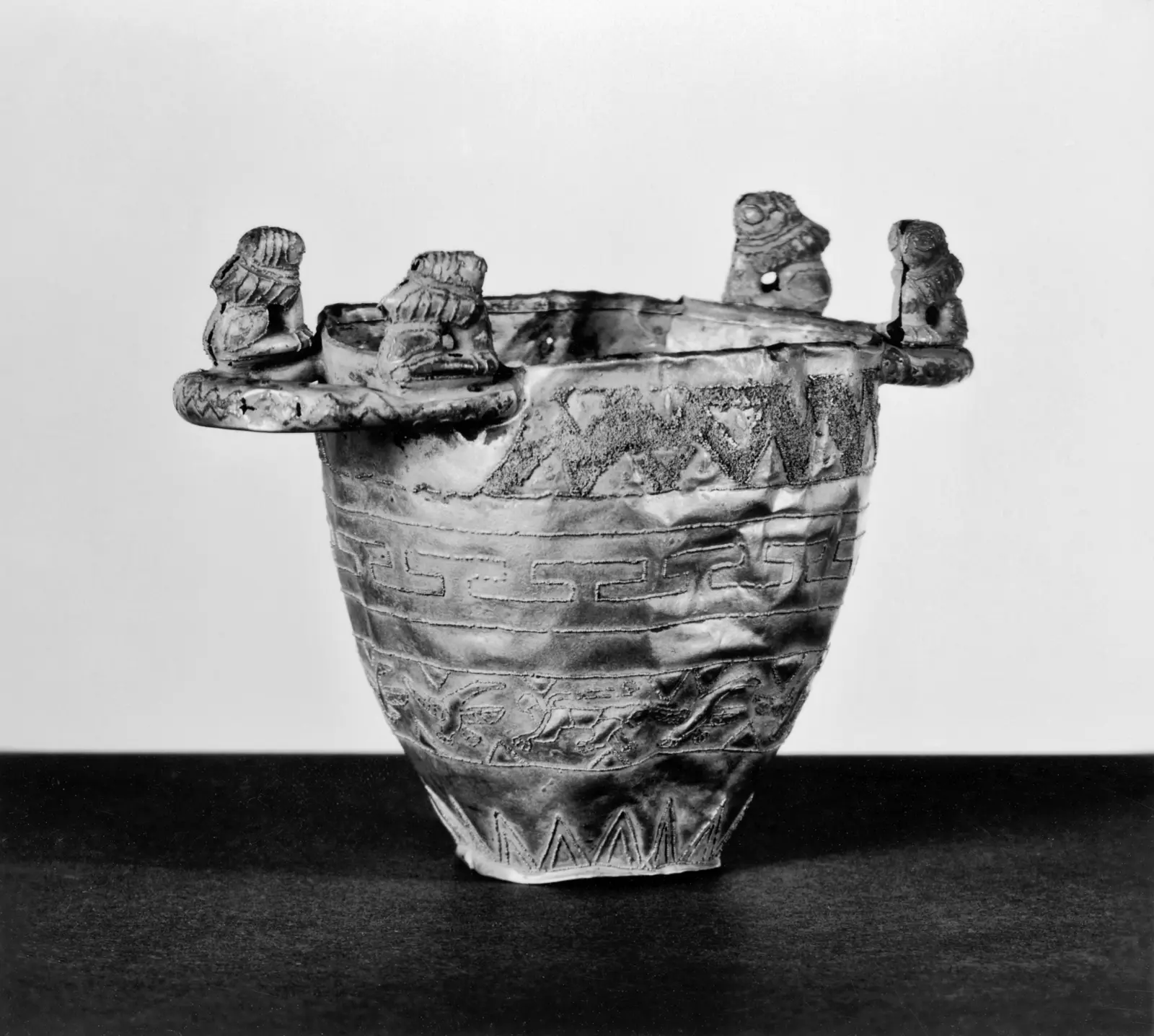
Pulviscolo is the same literacy at another size. Sphere, fused, repeated, until the eye gives up the count and keeps the pattern. The interior of the bowl is the picture. A twisted wire at the rim is a different sentence, a line rather than a field, and it frames the dust without becoming it. Filigree would have left holes you could see the cloth through. This surface is continuous. Light sits on it as a bloom, the way light sits on a fine weave.
The care follows the size. The finer the grain, the less a rub has any business there. Dust is still gold, and gold that fine loses its drawing if it is asked to shine like a sheet. A cloth, a separate pouch, a finger that knows it is touching a picture. The bowl is a lesson in scale: the same sphere that built a bird on a fibula can shrink until the bird is a shiver in a pattern, and the shiver is still the technique.
Three objects, one unit. The fibula lets the spheres be animals. The earring lets them be pyramids. The bowl lets them be a dust that still has birds in it. A row of beads along an edge remains a row. A lace drawn in wire remains a lace. Granulation is the field: gold that agreed to be many, and small, and round.
That is the note. A milgrain is a border. A filigree is a lace. A granulation is a field of spheres — animals, pyramids, or a dust — already the surface when the jewel begins.
Educational only · Not jewelry, insurance, or legal advice