Golden Ellipse, a proportion on the cuff
A Golden Ellipse is read from the outline inward. The case is a closed curve that refuses to be a circle. A Calatrava is that circle, and the circle is the whole of its sentence. A Gondolo takes a rectangle and bows the long sides until the case softens, and a corner is still there if you go looking. The Ellipse has no corner to find. In 1968 Patek Philippe drew the case to the golden section, the old proportion in which the long side and the short side keep one ratio, and named the watch for that proportion as well as for the gold. Reference 3548 was the first, a small ellipse, and the ratio was the announcement. You meet the curve before you meet the hour. Cover the dial in your mind and the icon is still there. It is the shape.
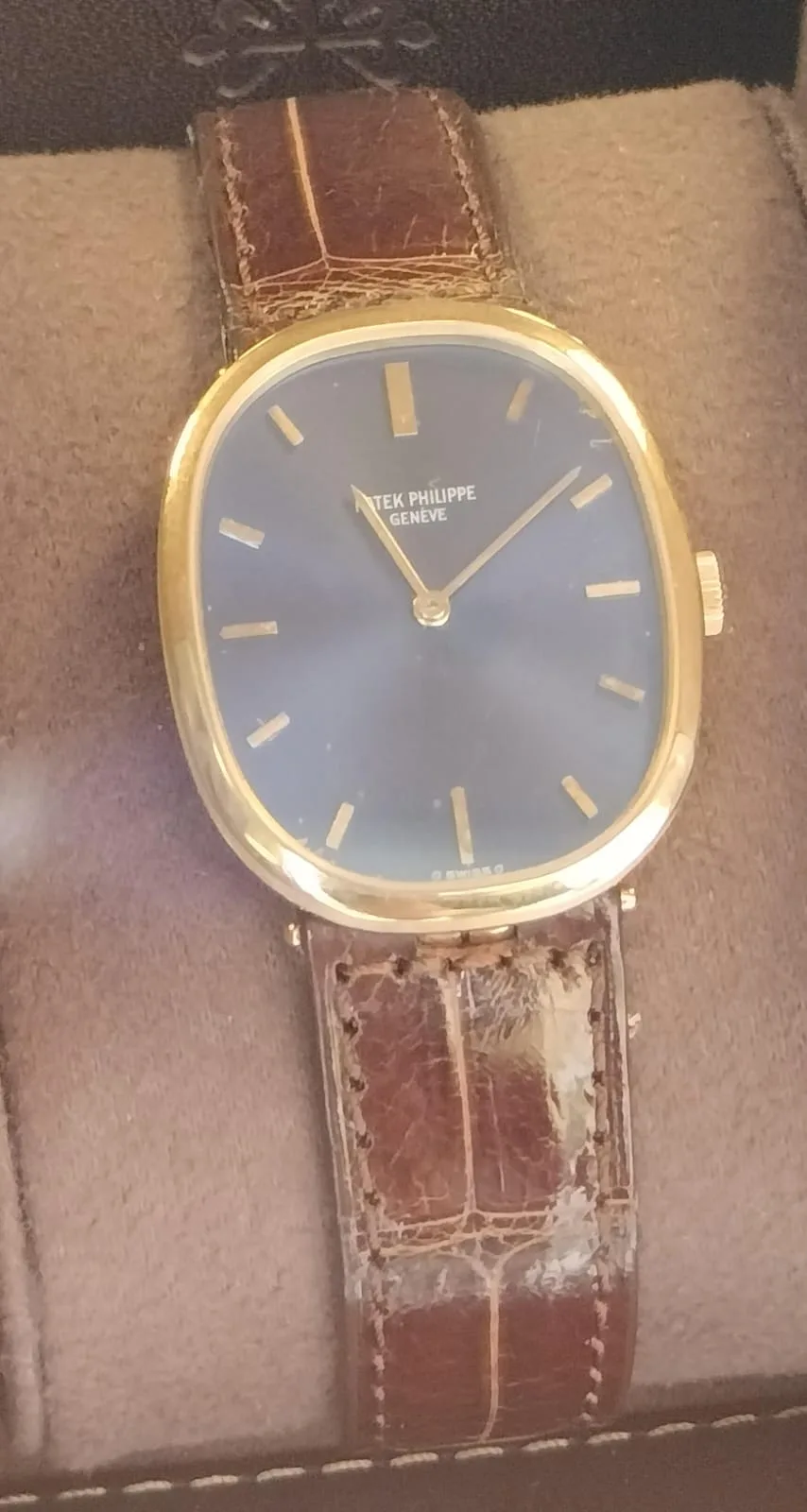
The curve, before the hour
One Golden Ellipse, off the wrist, on a white ground. A gold case, a blue dial that brightens toward the hands, gold stick markers, and a gold bracelet that grows out of the case instead of stopping at a lug. The blue is the weather this model is known for, a night color living on a dial that is itself gold. The manufacture has preferred to keep the method. The oval is the meeting, method or none. From across a cloth the watch reads as a smooth stone, a pebble of gold with a blue window, and only then as a timepiece. A round watch of this polish would have given you a coin. This one gives you a longer breath, the golden section at the size of a cuff.
The bracelet is the kindness and the risk of the lesson. It continues the gold until the case and the band are one river, so the ellipse does not end. You can still find the case, because the dial is the window and the rim is wider than any link. The markers are applied, a small architecture on the blue, and they furnish the oval without breaking it. Nothing in the still is a wrist. The picture is already the icon: a curve, a blue, a gold that does not know where to stop.
The blue is a surface and the oval is a polished edge, so the care is ordinary and worth one saying. A soft dry cloth for the case. The dial is behind a crystal; the blue is not a thing you rub. Store the watch so the flank is not asked to share a box with a bracelet that can cross it. The flank is the proportion. A scratch there is a line the golden section did not draw.
The scale is a cuff’s scale and still a jewel’s. You could follow the rim with a fingertip and never leave the object, short side to long side, and feel that the two lengths are in a fixed argument with each other. That argument is the reading. Not the hands. Not the strap. The curve.
A larger ellipse, stepped
Reference 3634 spends the same curve at a larger size. Eighteen-karat gold, an automatic Ellipse, the photograph’s own note placing it about 1981. A stepped bezel, a blue that brightens toward the middle, dauphine hands, a black strap, the crown a small pull at the right. The first watch let the outline be one smooth breath carried on by a bracelet. This one lets the gold take a step, a terrace around the dial, and then lets a black strap stop the metal, so the ellipse has an edge you can see as architecture and not only as a silhouette. You would still name it from the curve, before you asked which year had signed the movement.
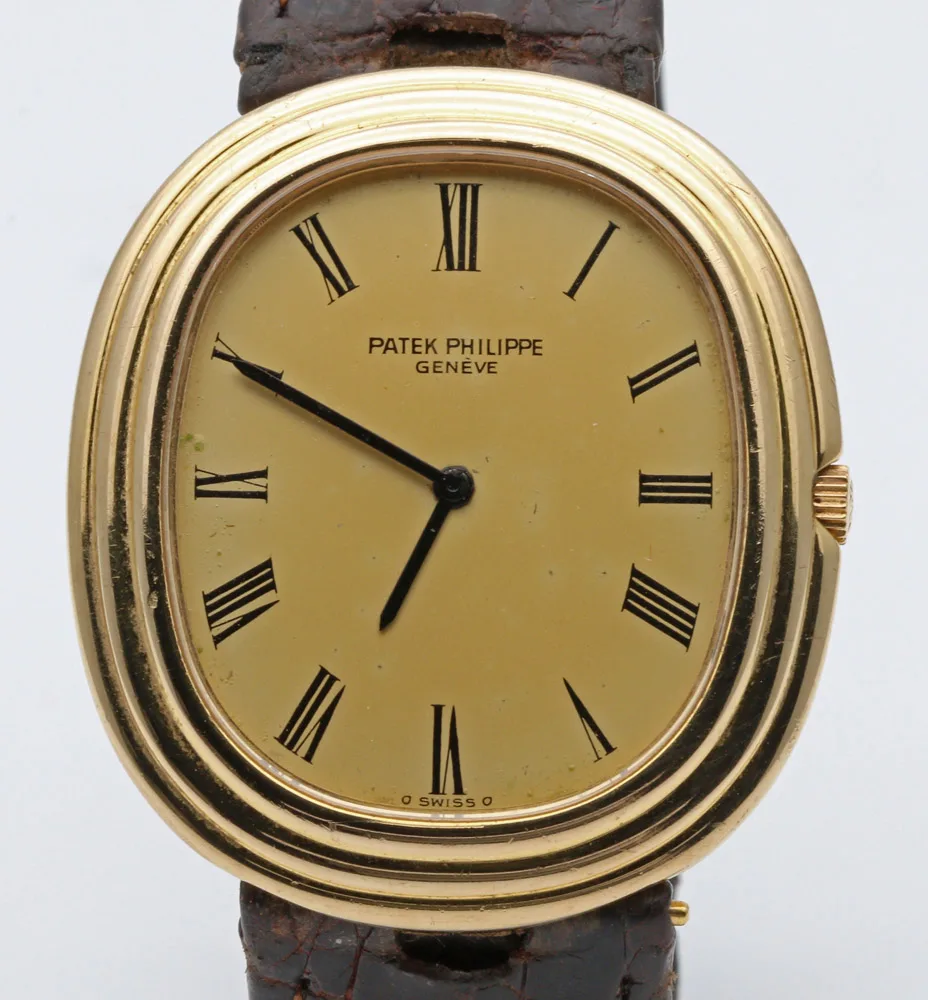
It is a different watch from the white-ground Ellipse. The ground is dark. The bezel has a step the other did not show. The blue is a sunburst, kin to the first dial’s brightening center, here on a darker ground and inside a stepped rim. Two ellipses, and neither is a second angle of the other. The form traveled from a smooth pebble to a stepped oval, and the proportion came along. The file notes thirty-six jewels in the automatic, which is a movement’s sentence and not the icon’s. The icon remains the case. An automatic can hide inside a circle just as easily. What it cannot do is turn a circle into this outline.
Leather and gold and a stepped edge want different mercies, and this Ellipse asks for all of them at once. A dry cloth on the gold. The leather kept away from a cloth that sits wet. Lift it by the case, not by the bars that hold the strap. Those bars are a fastening, and fastenings of this age are not a handle. Store it alone, the crown clear of any other flank, so the morning does not begin with a scratch across the step.
The larger size does not retire the ratio. A bigger ellipse is still an ellipse if the long side and the short side are keeping their old agreement. You can see the agreement even when a step has been cut into the rim. The step is a terrace on a shape. It is not a new shape. That is the test, and this watch passes it before you have read the reference.
When the gold is worked
A Rare Handcrafts Golden Ellipse keeps the test after the plain gold has had its say. The bezel is engraved, scrolls and geometry in the gold, a bracelet continuing the case, the dial still an ellipse with gold markers on blue. The first watch let the proportion stand with a plain rim and a bracelet. Reference 3634 let a step complicate the rim and a black strap end it. This one lets a hand work the bezel and still end where the others ended, in a curve you can name from across a room. The engraving is the weather. The ellipse is the climate. Cover the scrolls in your mind and the outline remains, which is how you know the scrolls are a dress on a shape and not a different watch.
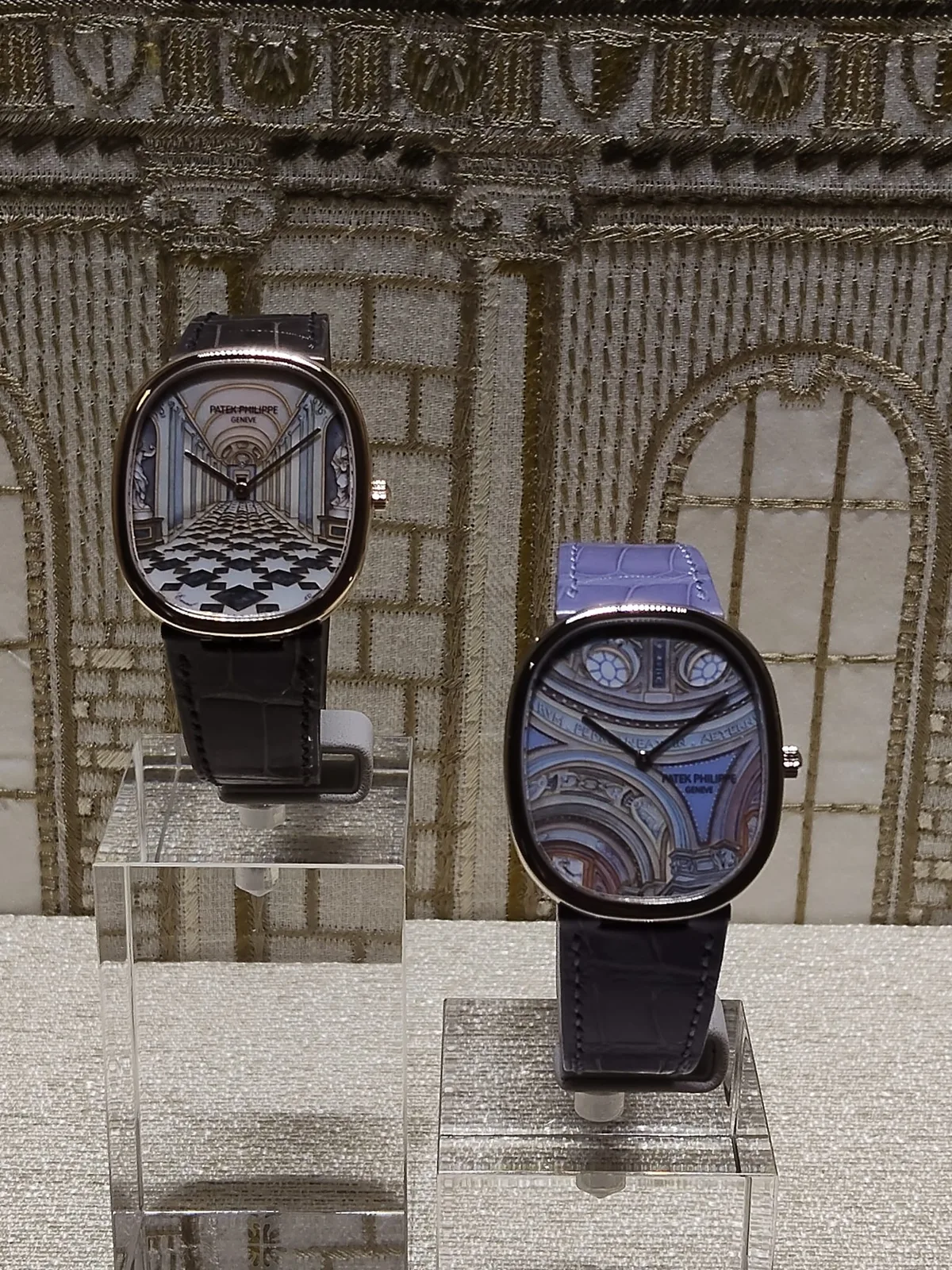
The white-ground Ellipse was a pebble on a bracelet. The 3634 was a terrace with a strap. This one is a written bezel: the gold has been engraved, and the engraving follows the curve instead of breaking it. Nothing in the still is a wearer. The picture is complete as an object, bracelet included, the links agreeing to carry an oval the way a strap agreed to stop at one. You would know it from the engraving and from the outline, in that order or the other, and still as one sentence. The hour can sit in the middle. The hour is a guest of the proportion.
Care follows the engraving, which is the height. A buff that wants a mirror will take the scrolls down toward a smoother gold, and a smoother gold with a memory of pattern is a different object. A soft dry cloth, along the curve, not across the engraving as if the pattern were a film to remove. The bracelet links want not to grind the engraved flank in a drawer. One watch, one soft place. The proportion was the point in 1968. It is still the point when the gold has been written on.
Three curves, one ratio. The plain Ellipse lets the golden section be a blue window in a smooth gold rim. Reference 3634 lets the same idea take a step and a sunburst, a larger oval, an automatic inside a shape that did not need a rotor to be itself. The Rare Handcrafts piece lets the gold be engraved and still read, first, as an ellipse. A Calatrava can still be the circle. A Gondolo can still be the rectangle that learned to bow. On a Golden Ellipse, you start with the proportion, and the hour agrees to sit inside it.
That is the icon. Golden Ellipse, a proportion on the cuff. The curve is the jewel. The blue is what the curve was willing to hold.
Educational only · Not jewelry, insurance, or legal advice