Demantoid as a green fire
Demantoid is this season’s green fire. An emerald keeps a deep green pane, one window you look through. A peridot keeps a lime light, clear and acid. A tsavorite keeps a saturated green, a field of color that sits. Tourmaline can be a saturated green as well, and chrysoprase a cool one, and jade a skin. Demantoid arrives already broken into sparks. The stones are small. The green is bright. The fire is what this garnet is willing to show, a scatter a single pane does not make.
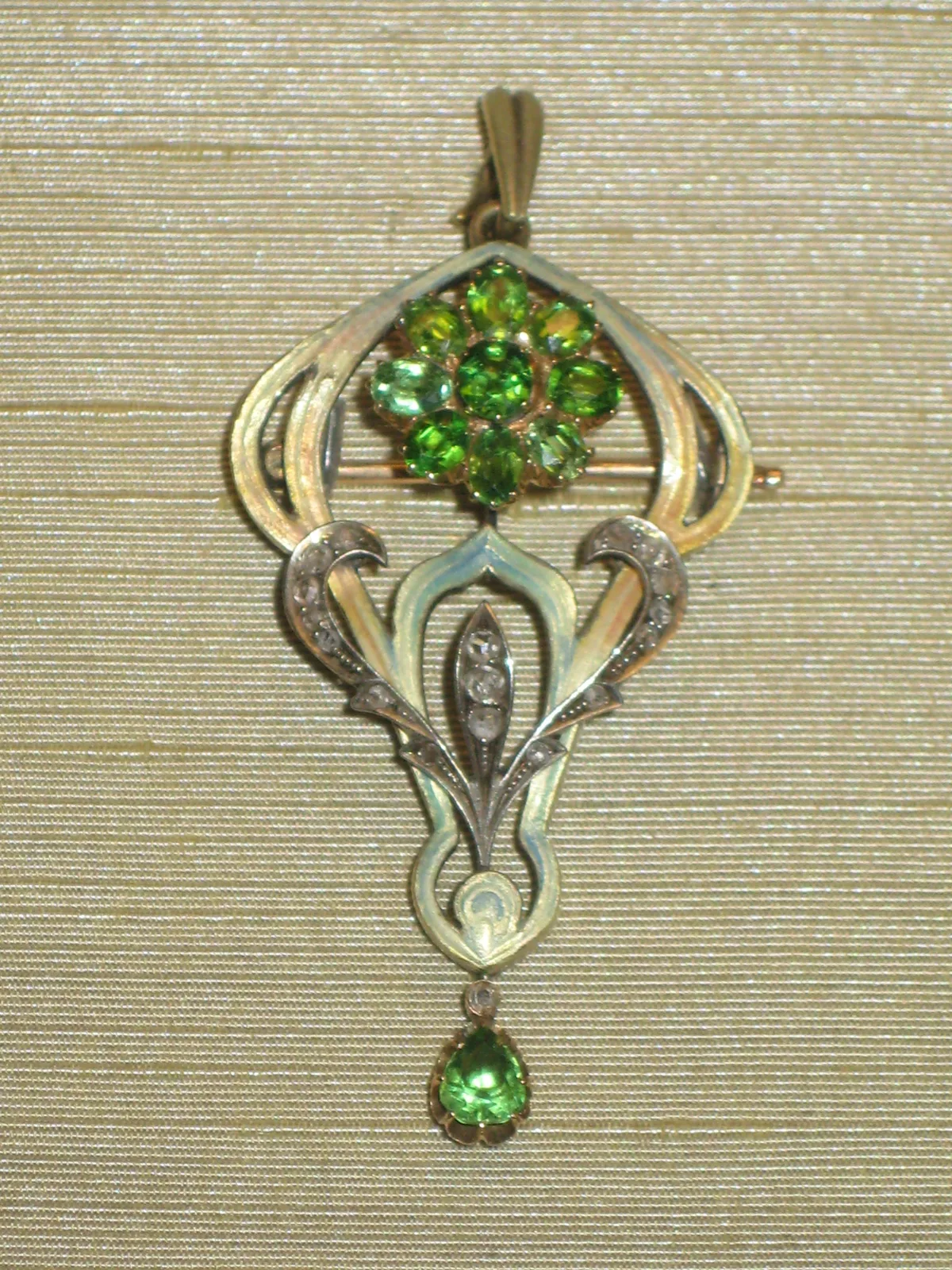
A bird made of sparks
A Moscow brooch-pendant, 1899 to 1908, keeps the season as a swan. The master signed with the monogram МВ. Demantoids and diamonds, gold, the Kirichenko collection, photographed as a catalog object. The neck is a smooth curve of gold. The body and the wings are a pavement of small green stones. Diamonds edge the wing. A pearl hangs under the tail. The green does not occupy a single seat. It is the plumage, each demantoid a point of fire rather than a pane you could read a room through.
A solitaire would have asked this green to be one face, a stone with a table and a name. Here the stones keep the habit of feathers. They overlap. They follow the wing. A diamond among them is a colder spark, and the demantoid is the warmer one, green and already moving. You meet the scatter before you meet a setting story. The gold is the drawing of the bird. The fire is the green that fills it.
Cover the head and the jewel is still a body of lights. That is the scale. This season’s demantoid often arrives the same way when a jeweler trusts a small stone to be bright enough, and then trusts another, until the color is a creature rather than a window. The turn of the century simply said it at full size: a swan whose light is many, and whose many never settled into one calm pane.
A cross, and a white center
A Tillander brooch spends the same appetite as a cross. Russia, the late nineteenth into the early twentieth century, the firm of A. Tillander. Demantoids, a brilliant, and diamonds, again the Kirichenko collection, again off any cloth. Four arms, a white fire at the crossing, green stones marching out toward the ends. The center can be cold. The greens take the arms, a geometry of small lights around a stone that does not try to be green at all.
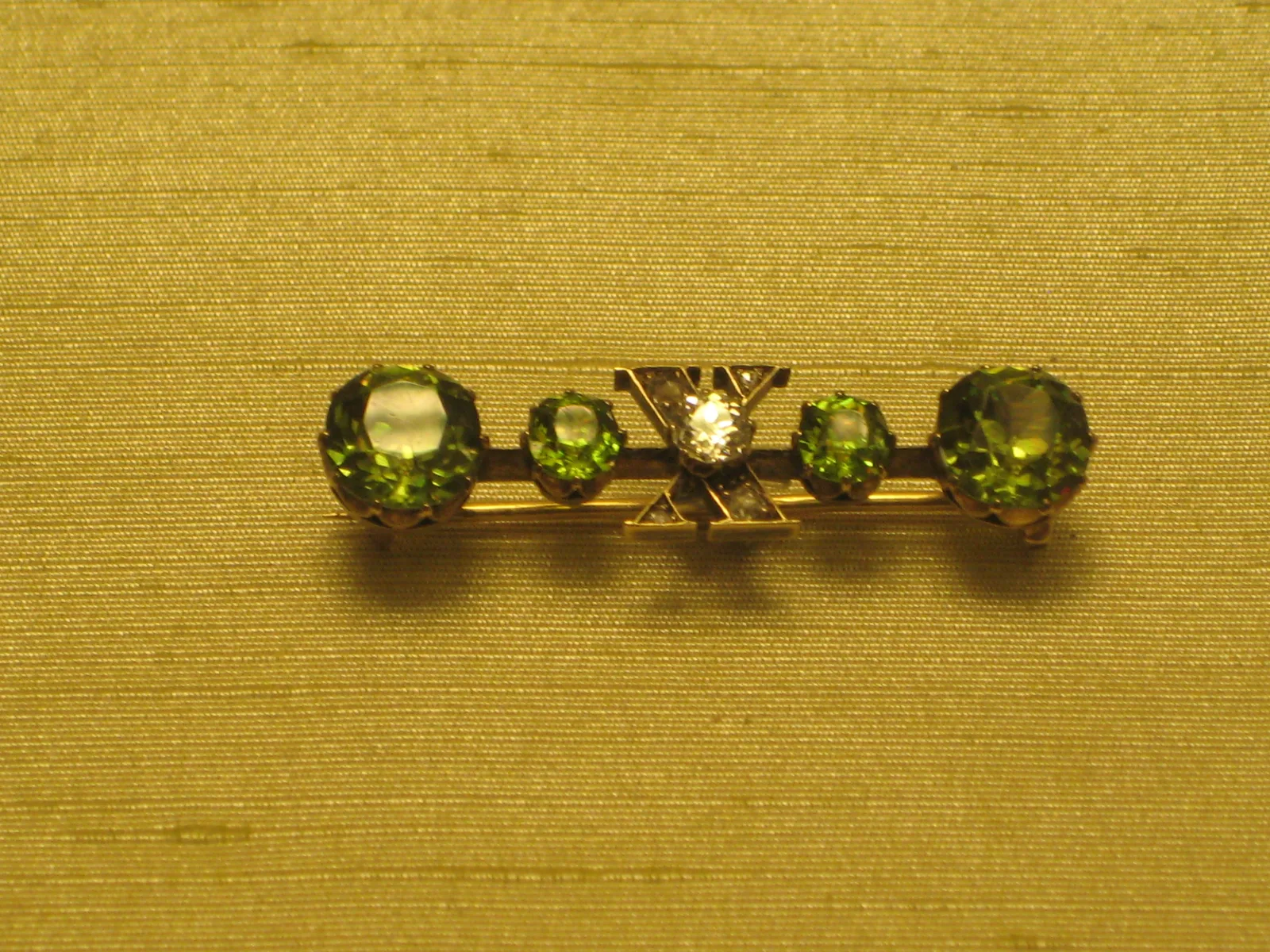
The pleasure is the disagreement. The brilliant holds a white heat. The demantoids answer in green, and they answer with fire of their own, so the brooch never becomes a halo of quiet melee around a louder center. Melee would have disappeared into the metal. A halo would have circled in order to enlarge the middle. These greens stay visible as greens. They are the color, arranged as a cross. The center is the guest.
Two brooches, one habit. The monogrammist gives the fire a body and lets it be a swan. Tillander gives it four arms and lets it be a cross. Turn from one catalog ground to the other and the stones are still small, still bright, still a scatter rather than a single pane. A deep green window is another jewel, calm and large. This is a company of sparks, each stone hot enough to be seen alone, willing to add up to a bird or to a cross.
A branch, the bow beneath
A pendant in Yekaterinburg, Moscow work of 1908 to 1917, the master with the monogram ИГ, draws the sparks into a branch. Demantoids and gold. The Museum of the History of Stone-Cutting and Jewelry Art keeps it as a catalog object, from the Kremlin’s gathering of Russian stone carvers. Leaves climb a stem. A bow sits at the foot. The drawing is botanical. The stones are the fire along it, a green that follows a vein instead of filling a frame.
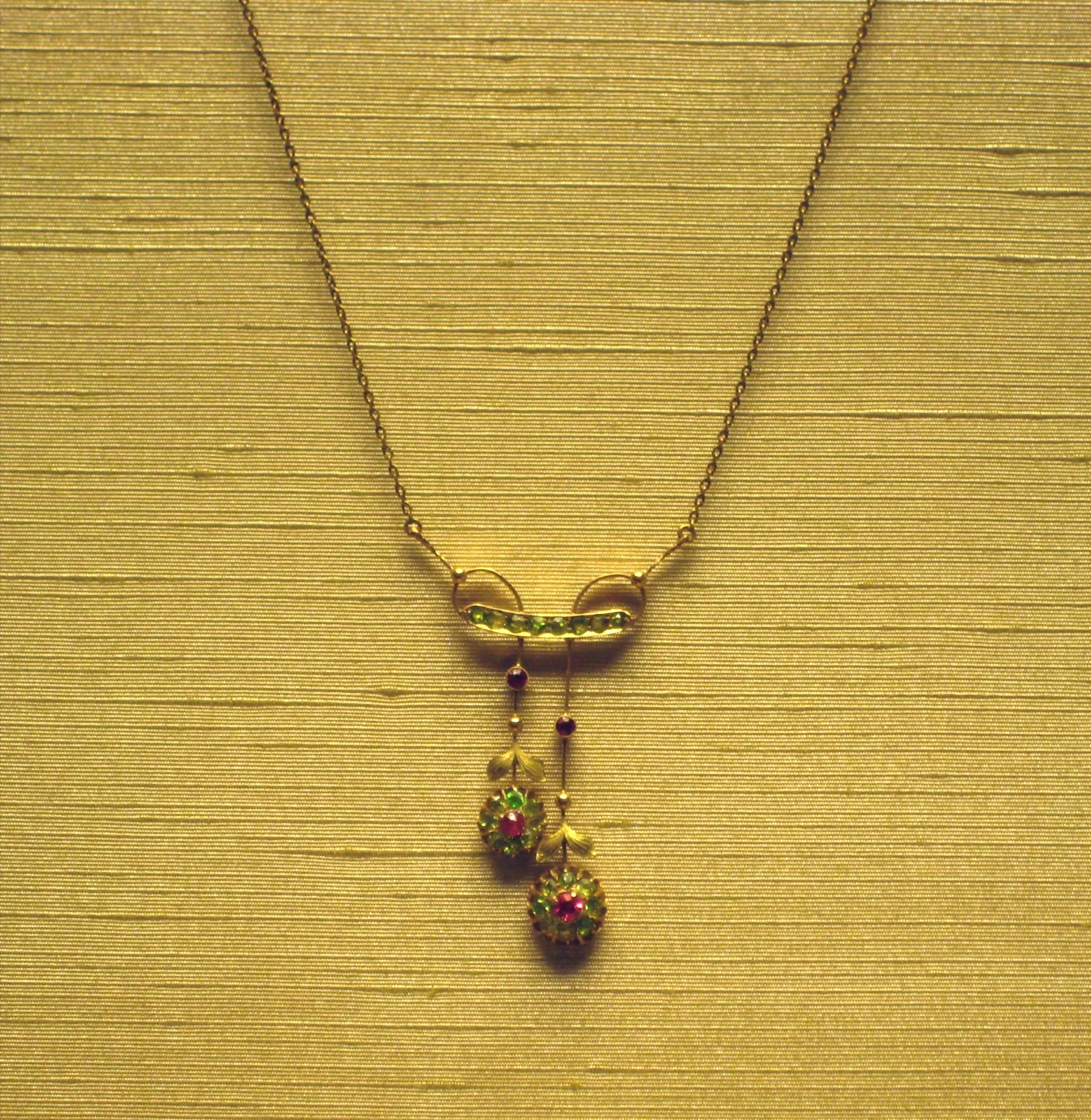
A carved emerald branch would have been one body, the color continuous, the shape taken from a single crystal. This branch is assembled. Each demantoid is its own small face, set where a leaf would catch the light, so the pendant flickers when it moves. The gold between the stones is the stem and the bow, the quiet drawing. You would feel the points before you felt the outline. The outline becomes a branch only after the fires have introduced themselves.
The years can be those last seasons of the old Moscow workshops. The habit is the one the swan already knew. Find a green that can be small and still be bright, and draw the plant it was already becoming. The branch does not need a large stone at its heart. It needs to be on fire, and to be left as many fires, with a bow to tie them.
The same green, the bow above
A Moskvin pendant, the same years, the same museum, spends the branch again with another hand. The workshop of A. Moskvin, Moscow, 1908 to 1917. Demantoids and gold. The family is immediate. A spray, a bow, a green that stayed a scatter. Here the bow sits at the top, and the leaves fall from it. The workshop changed. The fire did not. The grammar of the jewel did: a crown of ribbon, then the green descending.
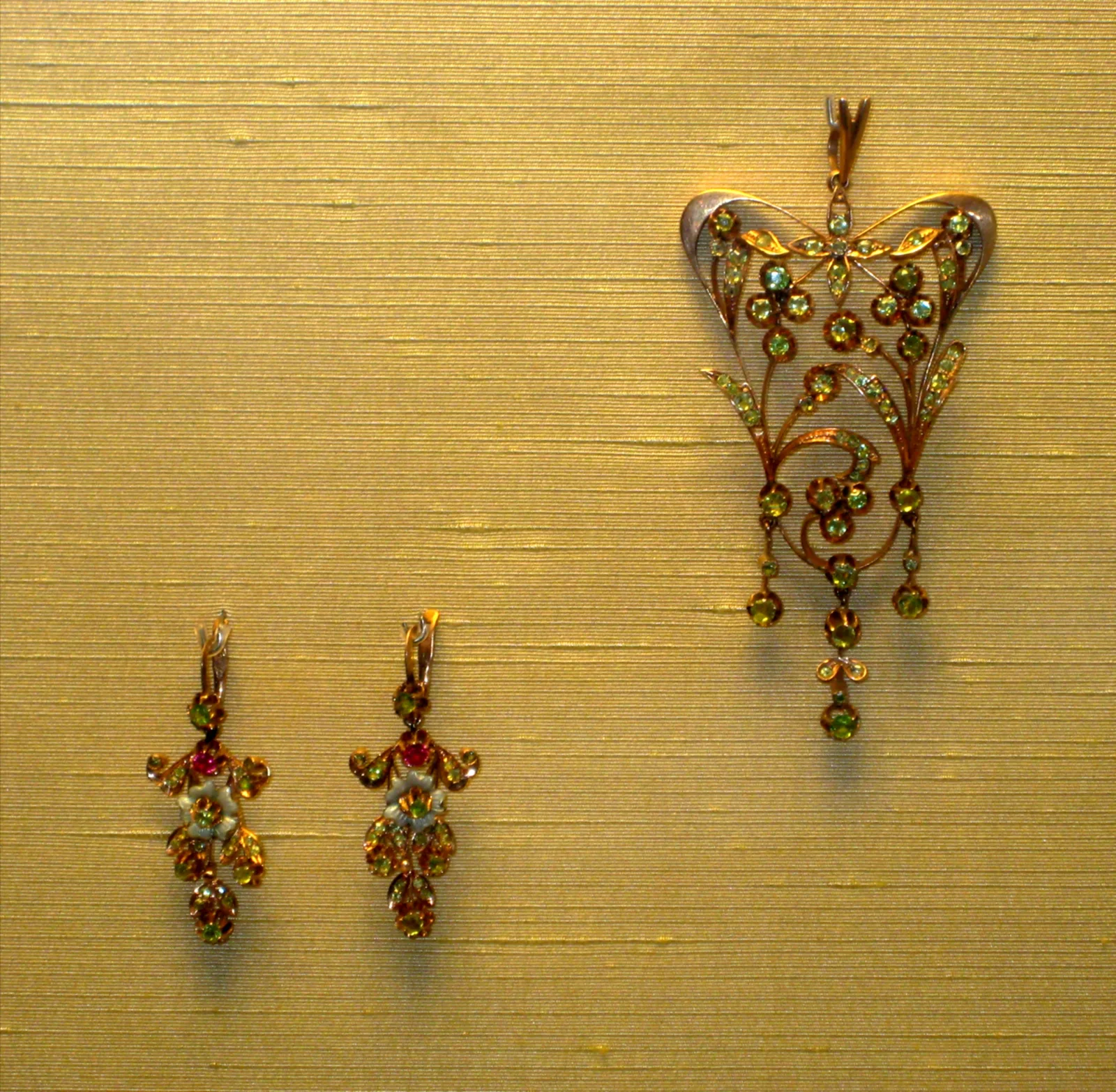
Hold the two pendants in the mind and the branches do not copy each other. One ties the bow underneath and lets the leaves rise. One ties it overhead and lets them fall. The gold can be as fine as a stem. The stones stay blunt and bright, which is their manners. This season’s demantoid often arrives in exactly that role: a finish that flickers, under a drawing that was willing to be precise. Precision in the gold, fire in the green, and the fire is the part that moves when the pendant is lifted.
Four jewels, one scatter. The swan gives the green a body and a pearl beneath the tail. The cross gives it four arms and a white center to answer. The ИГ pendant gives it a branch with the bow at the foot. Moskvin gives it a branch with the bow at the crown, and lets the two disagree. An emerald can still be worn as a pane, deep and single. A peridot can still be a lime. A tsavorite can still be a saturated field. This season’s green is the garnet that arrives already in sparks.
That is the sit. Demantoid as a green fire. A swan whose plumage is the stone. A cross of small lights. Two branches that never became a window.
Educational only · Not jewelry, insurance, or legal advice