Cognac diamond as a warm brown fire
The months have kept a brown in the room, and the brown that answers them can still throw a fire. Cognac diamond is that brown: amber through the table, a deeper chocolate where the color thickens, and a brilliance that belongs to diamond and not to a softer stone. Smoky quartz keeps a brown and spends it as a smoke you look through, the quartz quiet. Amber keeps a honey, and the honey is resin, a body of light with no pavilion under it. Citrine keeps a gold of quartz. Yellow sapphire keeps a golden pane of corundum. Imperial topaz keeps a peach the crystal grew. Hessonite keeps a cinnamon in the garnet. Cognac diamond holds a warm brown and then lets the brown spark. The fire is the jewel.
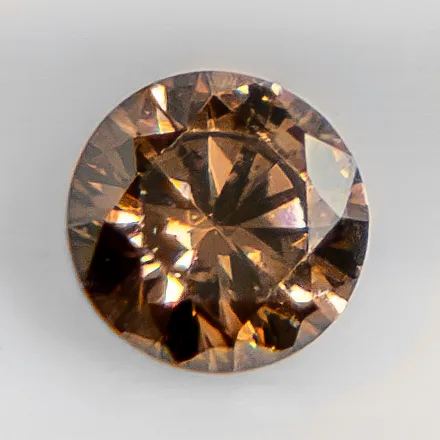
A small window of the amber
One round brilliant sits on a white ground and spends the color as a single window. The hue arrives before any story about a mine. Amber through the table, a little honey where the facets turn, the whole stone warm enough that the white only makes the fire clearer. A smoke of this outline would have been quartz, a brown that softens as you look. A resin of this outline would have glowed as a body, with no mirror under the color. This round is diamond asked to be worn as amber: transparent, the pavilion returning one warmth and a scatter of light, the table a small room the color can stand in.
Daylight is enough. A darker cloth this season does not have to argue with it. It gives the amber a chair. You would pick the stone out of a tray by the warmth and then by the flash, the brown never leaving when the fire arrives. That is the manners of this gem when the months want a metal-colored brown that is still a diamond: one hue, clear, willing to spark. The size is not the argument. The argument is that the pane is diamond, hard, and brown all the way through the window.
A facet here is only a wall the amber can stand against, so the color reads as a body and not as a flash that leaves. Take the name away and the round would still say the same thing. The brown is structural. It was not painted on the back. It was not a foil doing the work of a hue. The crystal grew a warm color, and the cut opened it. You are looking at a fire that has agreed to be brown.
The same weather, twice
Two smaller rounds, side by side on the same white, spend the amber as a pair. Each one is its own stone. Neither is a second angle of the first. The color is the first meeting, and the meeting happens twice, so the brown is no longer a single window. It is a weather you could set next to itself and still recognize. A lighter edge on one, a slightly deeper honey on the other, and the fire in both. The white ground does the work it did for the single round. It gives the amber nothing to compete with except itself.
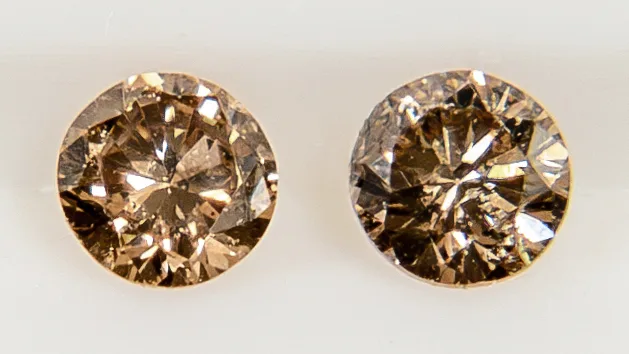
Set the single beside this pair and you are still in one gem. The loose round spent the brown as a window. The pair spends it as a conversation the color can have with itself: amber against amber, each stone not asked to contrast with its neighbor. A citrine in this chair would have been quartz’s honey, softer in the wearing, the fire a quieter guest. A yellow sapphire would have been corundum’s gold, a pane without this scatter. A smoky quartz would have gone duskier and lost the spark. These two stay a straight cognac, and the brilliance is the grammar they share. You would know the stones from across a cloth by the way the brown seems to continue from one into the other, and by the light that will not sit still.
The scale stays a jewel’s ordinary scale. Two rounds, a white ground, no mount, no hand. Nothing in the still is a finger. The pair is the color as a fact you could fasten later, and the fastening is not required for the hue to be whole. A cooler stone beside them would have made the amber look borrowed. Here each diamond keeps the same temperature as the other, which is why a fall palette can use the pair without translating it. The warmth does not wait for a setting. It is already the color of the thing.
A deeper brown, and the fire still
A darker pair spends the same idea at the other end of the brown. Two rounds, chocolate where the first was amber, the white ground again the chair. The color has thickened. It has not gone opaque, and it has not gone out. You still read a diamond. The facets still throw. What changed is the temperature of the body: less honey, more a brown you could almost call a night, and the night still sparkling. That is the range the season has room for. A cognac can be a light in the window or a darker wood, and both of them are diamond.
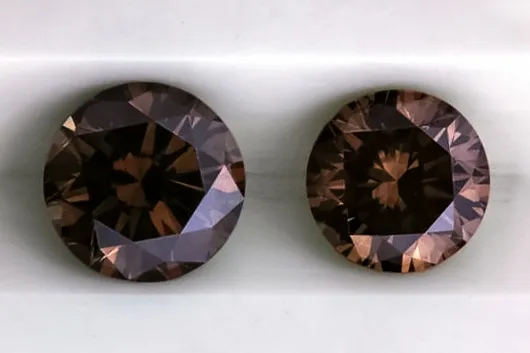
The single round let the amber be a jewel at the smallest scale, one window. The lighter pair let the same color meet itself and agree. This darker pair lets the brown go deep without handing the fire away. A garnet of this hue would have been a cinnamon, the flashes fewer, the body softer. A resin of this hue would have been amber the fossil, warm and quiet, no pavilion to return the light. A topaz of this appetite would have gone toward peach. These two stay diamond. The darkness is only more of the color. You would still pick them out of a tray by the spark inside the brown, before you asked which amber had been set aside.
Three stills, one fire. The round lets cognac diamond be a window, amber through the table, the brilliance already in the pane. The lighter pair lets that window happen twice, the color agreeing with itself. The darker pair lets the brown thicken into chocolate and keeps the spark. A smoke can still be smoky quartz. A honey of resin can still be amber. A gold of quartz can still be citrine. A golden pane can still be yellow sapphire. A peach can still be imperial topaz. A cinnamon can still be hessonite. This season’s brown is the one that stays a diamond: warm, clear, and willing to throw a fire.
That is the sit. Cognac diamond as a warm brown fire. A round, a lighter pair, a darker pair — the amber, worn when the months want a brown that still sparks.
Educational only · Not jewelry, insurance, or legal advice