Cloisonné is wire and enamel
Cloisonné is wire and enamel. A thin strip of metal, usually gold, is bent into a wall and fixed to a ground, and the little room it makes is filled with enamel and fired. The wire is the cloison, the cell. The color is what the cell holds. Champlevé digs the room out of the metal, a trough cut or cast in the ground, and fills that. Painted enamel lays color on an open skin, a picture with no wall around each passage. Filigree draws a lace in wire and leaves the air in it. Granulation covers a surface with spheres. Cloisonné builds a room, then glazes it. The literacy is the wall.
A figure drawn as rooms
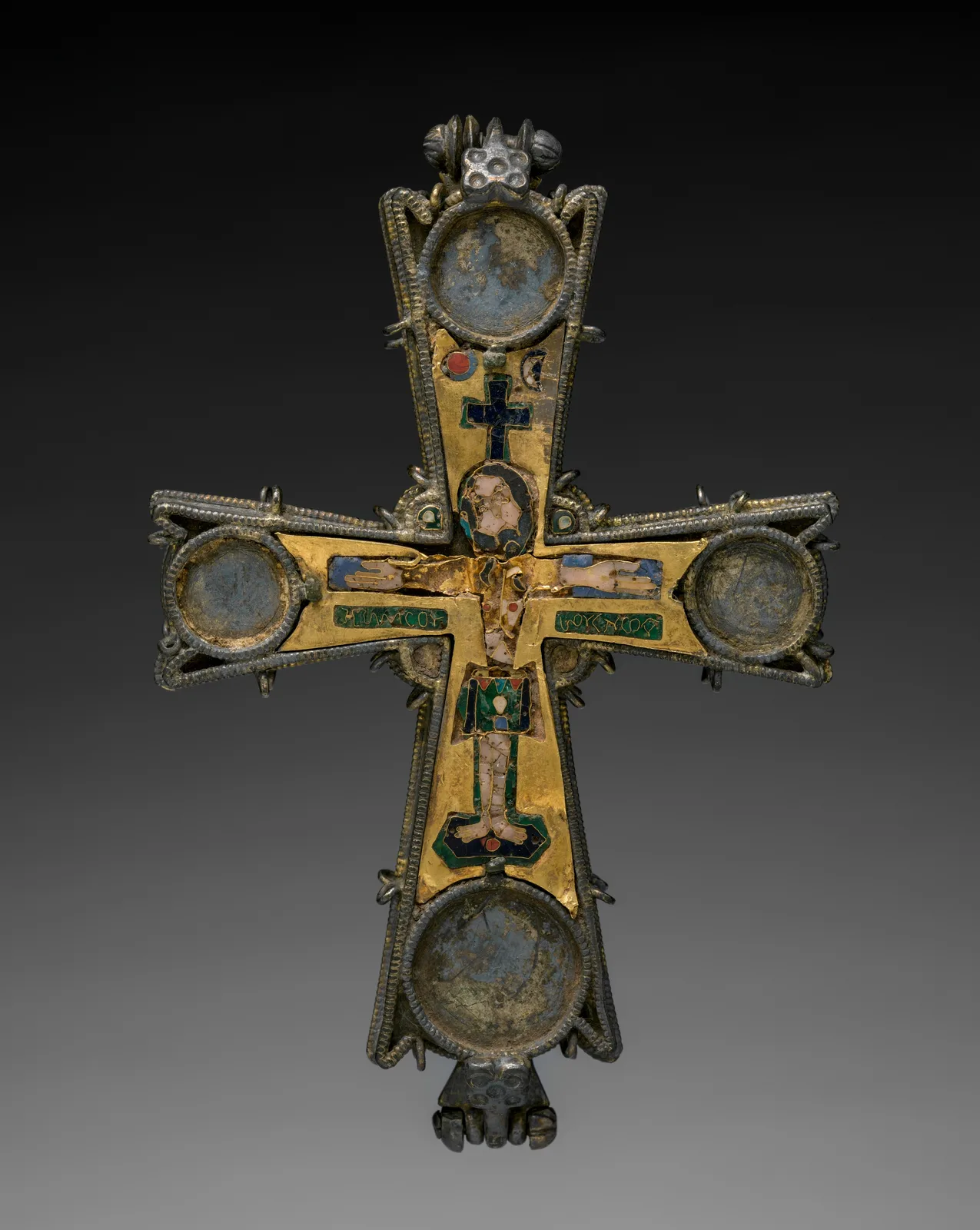
A pectoral cross from Constantinople, tenth century, keeps the cell at the size of a jewel you would wear. Gold, gilt silver, and cloisonné enamel, the Cleveland Museum of Art, 1948.20. Christ on the cross, Mary and John beside him, each face and robe a cluster of tiny rooms. The wires are the drawing. Where a painter would have used a line of pigment, the goldsmith used a wall, and the enamel — blue, green, red, white — sits up to that wall and stops.
You can see the method without a label. Follow one sleeve. The color changes when the wire says it may. A trough cut into the gold would have given the same compartments, but the wall would have been the ground itself, dug out, and the edge would read as a cut. Here the edge reads as a wire that was added, fine, a little raised, a line you could imagine lifting. That is the difference the eye is being asked to learn. The picture is real. The picture is also a floor plan.
The chain belongs to the cross, and the cross belongs to the chest. The care belongs to the cells. Enamel of this age is glass fused in a small room. A knock at the corner can take a chip out of a room and leave the wire standing over a hollow. A buff that wants the gold brighter asks the wire to lose the height that separates one color from the next. A soft cloth, and the piece left out of a soak, keeps the rooms full. The drawing stays a drawing when the walls stay proud of the color.
A picture the wire is holding
An enkolpion from Constantinople, about 1080 to 1120, spends the same wall on a single scene. Silver gilt and cloisonné enamel, again Cleveland, 1972.94, the front with the Crucifixion. The wires are closer here, a denser plan, the figures held in cells so small the color reads as a miniature until you come near and the gold lines reappear. Painted enamel would have given this scene as a skin, brushwork on a ground, no wall between the blue and the body. This scene is built.
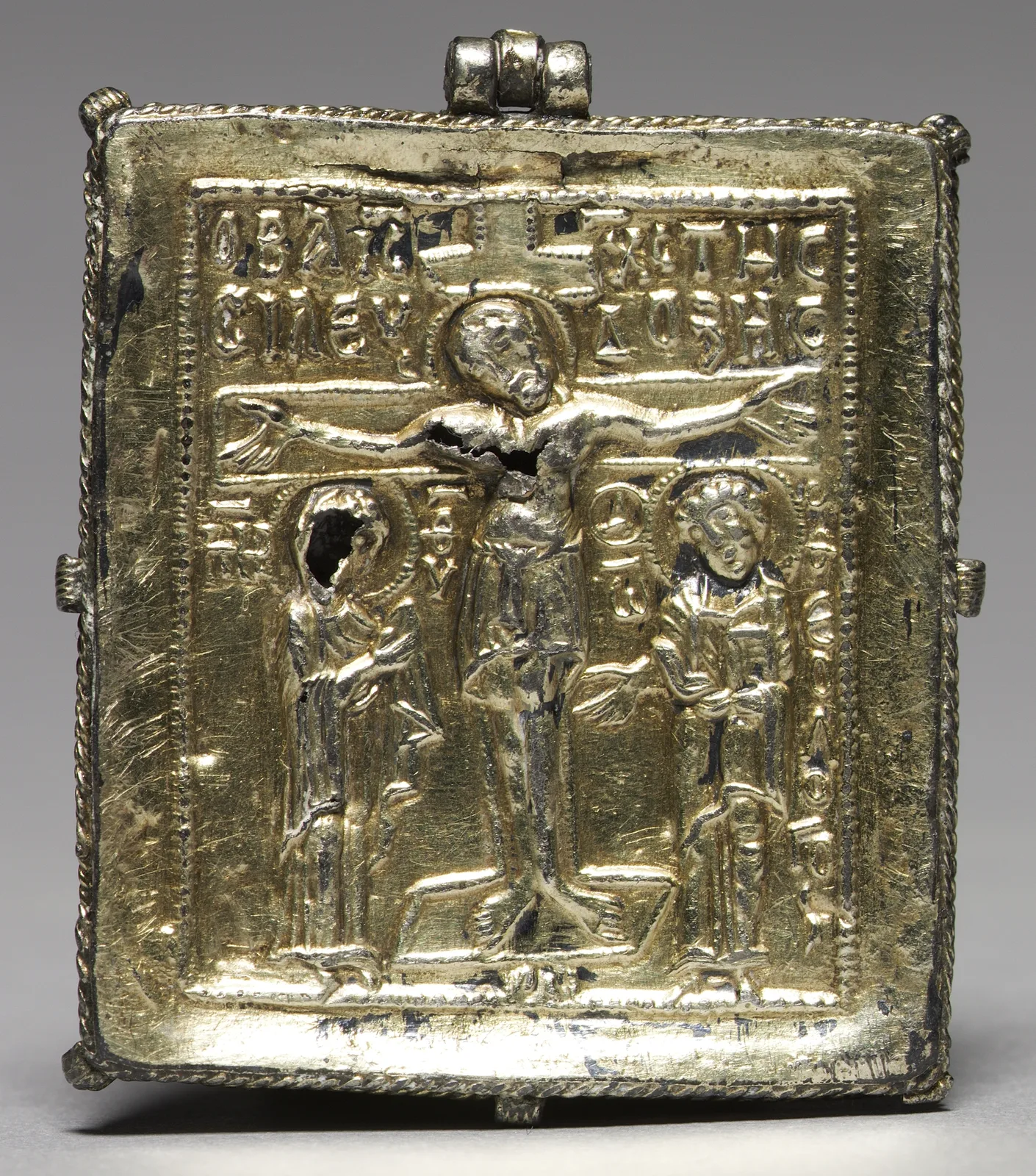
The ground around the scene is part of the literacy. Metal shows between the cells and at the rim, so you can see that the color is an inlay in a structure, not a coat over a sheet. A filigree of this fineness would have stopped at the wire, a lace with daylight through it. Here the wire has a job after it is bent: to keep each melt of enamel in its own address until the firing is done, and then to remain as the line. The picture depends on the walls. Take the walls away in the mind and the colors would run into one glaze.
The piece is a pendant, a small box of devotion, and the face you meet is already a lesson in scale. Cloisonné can be a field the size of a saucer. On a jewel it is this: rooms small enough that the wire and the color arrive together, and you need a moment to see that the line is metal. That moment is the note.
A jewel for the hair
A temple pendant from Kievan Rus’, eleventh or twelfth century, takes the cell out of the icon and into a jewel meant to hang beside the face. Cloisonné enamel and gold, the Metropolitan Museum of Art, 17.190.680, the gift of J. Pierpont Morgan. Two sirens flank a tree, the whole pendant a little architecture of wire and color, pearls at the points where a pendant wants a weight. The wires are still the walls. The enamel is still the fill. The object has simply agreed to be worn in the hair.
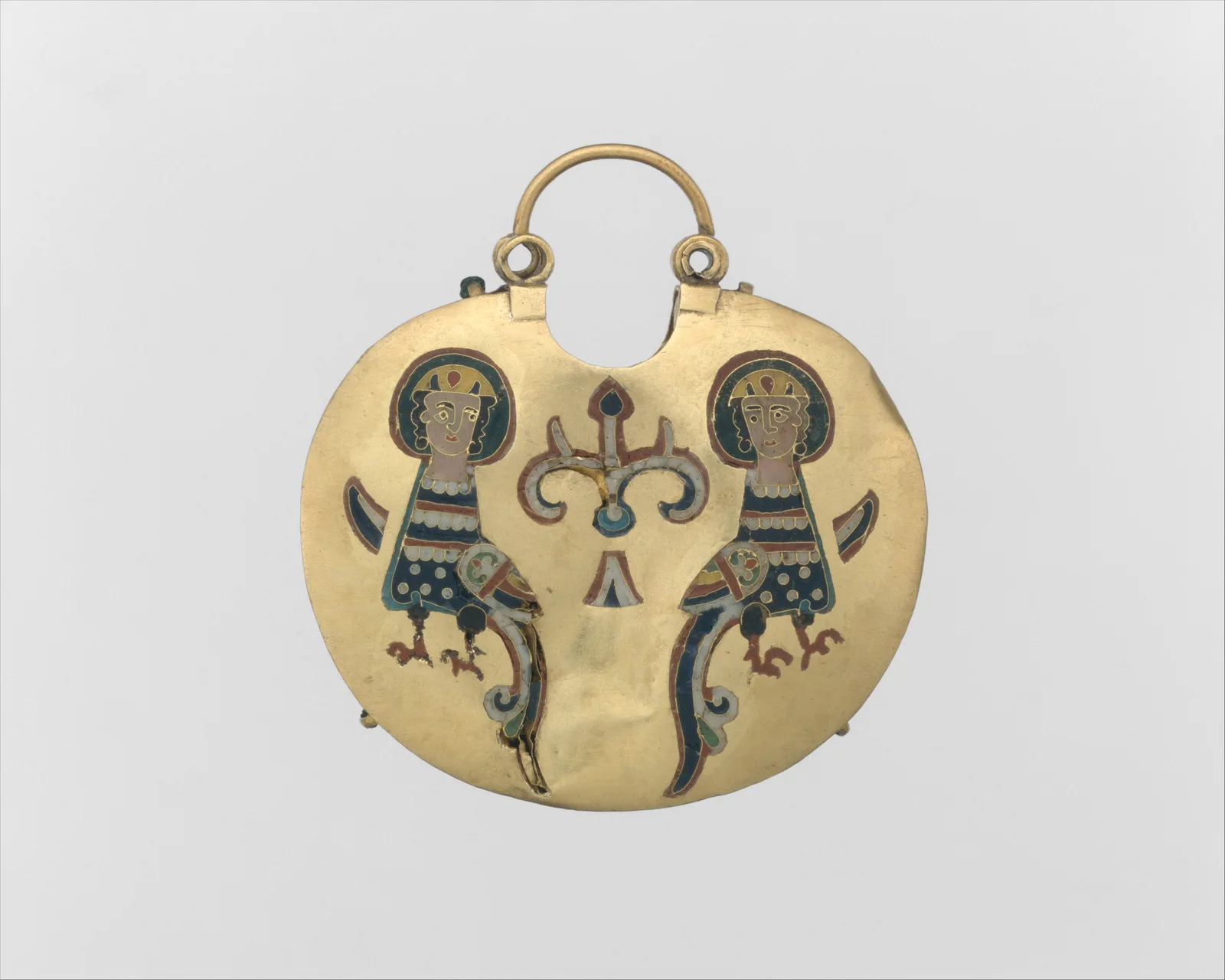
A granulation on a pendant of this appetite would have been a field of spheres, the surface a weather of balls. This surface is a set of rooms. The tree, the wings, the border: each is a plan of cells, color butted to color with a gold wire between. The pearls are a different sentence, a light outside the enamel, and they do not do the cells’ work. Inside the frame the work is the same work as the cross and the enkolpion. Wire. Fill. Fire. Then a polish that stops when the wire and the glass are one level you can read.
The care is the same at this smaller, more jeweled scale. The pearls want a gentle cloth and want to stay clear of a soak. The enamel wants its surface left alone, especially at the edge of a cell, where a chip begins. The wire wants its edge. A temple pendant is worn where hair and a collar can catch it. The cells are why it is carried in a soft place between wearings, the way any enamel jewel is, so the rooms stay full.
Three jewels, one wall. The cross lets the wire draw a figure at the size of the chest. The enkolpion lets it hold a Crucifixion in a denser plan, a miniature that is still a floor of cells. The temple pendant lets it be a jewel for the hair, sirens and a tree, pearls at the points, the rooms unchanged. A trough cut into metal remains a champlevé. A picture brushed on an open ground remains a painted skin. A lace of wire remains a filigree. A field of spheres remains a granulation. Cloisonné is the cell: a wall of wire, a fill of enamel, already a room when the color begins.
That is the note. Enamel can be a skin. Cloisonné is wire and enamel — a cross, an icon, a pendant — the color held in place by a line of metal the goldsmith bent to be a wall.
Educational only · Not jewelry, insurance, or legal advice