Chronomat, a bezel you can hold
Before a counter, a grip. The Chronomat puts four tabs on the bezel, small riders standing up from the ring, so the circle is something a hand could take hold of. A Navitimer lays a slide rule on the same house’s bezel and asks you to read it. A Daytona opens on counters. An El Primero opens on a count in three colors. A Monaco opens on a square. A Submariner opens on a ring made for a dive. The Chronomat opens on those four tabs. The hour is still told. The grip is what you remember.
Two metals, and the tabs between them
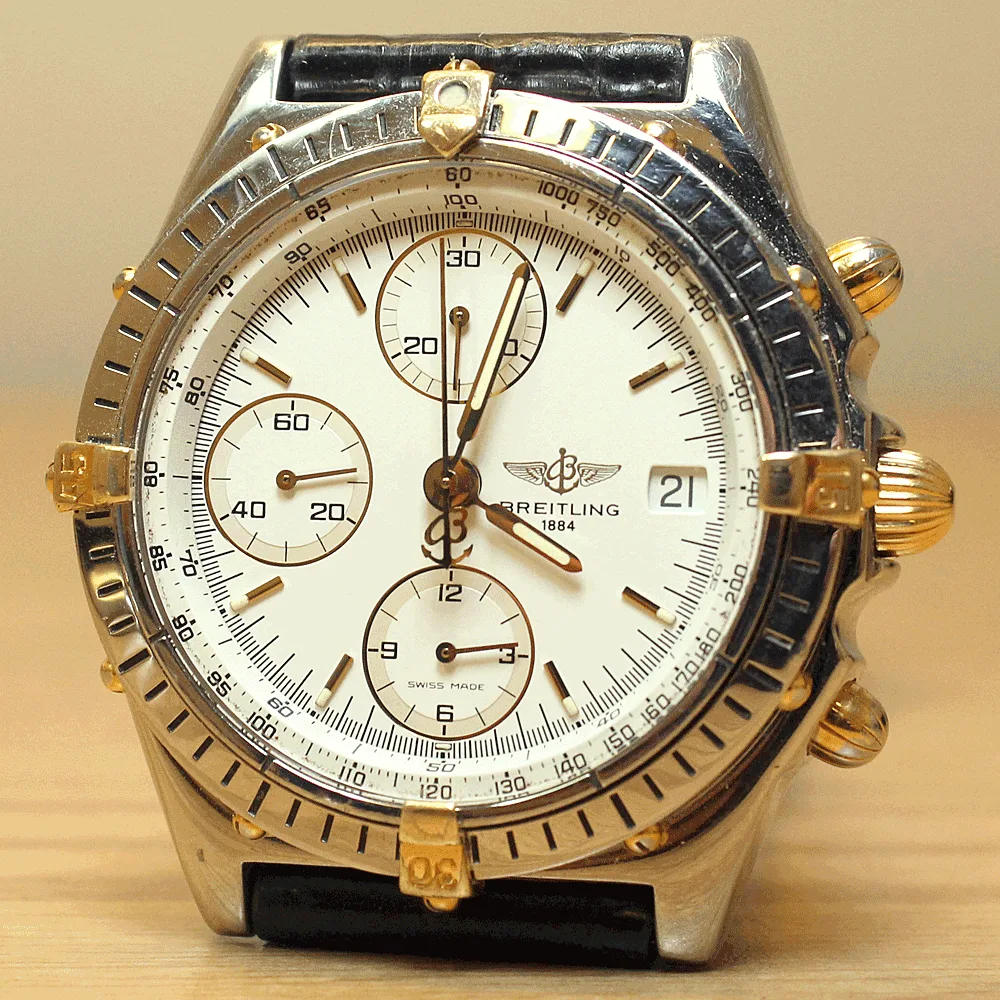
A B13050, off the wrist, on a white ground. Stainless steel and 18k gold, a white dial, a date, three counters, and the bezel carrying its four tabs like the corners of a thought. The tabs are the first meeting. Nothing in the plate is a wrist. Take the name away and the watch still says the same thing: the ring was finished so it could be held, not only so it could be read.
The two metals are the manners. Gold sits in the bezel and in the bracelet’s brighter links, steel in the case and in the rest of the line, and the tabs rise out of that agreement as the part your eye can imagine a fingertip finding. Another house might have left the bezel smooth and let the counters be the jewel. Here the counters do their work, and the jewel is the decision to interrupt the ring four times. You would name the watch from the tabs and from the way the bracelet bulges along its center, the rouleaux links a row of small rounds, before you counted a register. The case does the work of a mount. The tabs do the work of a clasp you do not close: a shape the hand understands.
The scale of that decision stays a jewel’s scale. The watch is still a round on a bracelet, still a thing arranged to be fastened, and the tabs do not turn it into a tool laid out on a bench. Off the wrist, the picture is complete. You are looking at a grip that has agreed to tell the time. The date keeps its little aperture. The hands cross a dial that has already decided the bezel is the sentence. A slide rule would have asked to be calculated. These four stands ask to be met, the way a set of corners asks to be met, and then they give you the hour.
Gold against steel is not a costume. It is the same idea in two temperatures, the tabs the place where the temperatures meet your hand. A fluted ring would have made the shine the first fact. This shine is broken, on purpose, four times. The breaks are the icon. You could cover the logo with a look and the bezel would still be a Chronomat, because the tabs are the drawing.
The same hold, on a black
A Bluebird, reference A1335018, spends the tabs on a darker face. Off the wrist, steel, a black dial, the riders still standing on the bezel, the counters still there and no longer the reason you stayed. The black is the first change. Where the two-tone was a conversation of metals, this one is a single dark field and a bright ring of grips. The hour is told. The hold is the fact.
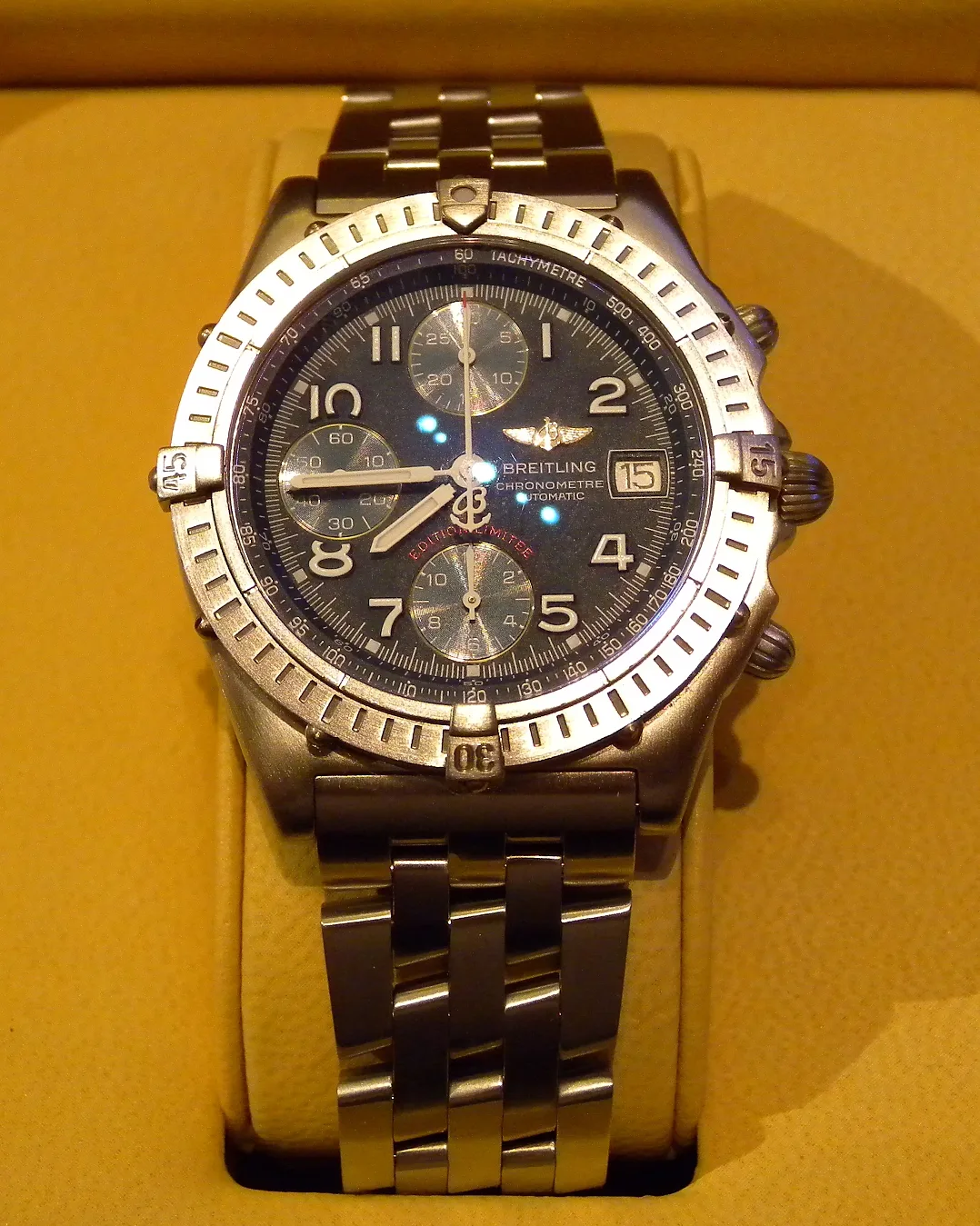
The B13050 gave the tabs a gold to rise from. The Bluebird gives them a night to stand against, so each rider reads as a small polished interruption. Two watches, and the grip is the icon’s constant. A sunburst would have made the dial a flash. A slide rule would have filled the ring with scales. This bezel is almost empty between the tabs, which is the point: the emptiness is what makes the four of them a rhythm. On a white ground, with no wrist in the picture, the watch is simply a dial you are allowed to study, and the study ends at the riders. The shape is enough. The grip is the memory the shape keeps.
Set the two-tone beside this Bluebird and you are still reading one sentence. The bezel has a hold. On one, the hold is gold and steel, a bracelet of rounds under it. On the other, the hold is steel against black, the same four places, a later quiet. Attention goes to the ring, and the ring does not send you into the counters yet. It keeps you on the tabs. A date on both, a chronograph hand on both: each is a small honesty, and neither is the reason the bezel was built this way. You stayed for the grip.
The black dial is a kindness to that lesson. A white face can be loved as a clean page, the tabs hiding in the brightness of the metals. A black face, the riders catching light at the edge, is harder to mistake. Each tab is a short wall. The bezel turns under them, or they turn with it, and the hand learns four stops. You could cover one counter with a look and still have the method left over: a ring, four grips, a dial that agreed to sit inside them.
A blue, and the tabs again
A Chronomat Yachting from the 1990s spends the same idea in another color. Off the wrist, a blue dial, the tabs still the first architecture, the registers arranged inside a ring that has not forgotten how to be held. This is not the B13050 and not the Bluebird. It is a third piece, met by the grip it keeps. The blue is the first meeting after the tabs. It is not a dive’s black and not a dress white. It is the same appetite: a bezel finished until the fingers would know it.
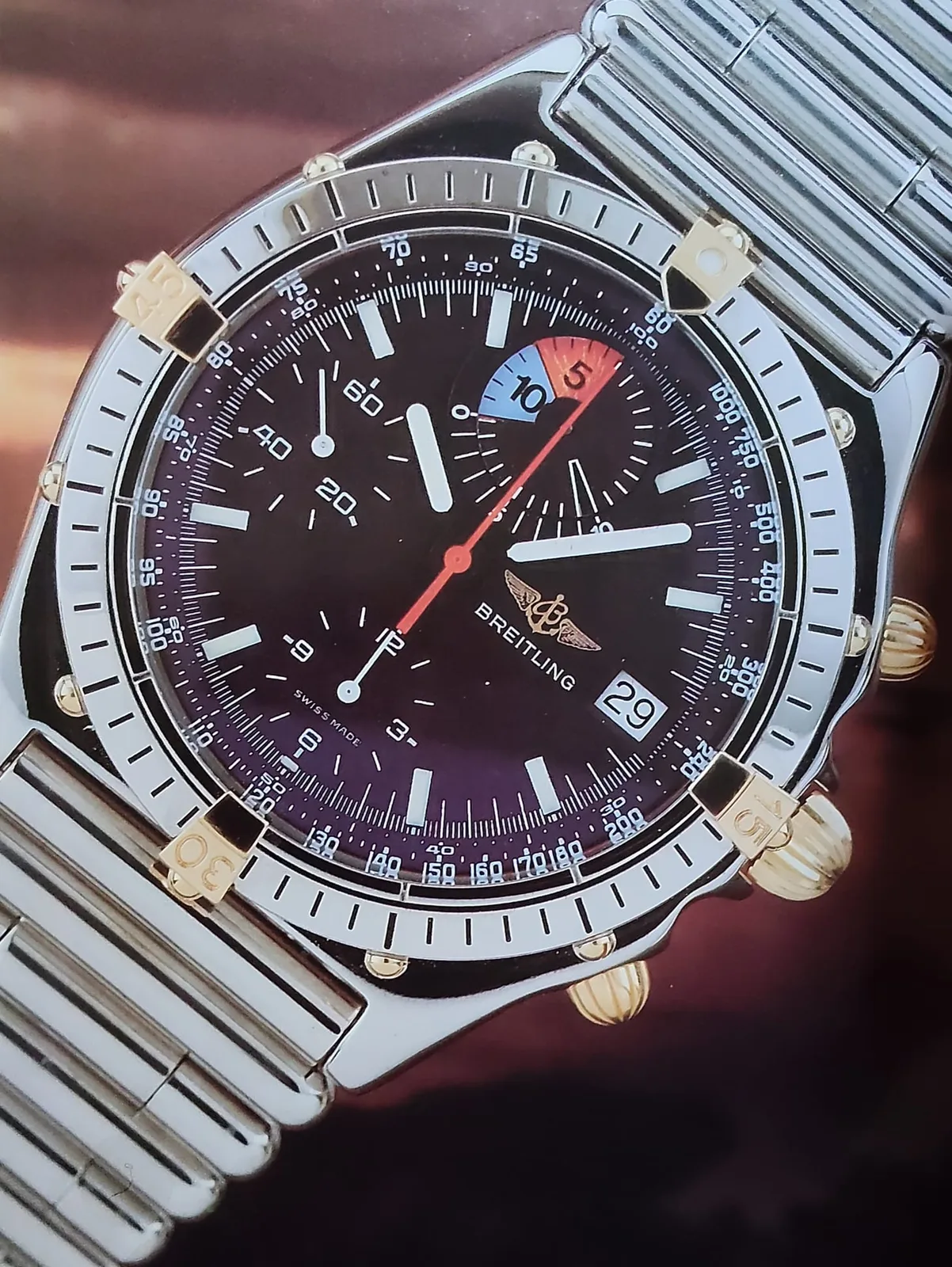
The closed metals of the two-tone let you wear the grip as a warmth. The Bluebird lets you wear it as a contrast. This one lets you wear it as a color, a blue the tabs agree to frame. A fork left open would have made a mechanism the jewel by leaving it bare. Here the mechanism stays inside, and the outside has been dressed: four riders, a polish, a bezel asked to be useful to a hand and calm to an eye. You would know the finishing before you read a scale. Nothing in the still is a wrist. The watch is simply a round you are allowed to study, and the study ends at the tabs.
That dressing is why the dials can change and the icon does not. A white can stay a white, a black can stay a black, a blue can stay a blue, because the fact did not all have to happen in the color. Some of it was saved for the ring. You meet the grip first, which is the icon’s order. Then the dial offers its weather, and the weather is free to vary. The hour was never the only thing being finished. The bezel was finished to be held.
Three stills, one grip. The B13050 lets the tabs be a two-metal fact, gold and steel, a bracelet of rounds beneath. The Bluebird lets the same four riders stand on a black and become unmistakable. The Yachting lets them frame a blue from the 1990s, a third watch, the hold unchanged. A slide rule can still fly on a Navitimer. Counters can still sit on a Daytona. Three colors can still count. A square can still race. A diving ring can still turn. On a Chronomat, you meet a bezel you can hold.
That is the icon. Chronomat, a bezel you can hold. A two-tone automatic, a Bluebird, a Yachting in blue — the tabs, already the thing you meet.
Educational only · Not jewelry, insurance, or legal advice