Chatoyancy is a moving line
Chatoyancy is a moving line. Parallel inclusions, needles or fine channels laid in one direction, throw back a single bright band, and the band travels across a cabochon as the stone turns or the light shifts. A star is a crossing of bands, more than one line meeting. Labradorite keeps a flash, a cool sheet of color that comes and goes across a feldspar. Moonstone keeps a soft light, a glow that floats. An inclusion, met as a guest, is a needle or a crystal you can find and name inside the stone. A cabochon is the dome, the curve that gives a stone a volume. Chatoyancy is what that dome can do when the inclusions agree to be parallel: one line, and the line moves. The band is the fact to learn.
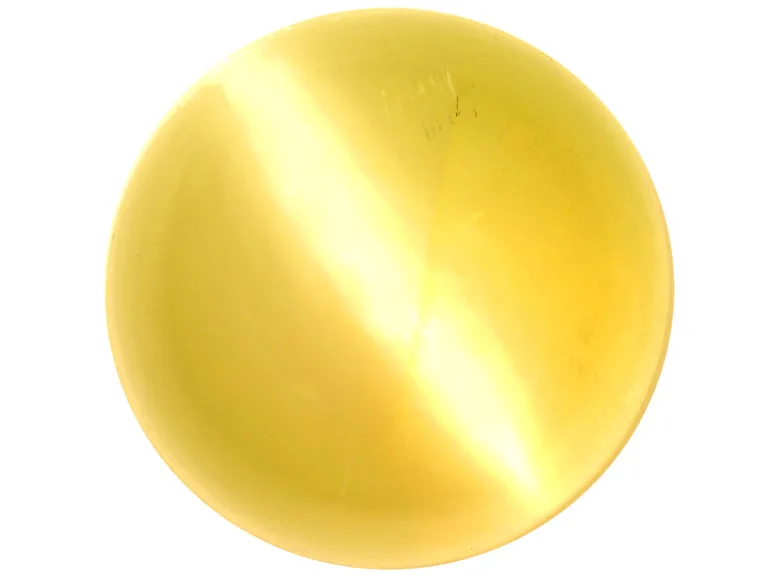
A line on one dome
A cat’s-eye chrysoberyl, 6.1 carats, keeps the band at the size of a jewel you would set. A round cabochon, honey into olive, the line a pale stroke through the middle, sharp enough to read as a slit of light. The dome is smooth. The light is not a facet’s flash and not a stain on the surface. It is a band that belongs to the direction of the inclusions, and it leaves the center when the stone is turned. That leaving is the name.
The chrysoberyl is the classic chair for this light, which is why the trade says cat’s eye and means the band. A guest inclusion would have asked you to look inside and find a needle, one crystal visiting another. Here the needles have agreed to act together, and what you meet is not each needle but the stroke they make. The dome holds them. The band is the sentence. Turn the stone in the mind and the stroke walks. A still can only catch it once. The literacy is knowing that the caught line is a traveler.
A stroke in a vitrine
A cat’s-eye chrysoberyl at the San Diego Natural History Museum spends the same band on a single stone. The line is there, a bright stroke on a honey dome, the rest of the stone quieter, a little olive at the rim. You meet the stroke before you ask the case. A flash of labradorite would have spread as a sheet, blue or green, a weather across the whole face. A moonstone’s light would have floated, soft, without an edge you could follow with a pin. This edge is the point. One band. The dome only gives it a path.
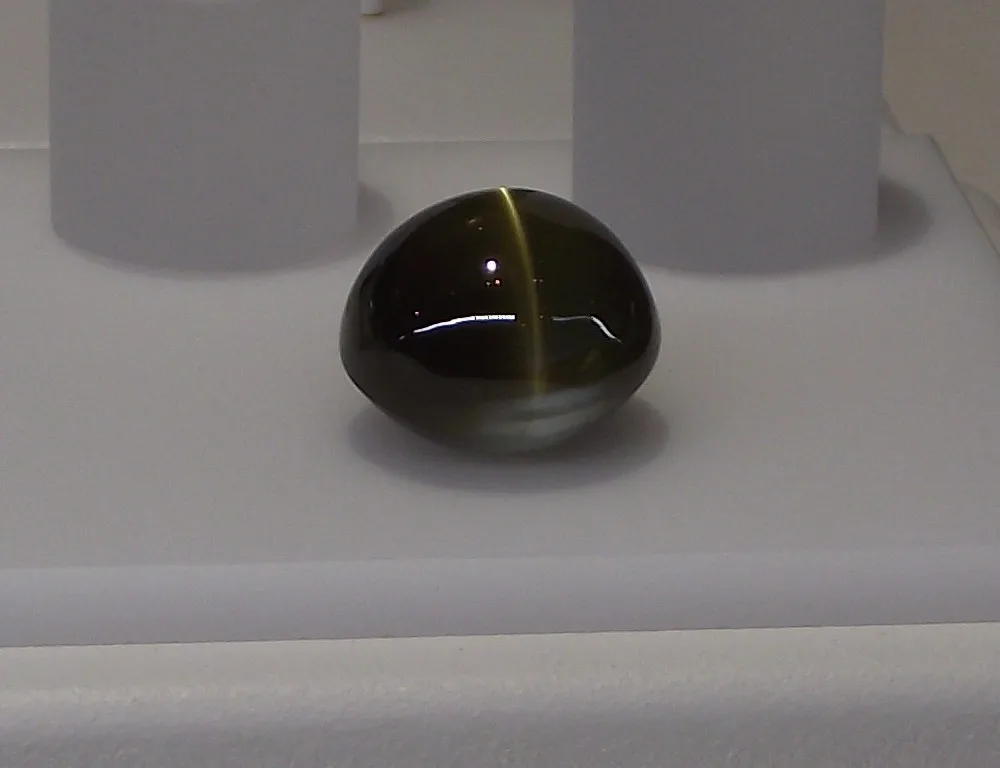
The care belongs to that path. The band is only as clean as the surface it crosses. A scratch on the curve breaks the line the way a nick breaks a reflection. A buff that wants the stone brighter asks the dome to lose the very curve that lets the band travel. A soft cloth, and the piece left out of a harsh polish, keeps the surface the eye needs. The line stays a line when the dome stays whole. Nothing in the care is complicated. The eye wants a clean surface, and the cloth is how the surface stays a path.
The same band, another mineral
A cat’s-eye tourmaline at the German Gem Museum in Idar-Oberstein takes the band out of chrysoberyl and into another stone. A round cabochon, darker, green into olive, the line still one stroke, quieter than the 6.1-carat chrysoberyl, still a single light that knows a direction. Enamel would have given color as a skin. Cloisonné would have held color between wires. This color is the mineral, and the event on it is the band. The species changed. The literacy did not.
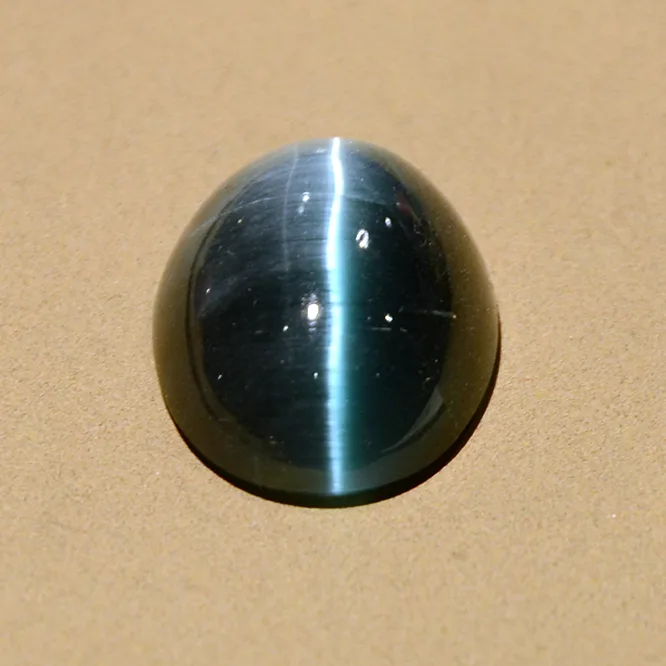
A cabochon of this appetite without the parallel inclusions would have been a dome and a glow, the curve doing all the work. This dome has a job after it is polished: to let one band travel. The tourmaline shows that the job is not a chrysoberyl privilege. Any stone whose inclusions lie parallel can keep a cat’s eye. Chrysoberyl does it famously. Tourmaline does it here, in a museum tray, the stroke a little shy and still unmistakable once you are looking for a line and not for a color.
The care is the same at this scale. The dome wants a gentle cloth. It wants to stay clear of a soak that worries a setting, and clear of a paste. A film on the outside dulls a reflection that was organized by what is inside. A cat’s eye is worn where a ring or a pendant meets the light. Between wearings it is carried the way any soft dome is carried, so the line has a clear curve to cross.
Three stones, one band. The 6.1-carat chrysoberyl lets the line be sharp, a studio dome, honey and olive. San Diego lets it be a museum stone, the stroke the first fact in the case. Idar-Oberstein lets it be tourmaline, the same moving line in another mineral. A sheet of color remains a flash. A floating glow remains a moonstone’s light. A needle you can name remains a guest. A curve with no band remains a dome. A star of crossing bands remains a star. Chatoyancy is the line: one bright band, moving when the stone or the light moves.
That is the note. A cabochon can be a dome. Chatoyancy is a moving line — a chrysoberyl, a museum stone, a tourmaline — the light held to a single band by inclusions laid in parallel.
Educational only · Not jewelry, insurance, or legal advice