Chatelaine, a watch at the waist
A chatelaine is read from the waist downward. The belt holds the hook. Everything else is hung, and the hanging has a job. A girandole is counted at the ear, three drops, and the count is the word. A sautoir is a long line at the neck, finished when the line is long enough. A chatelaine begins where a waistband can take it, passes through a body of links, and finishes in the thing it was built to carry. Often that thing is a watch. Cover the watch in your mind and you still have a chain. The chain without a burden is only half the icon. You are not done until you have found what it holds.
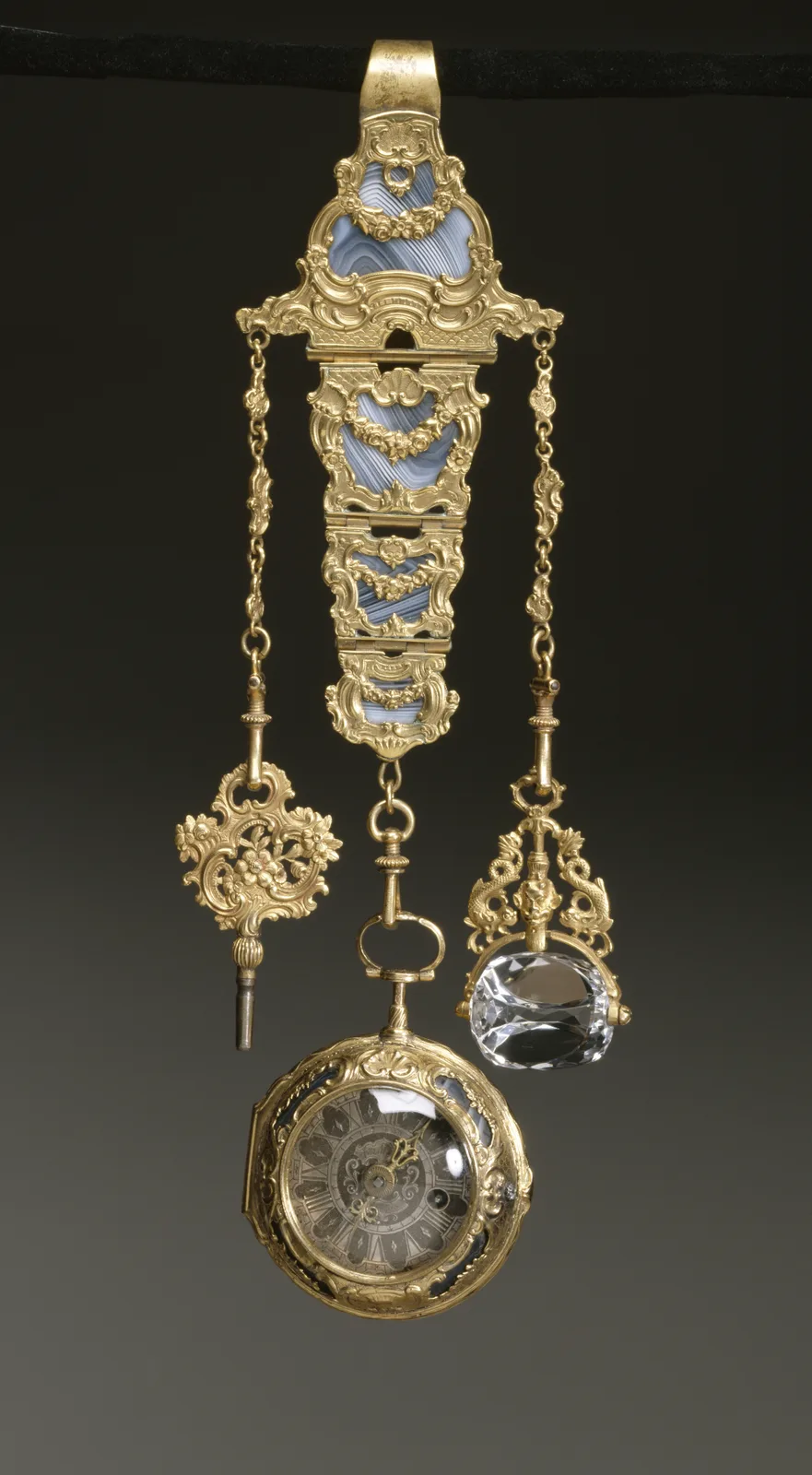
Panels that follow the body
One chatelaine, eighteenth century, French, at the Walters Art Museum. Gold and gilt metal, the links faced with agate, scrollwork and garlands laid over the stripes so the stone reads as a skin and the structure stays a chain. A hook at the top, where a belt would take it. Panels below, separate and flexible, so the jewel can answer a step and a turn of the waist instead of standing out as a plaque. At the bottom, a watch. The length is the first meeting. You would name it from the descent, before you asked which engraver had drawn the garlands.
The agate is a kindness to that lesson. A plain gold chain would have been a line of metal, easy to lose against a silk. The stripes give each panel a weather, brown and cream, and the garlands give the weather a handwriting. The watch at the end is small beside the length of the chain, and the smallness is right. The chain is the jewel’s height. The watch is the reason the height exists. A pocket can hide a watch. A chatelaine publishes it, at the hip, where a hand can find it without a search.
The museum’s own note is worth keeping, because it is about what a chain is willing to carry. A watch key, and a seal of rock crystal that turns, travel with this one, fittings likely made at another moment and then given a place on the links. The face of the icon does not depend on them. The face is hook, panels, watch. The fittings are the chain doing its older work, holding the small tools a waist used to need. Care follows the hinges. A chatelaine catches on a knit, on a chair, on a careless chain in a box. Store it so the watch is not asked to bend the panels, and so the order of the links stays the order the goldsmith hung. The movement you want is a step, not a fold.
The scale is a torso’s scale and still a jewel’s. Nothing in the still is a wearer. Off the belt, the picture is already the icon: a long, striped, flexible thing with a timepiece at its lowest point. You could follow it with a fingertip from the hook to the watch and never leave the object. That path is the reading. Waist, then body, then what the body holds.
The watch the chain agrees to hold
A London piece of the same century spends the lesson on the watch. Probably Francis Perigal, the Metropolitan Museum of Art, 17.190.1439a–c, the gift of J. Pierpont Morgan. Gold, enamel, diamonds. An eighteenth-century case, a dial set with diamonds, silver hands, a diamond endstone in the movement. The chain above it is there so this brightness can hang where a hand expects a watch to be. The ornament and the instrument are one object. Separate them and you have a handsome chain and a handsome watch, and you have lost the icon.
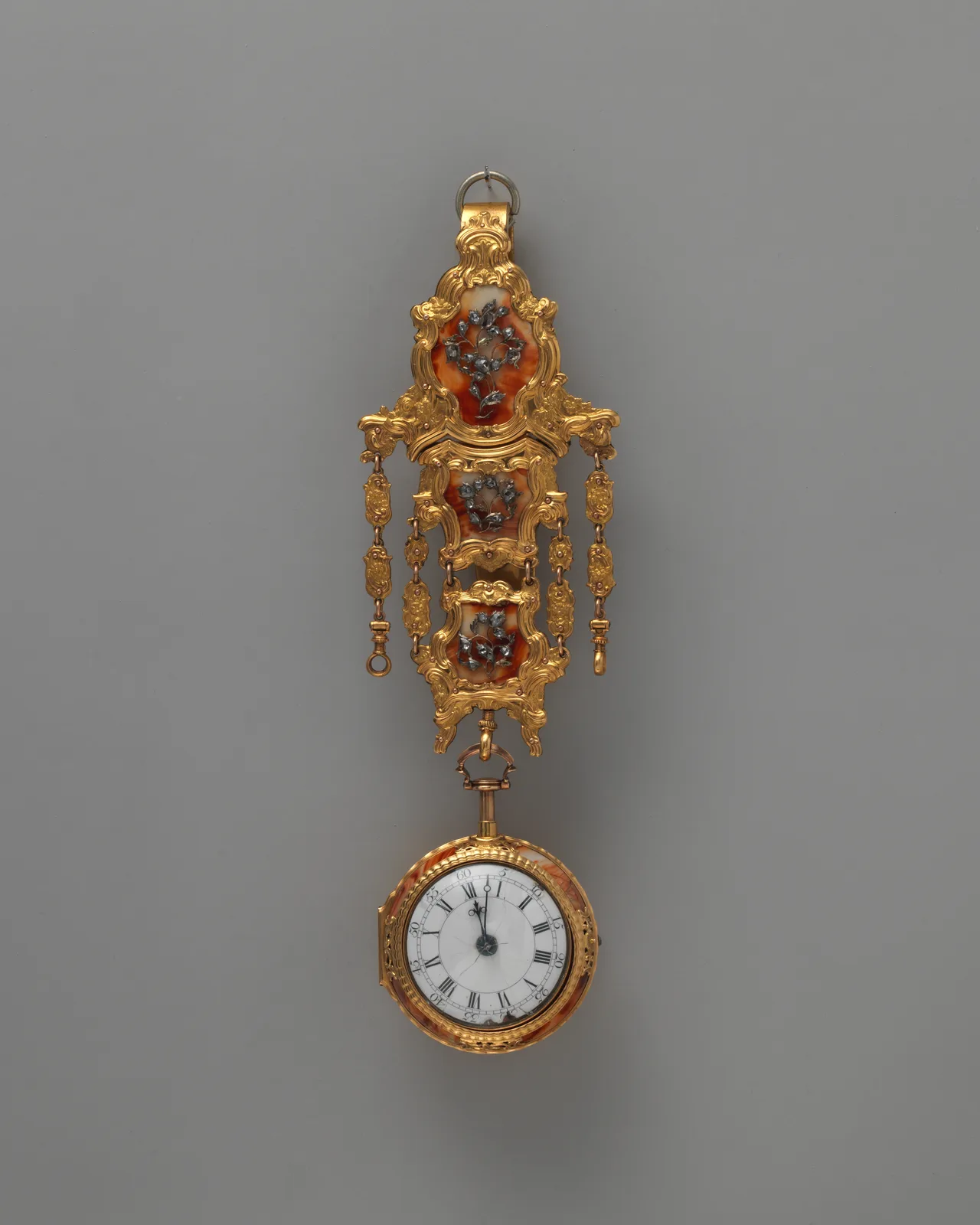
The Walters chatelaine let the panels be the first meeting, agate stripes you could name from across a cloth. This one lets the watch be the first meeting, and then you look up and find the chain that agreed to carry it. Enamel gives the gold a second surface, a picture and a color the metal alone would not have had. Diamonds give the dial a night of points. Neither replaces the job. The job is suspension. A wristwatch of a later century will sit in one place and be finished when the bracelet closes. A chatelaine watch is finished when it has been hung, and it is meant to move a little when the wearer moves. The links are the manners.
You would know it from the gold and from the watch together, in that order or the other, and still as one sentence. Two objects in the photograph, a chain and a timepiece, and they are not a pair of alternatives. They are the form. Set it beside the agate and the constant is the downward reading. Belt, body, burden. The burden here is eager to be seen. Diamonds on a dial are a decision to let the timepiece be jewelry while it tells the hour. The chain is the jewelry that lets the hour leave the pocket.
The care is the same kindness at a brighter scale. Diamond edges and enamel and a small hinge want different mercies, and a chatelaine asks for all of them at once. A soft cloth, a dry brush for the links, no bath that promises to wake the gold. Lift it by the stronger part of the chain if you can, not by the last ring that holds the watch. That ring is a fastening. Fastenings of this age are not spare parts. Store it alone, the watch beside the chain in the order it was worn, so the morning does not have to solve a tangle before the waist can take the hook.
Later, and still a chain
A Paris chatelaine of about 1875 to 1878 keeps the test after a long gap. Hippolyte Téterger, the Metropolitan Museum of Art, 59.43a–c. The chatelaine is partly enameled gold and platinum, set with diamonds. The movement is gilded brass and steel. A century away from the agate panels, and the question is unchanged. You meet a hook, a body of links, and a watch. The grammar has brightened. Platinum is in the mix, enamel is doing more of the talking, diamonds are still willing to be the spark. The form has not been retired.
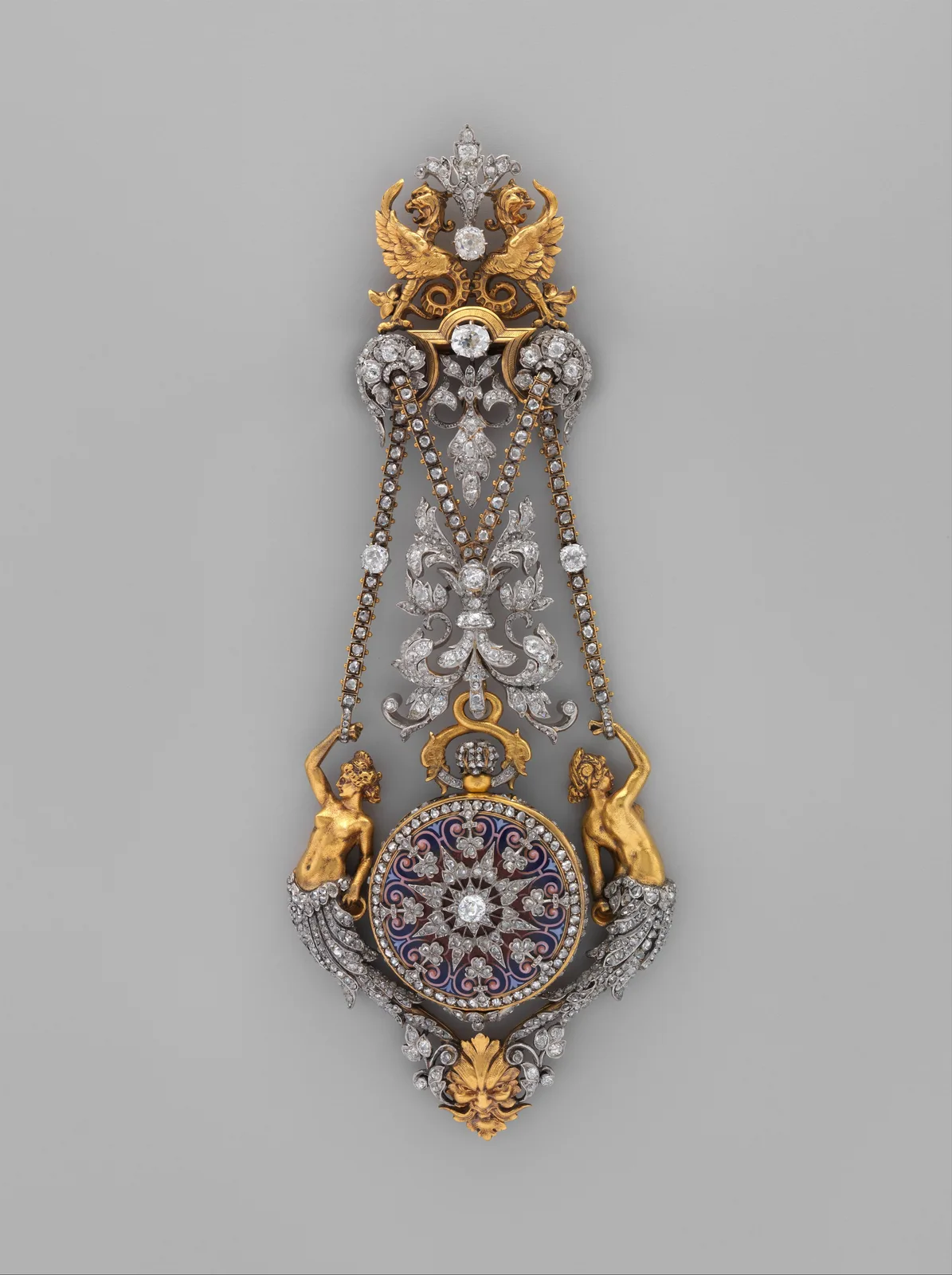
The agate let the chatelaine be a length of striped panels that could follow a body. Perigal let the watch be the brightness the chain exists to publish. This one lets a later decade wear a richer surface and still end where the others ended, in a timepiece hung at the lowest point. You would still read it from the waist downward. The top is what the belt accepts. The middle is the chain, enameled, linked, a little architecture against the hip. The bottom is where the object decides to be a watch and not only a jewel. Nothing in the still is a wearer. The picture is complete on the cloth.
That brightness does not change the care. Enamel and platinum and a diamond want a soft cloth and a cool room, and the joints between the links want not to be forced. A chatelaine of this length is a landscape you store in its own direction, hook at one end, watch at the other, nothing laid across the middle that would bow a link. The platinum is not a coat you can rub away, and it is still a surface. Leave it its color. The enamel is the drawing. Level it and you have a smoother gold with a memory of pictures, which is a different object.
Three suspensions, one direction. The agate lets the chatelaine be panels that move with the waist, a striped length with a watch at the end. Perigal lets the watch be the reason, gold and enamel and diamonds hung where a hand can find the hour. Téterger lets the 1870s wear platinum and enamel and still obey the old order: hook, chain, timepiece. A girandole can still be three drops at the ear. A sautoir can still be a line at the neck. On a chatelaine, you start at the belt, and the jewel is what the chain was willing to hold.
That is the icon. Chatelaine, a watch at the waist. The hook takes the belt. The links do the carrying. The watch is why the carrying dressed itself.
Educational only · Not jewelry, insurance, or legal advice