Carrera, a racing dial that counts
TAG Heuer Carrera keeps the hour on a round racing dial. A tachymeter circles the face, a scale that turns the seconds into a count, and the case stays a circle. The Monaco, from the same house, races by being a square, a geometry you meet before the hour. A Daytona is a chronograph that sits, the registers inside a circle that has agreed to be still. A Speedmaster is a chronograph that went to the moon. A Navitimer carries a slide rule, a bezel of scales for a flight. El Primero counts in three colors, the registers themselves the jewel. The Carrera opens on the tachymeter. The jewel is the racing dial’s manners, a round face that counts.
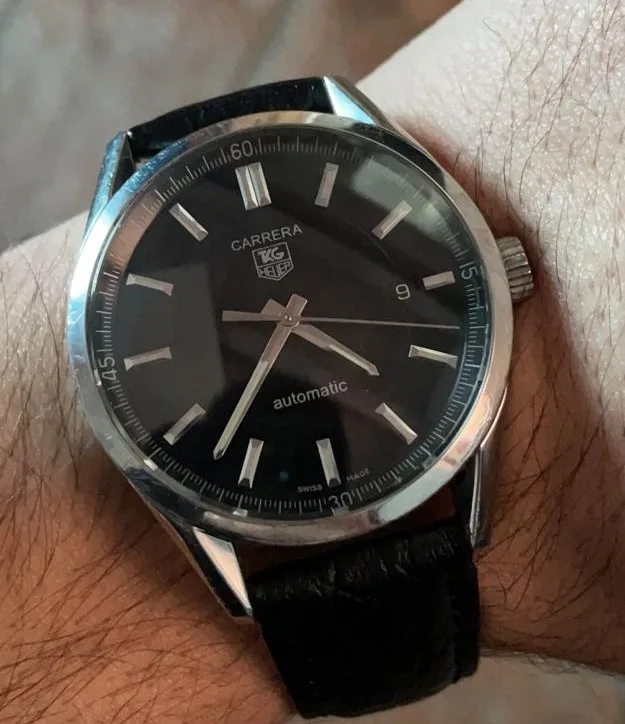
A tachymeter, and three hands
A Carrera Calibre 5 from about 2010 is the whole watch, off the wrist, on a white ground. Steel case, black dial, applied markers, a date, and a tachymeter cut into the bezel. No subdials. The count lives on the ring. The name sits on the dial where a name belongs, and the scale outranks it: a circle of speeds, the round face already measured before you read the hour.
A square case would have made the geometry the first fact. This dial makes the scale the first fact. Take the name away and the bezel still says racing watch: three hands, a date, the chronograph left off, the numbers still circling. The bracelet belongs to the case and stays in the plate with it. Black dial, steel, a ring of speeds. That is one scale of the icon, and it is enough to know the family. The manners are the scale. The hands only cross it.
A blue field, and the registers
A Carrera automatic chronograph in blue spends the same idea with the registers present. Off the wrist, on a white ground, a steel bracelet, a blue dial, three subdials, a date toward six, a tachymeter still on the bezel. The hands are what cross the field. The subdials are the small clocks inside the large one, a chronograph’s way of keeping a count you can start. You would know it as a Carrera from the round case and the scale. The color changes. The dial keeps its job.
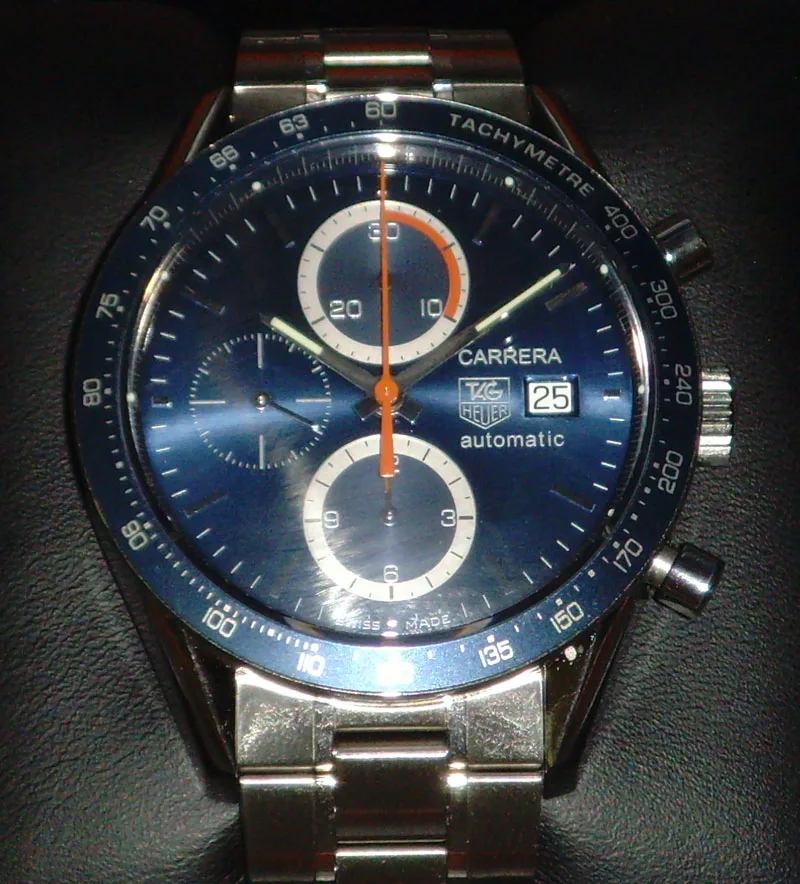
A Monaco in blue would have put that color in a square, and the square would have been the sentence. Here the blue is a field the tachymeter frames. The registers sit where a racing chronograph puts them, and the case does not compete by becoming a shape. Steel does the work of a frame. The dial stays the subject. Round, blue, a scale, three small faces. The hour is still told by hands on a ground, and the count is still the ring plus the registers. That is the same jewel as the Calibre 5, with the chronograph invited back in.
The bracelet is a quiet line under the lugs, there so the watch reads as a whole object and not as a dial floating. Nothing in the plate is a wrist. The pleasure is how complete the face is before any cuff arrives: blue, ruled, ready to count.
Black, and the count close
A Carrera chronograph, reference CV2010, from 2008, keeps the black dial and the registers together, off the wrist, the face on a white ground. Subdials, a date, a tachymeter, the hands laid over a field that has already been ruled for a race. The house name stays where a name belongs. The pleasure is how much of the dial is given to counting, and how calm that counting stays when the watch is simply sitting in the light.
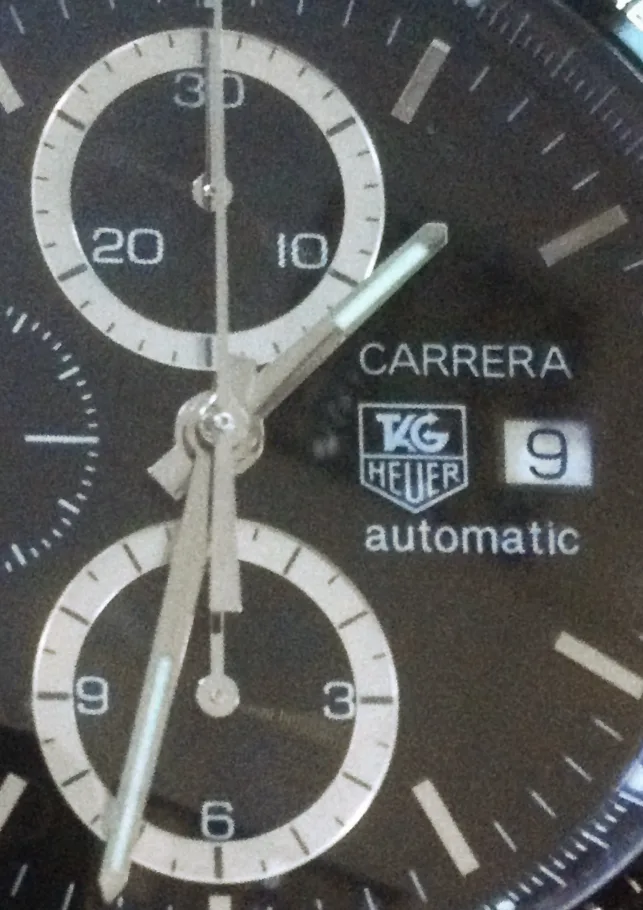
A slide-rule bezel would have put a flight’s arithmetic on the ring. A moon-watch would have carried the chronograph toward another story. A count in three colors would have made the registers the palette. This watch puts a tachymeter on the bezel and leaves the rest of the count to the subdials, black on black, the scale in the metal. Between twelve and six the field is open enough to be a jewel’s ground, and still ordered enough that the eye knows where the seconds are going. That is the manners of a racing dial worn as jewelry: the case is a circle, and the circle’s job is to hold a count.
The three hands of the Calibre 5 and the registers of this CV2010 are two ways of furnishing the same room. One leaves the scale to speak alone. One gives the scale companions. Both are round. Both are Carrera. The square that races remains a different jewel, a case you meet as a shape. Here you meet a dial.
Three stills, one face. The Calibre 5 lets the tachymeter be the whole count, three hands, the scale doing the work. The blue chronograph lets the same round face carry subdials, the color a field. The CV2010 lets the black dial and the registers be the thing you actually see, the count up close. A square can race by being a square. A chronograph can sit, or moon, or fly by a slide rule, or count in three colors. On a Carrera, the hour is kept by a round racing dial that counts.
That is the icon. Carrera, a racing dial that counts. A tachymeter with three hands, a blue chronograph, and a black one — the scale, already the first thing you meet.
Educational only · Not jewelry, insurance, or legal advice