Benitoite as a triangle of fire
Benitoite is this season’s triangle of fire. Sapphire keeps a deep pane, a blue you meet once a crystal has been opened into a window. Apatite keeps a blue that will not settle, several hues across one phosphate. Zircon keeps an icy fire in another mineral’s body. Aquamarine keeps a cool water. Topaz keeps a pane that can go cold and blue. Paraíba keeps a neon, a tourmaline switched toward green. Benitoite arrives already drawn. The crystal grows as a triangle, the blue sits in that drawing, and the blue throws a fire along the edges it grew. You meet the shape before you ask for a wheel.
Triangles on a white ground
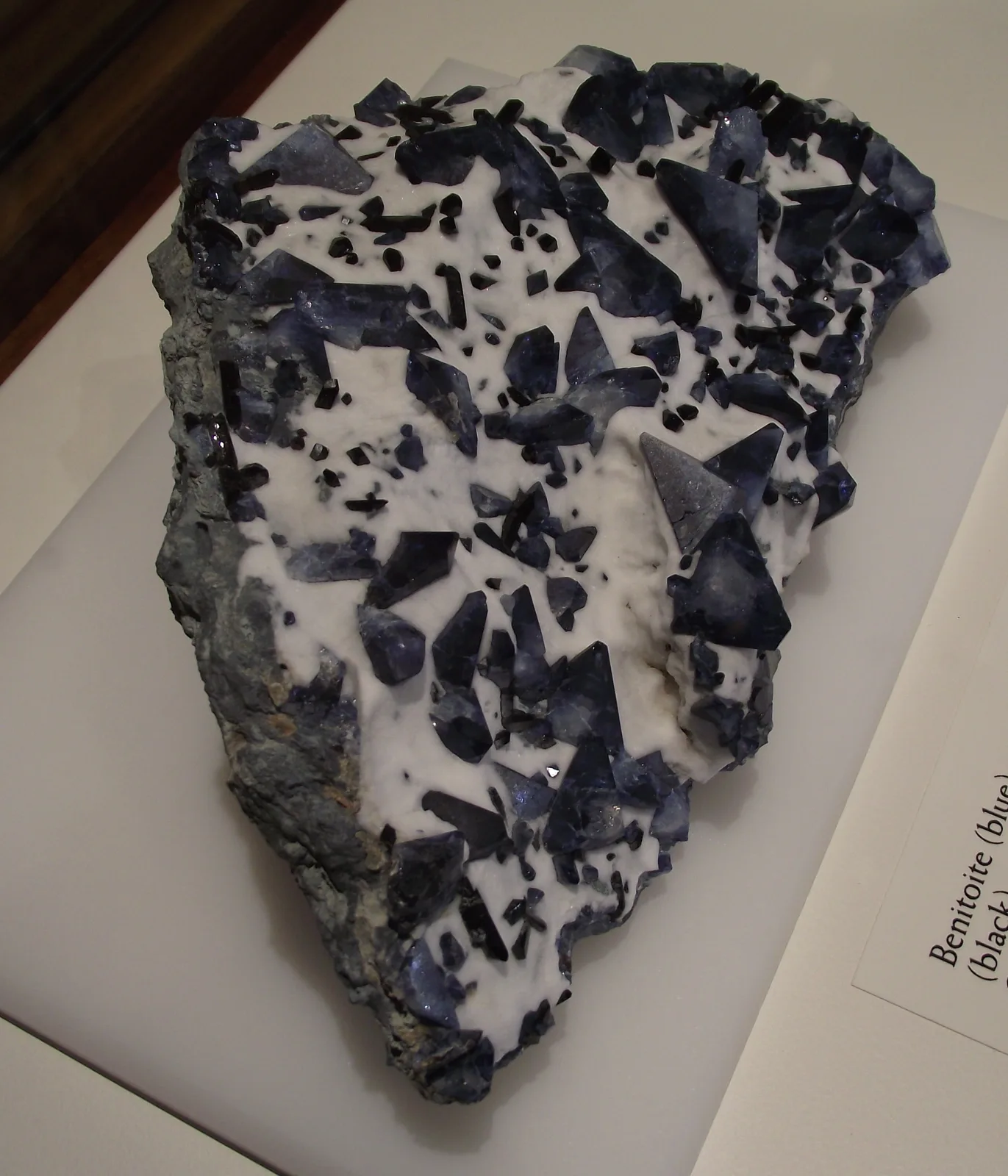
A group at the San Diego Natural History Museum spends the blue as triangles in a white. Natrolite is the white, the soft mineral the crystals grew through. Neptunite is the black, blades set beside the blue, a dark company the eye uses as a frame. The benitoite is the fact. Each crystal is a small geometry the mineral agreed to, faces meeting where a triangle meets. A label in the case names the county. San Benito is the place this blue is willing to be itself, and the museum lets you meet it off the mine, the ground cleared toward white so the triangles can read.
The fire is in the blue even here, before a brilliant has been asked for. Turn the crystal in the mind and the faces are already planes. A sapphire of this habit would still be waiting to become a pane, a barrel or a pyramid a cutter opens. These triangles have opened themselves. The black blades are not the jewel. They make the blue look decided. The white does the work of a cloth. The specimen is a small landscape of three minerals, and one of them is the season’s light.
The triangles are large enough to read across a table and small enough that a single one could live at the throat. The museum has kept them together, which is a kindness: you see the habit, a family of the same drawing, rather than one lonely stone. A row of cut apatites would have argued about the hue. These agree about the shape. The blue is one blue. The triangle is the sentence.
That agreement is the pleasure of the still. The crystal is wearing its own faces. The months have had their golds and their peaches. This blue does not lean toward green and does not ask to be several. It sits in the triangle and flashes when the light finds an edge. The dispersion is high — higher than a diamond’s — which is why a small face can throw a color the blue did not seem to contain. The black stays black. The white stays a ground. The benitoite does the color.
The same triangle, in the rock
A second specimen spends the habit inside the stone it grew from. Crossite, a dark blue-gray of the country rock at the Dallas Gem Mine, holds the benitoite with neptunite and joaquinite-(Ce). The piece is OM1-203A, from the RGB collection of Geipel. You meet the matrix before you meet a cleared white. The triangles are still triangles. They sit in a darker bed, so the blue reads as something the rock is giving up, a light lodged in the mine.
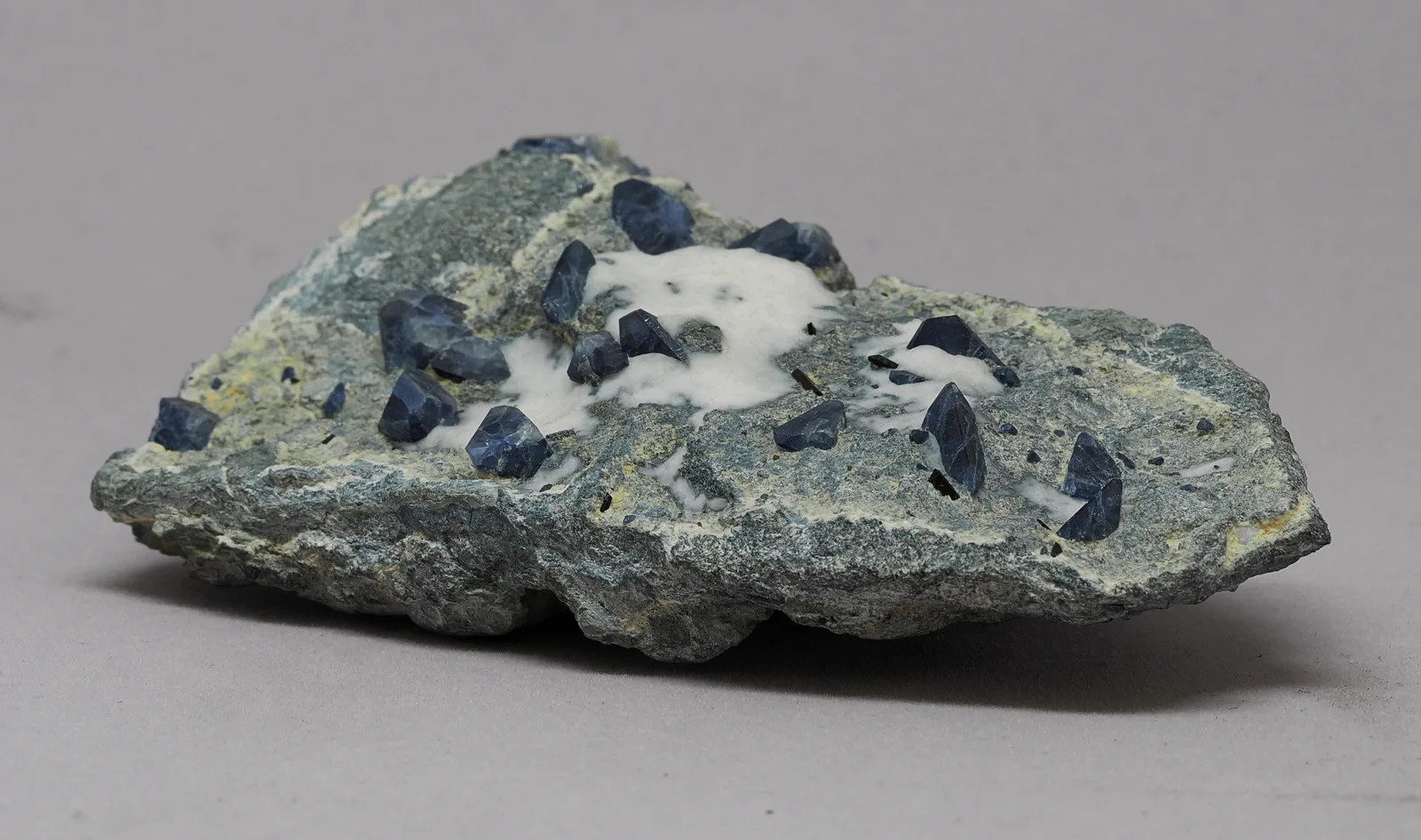
The ground changes the feeling and leaves the mineral alone. On natrolite the blue is a guest that has been given a space. In crossite the blue is at home in a harder dark, the black blades closer to the color of the rock, the joaquinite a smaller warm note if the eye goes looking. A topaz from a pocket would have kept a prism. This is still the triangle. The season’s point survives the change of bed. A thumb could cover the little label, and the shape would still tell you the name.
Dallas Gem Mine is the locality the stone is famous for keeping. Three stills can share a county and remain three objects. This one is the rock. The museum piece was the cleared ground. The next returns to a pale ground and lets an orange mineral take a larger share of the company. The blue does not have to be alone to be the light. It only has to keep the triangle.
An orange beside the blue
A third specimen, photographed by Géry Parent, spends benitoite with joaquinite-(Ce) and natrolite, again from the Dallas Gem Mine, and the black blades of neptunite are in the picture too. The ground of the still is dark, so the white of the natrolite reads as a brightness the crystals carry with them. Joaquinite brings a copper-orange, small warm crystals against the blue triangles. You meet the pair of hues before you sort the mine. The blue is unchanged in its habit. The neighbor has stepped forward.
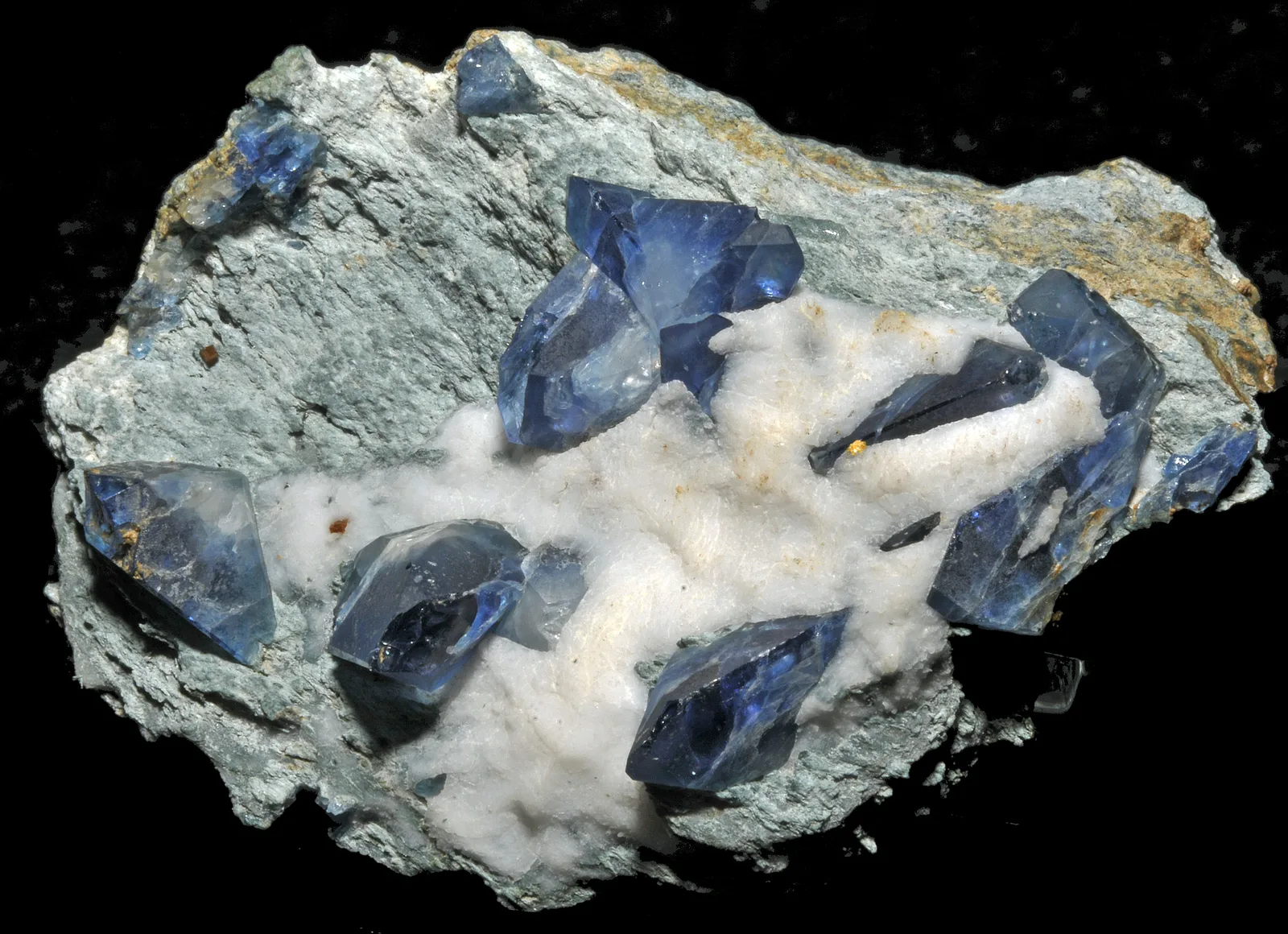
The orange is a kindness to an eye that has been living in blue. It does not turn the benitoite into a sunset. It gives the triangle a rim the way a setting gives a stone an edge. Joaquinite is not the jewel of the season. It is the company the jewel kept in the ground. Natrolite is the white. Neptunite is the black the first still already taught. The one you would wear is the one that throws color from its edges. The faces are already there. A cutter would be continuing a drawing the crystal began.
Three stills, one triangle. San Diego lets the blue be a group on a pale ground, neptunite as the black beside it, the museum’s own case. Geipel’s OM1-203A lets the same habit sit in crossite, the rock still in the picture. Géry Parent’s specimen lets joaquinite bring an orange up against the blue, a third object, the triangle intact. A pane can still be a sapphire. An unsettled blue can still be an apatite. An icy fire can still be a zircon. A water can still be an aquamarine. A cool pane can still be a topaz. A neon can still be a Paraíba. This season’s blue is the one that grew as a triangle and kept a fire in the body of the crystal.
That is the sit. Benitoite as a triangle of fire. A shape the mineral drew, a blue that flashes, a jewel the crystal already resembles.
Educational only · Not jewelry, insurance, or legal advice