Asterism is a moving star
Asterism is a moving star. Fine needles in a stone lie in more than one direction, and where those directions cross they return a star — often six rays, sometimes four — that travels across a cabochon as the stone turns or the light shifts. Chatoyancy is a single band, one line from inclusions laid parallel. Labradorite keeps a flash, a cool sheet of color that comes and goes across a feldspar. Moonstone keeps a soft light, a glow that floats. An inclusion, met as a guest, is a needle or a crystal you can find and name inside the stone. A cabochon is the dome, the curve that gives a stone a volume. Asterism is what that dome can do when the needles agree to cross. The star is the meeting. The movement is the fact to learn.
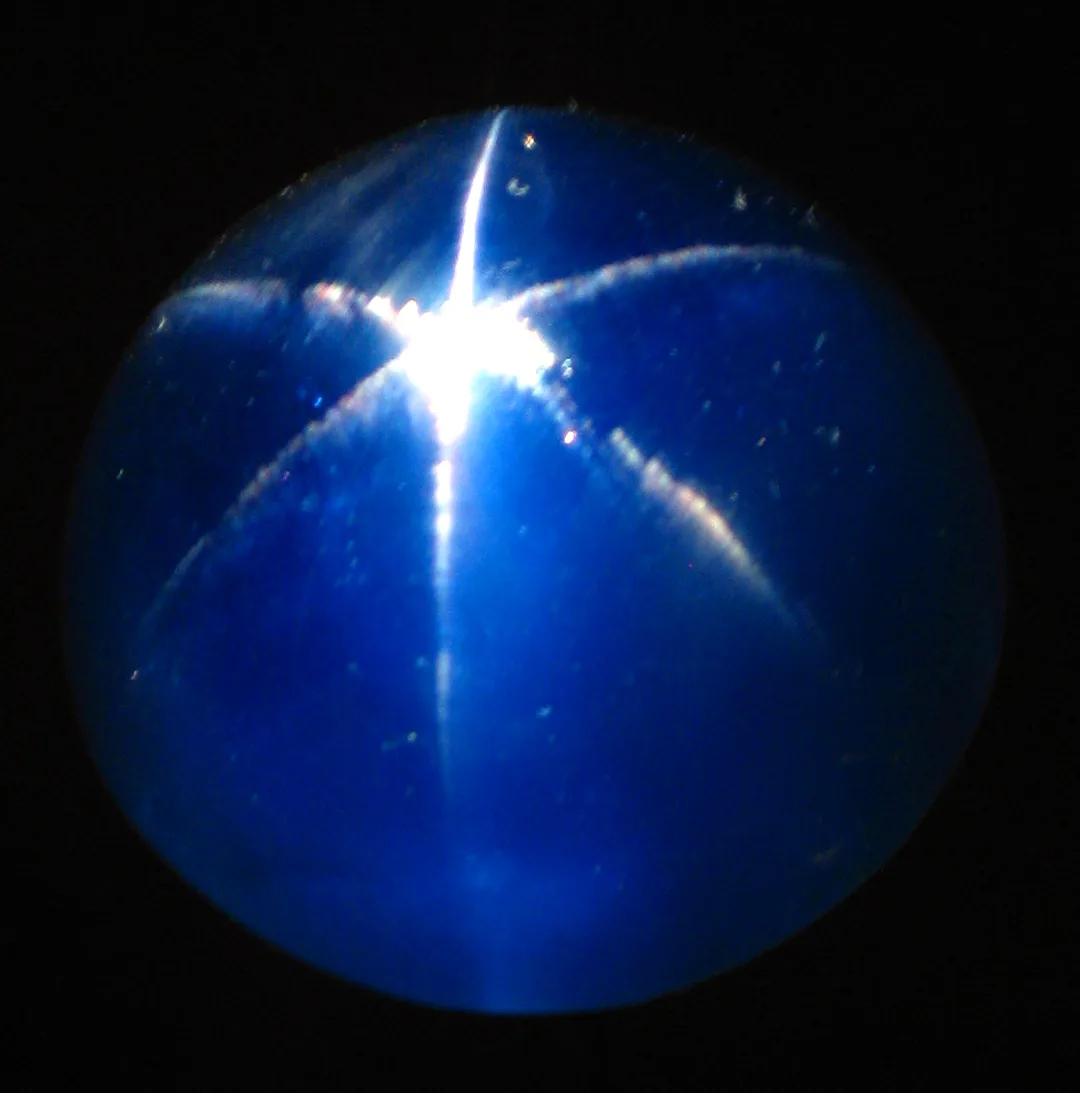
Six rays, and a center that will not stay
The Star of Asia, a 330-carat star sapphire from Burma, in the National Museum of Natural History in Washington, keeps the star at the scale of a museum stone. A close view, the cabochon filling the frame, six pale rays crossing on a deep blue. The dome is smooth. The light is not a facet’s scatter and not a color painted on the skin. It is a star that belongs to the crossing of the needles, and the center of that star is only where the light and the stone have agreed to meet for this one view. Turn the stone, or move the lamp, and the meeting walks. A still can hold the star once. The literacy is knowing the held star is on its way somewhere else on the dome.
A single bright band would have been a cat’s eye, chatoyancy’s one line, the needles all laid the same way. Here the needles have taken more than one road, and what you meet is the place they cross. You do not have to find each needle. The star is the sentence they write together. Blue makes the rays easy to read, silver against the sapphire, which is why a museum stone like this became a picture people carry of the word. The picture is fair. The word is larger than the one stone. Any dome with the same crossing can keep a star, famous or not.
The rays are a geometry you can trust. Six of them means three sets of needles, each set throwing a band, the bands crossing at sixty degrees in the plane of the dome. Four rays would mean two sets. The count of the rays is the count of the directions. That is the whole mechanism, and it is enough. The dome’s curve is what lets you see the meeting as a star rather than as a scratch deep in the stone. Without the curve, the needles would still be there. With the curve, they become a light that can travel.
The star at the size of a jewel
Gold sheen star sapphires, a short row of cabochons, spend the same crossing without the fame. Each dome carries a six-rayed star. In this plate the ground reads silver and blue, the rays pale and centered, the trade’s gold sitting quietly behind a cooler light. You meet the star before you ask a locality. The species is still sapphire. The event is still the meeting of bands. The Star of Asia showed the star as one great chair. This row shows it as a fact you could set, jewel after jewel, each star its own.
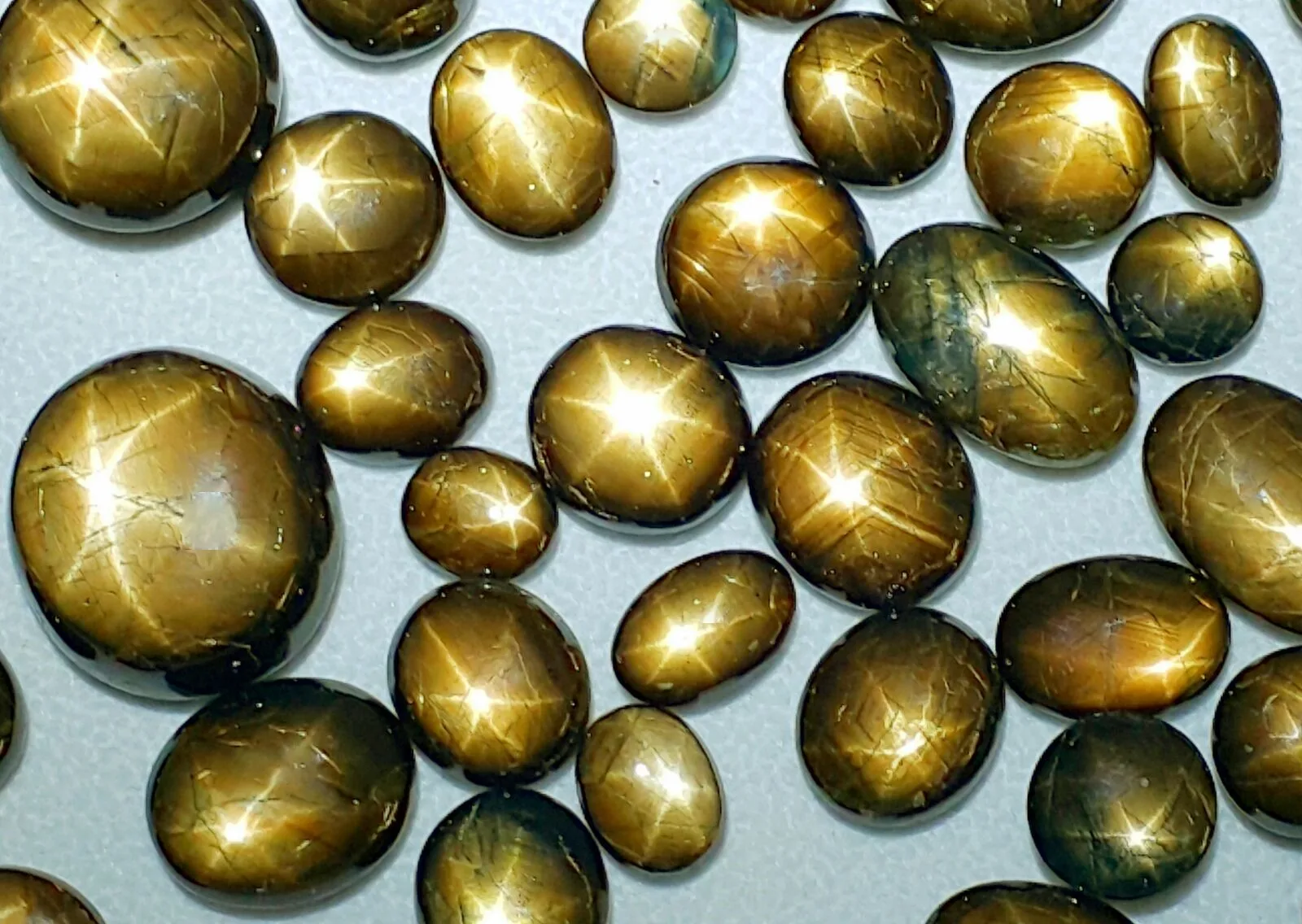
The row is also where the movement becomes easy to imagine. Each cabochon is small enough to turn between two fingers. Turn one and its star walks across that dome alone. The stone beside it keeps its own center until you turn that one too. The star is not a lamp in the room. It is an agreement between the light and the way that particular stone is facing. Two cabochons on one cloth can show two stars in two places, which is the lesson in a single glance. A flash of labradorite would have spread as a sheet across a feldspar, weather rather than a centered figure. A moonstone’s light would have floated without rays you could count. These rays can be counted. Six, and a center, and a center that moves.
A guest inclusion would have asked you to look inside and find one crystal visiting another. Here the needles have agreed to act as sets, and the eye is invited to the star, not to the inventory of needles. The sheen is the sapphire’s own body, a ground the rays cross. Along the row the color can cool toward silver or warm a little from stone to stone. The star does not resign when the ground changes. That independence is worth learning. Asterism is not a hue. It is a figure the hue is willing to carry.
Many sizes, the same meeting
A tray of gold sheen stars takes the figure across sizes. Small cabs and larger ones, each with its own star, the rays still meeting at a center that will move when that stone moves. The tray is a lesson in scale. A tiny dome can hold a star. A larger dome can hold a star. The rays do not wait for a famous carat weight. They wait for needles in crossing sets, and for a curve polished clean enough to let the meeting show.
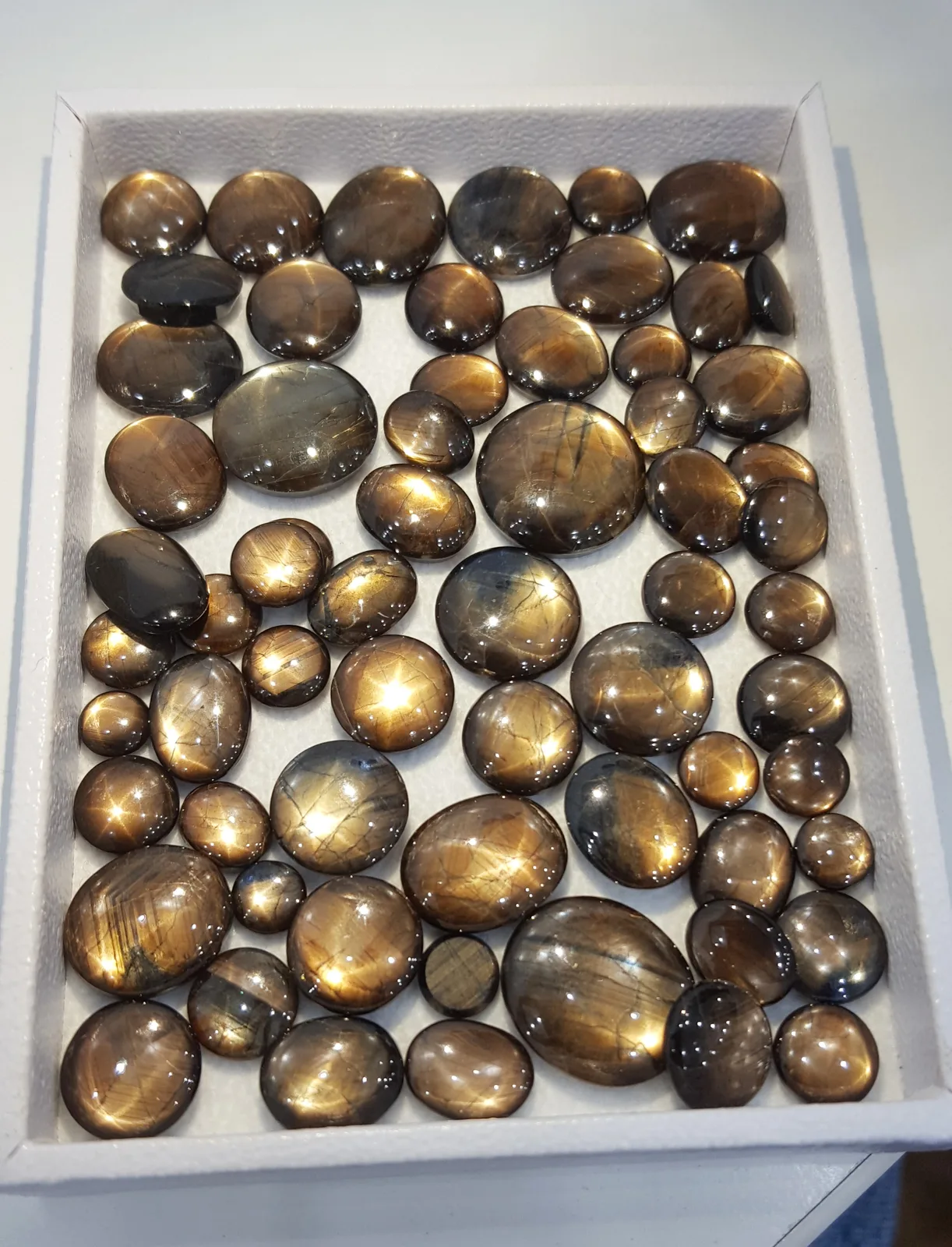
A cabochon of this shape without the crossing needles would have been a dome and a glow, the curve doing all the work, which is a beautiful fact of its own and a different word. This dome has a further job once it is polished: to give the crossing a stage. The tray shows the job is not reserved for one blue stone in a museum story. Sapphire after sapphire, small and large, keeps a star because the needles were laid that way. The Star of Asia does it on a deep blue, close enough that the rays fill the view. The row does it at the size of a jewel you might set. The tray does it as a crowd, each star a little different in its sheen, each one still a meeting of bands.
The surface is part of the lesson, and the care is simple. The star is only as continuous as the dome it crosses. A soft cloth keeps that dome clear. A film, a scratch, or a paste breaks a ray before the eye can follow it. Between wearings the stone wants the same gentleness any polished curve wants, so the light still has a clean path to the center, and from the center out along the arms. Nothing in the care asks for a special rite. It asks for the surface to remain a stage.
Three stills, one star. The Star of Asia lets the rays be a single blue dome, the meeting caught close, a center that will walk when the light does. The gold sheen row lets the same star be a jewel you could set, each cabochon with its own center. The tray lets it be a fact of size, small and large, the meeting holding. A single band remains a moving line. A sheet of color remains a flash. A floating glow remains a moonstone’s light. A needle you can name remains a guest. A curve with no star remains a dome. Asterism is the star: crossing bands on a cabochon, moving when the stone or the light moves.
That is the note. A cabochon can be a dome. Asterism is a moving star — a blue sapphire, a row of gold sheen, a tray of sizes — the light held to a star by needles laid so they cross.
Educational only · Not jewelry, insurance, or legal advice