A trillion is a triangle
A trillion is a triangle. Under its other name, a trilliant: a three-sided outline, the sides straight or gently curved, with the facets written as a brilliant — many small planes, a sparkle — inside that shape. Often the stone is cut shallow, so it looks large when you look down on it, more face than depth. It is a common side stone, flanking a center, and a bold solo when the material is a colored stone. A pear is a drop, one end rounded, the other a point, already its own outline. A shield keeps a crest: a broader top, sides that fall, a point at the base, more coat of arms than triangle. The trillion keeps three sides and fills them with fire. The literacy is that triangle.
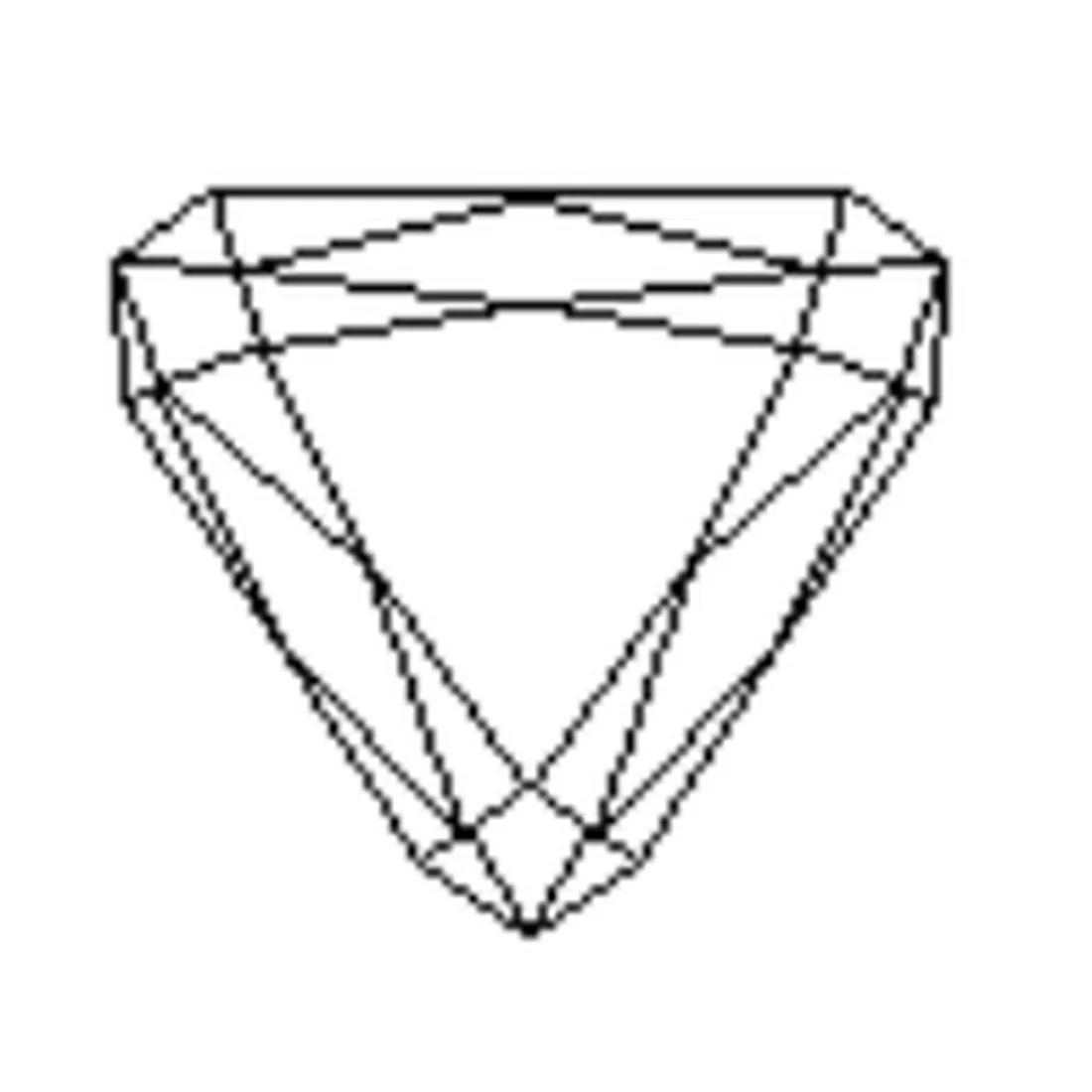
Three sides that throw
A diagram of a trilliant keeps the lesson as a drawing. Three corners, sides that bow a little, a field of facets meeting toward the middle, the outline already a triangle before any metal arrives. You would feel that shape before you named a carat. A pear would have asked one end to round and the other to come to a single point. A shield would have asked for a crest, a top wider than a triangle’s side. This stays a trillion. The face is the triangle, and the facets are how the triangle throws.
The brilliant pattern is how the word finishes on top. The planes are many, and they are a scatter of light rather than steps in a hall. The cut is often shallow, which is why a trillion can look larger face-up than its depth would suggest: a wide triangle, a modest pavilion, a stone that spreads when you look down. You would cover the carat with a look and still have the cut left over. Three sides. A sparkle. A stone content to sit beside something, or to sit alone if the color is the point.
If one end has rounded and the other has come to a point, you are in a pear. If the outline has become a crest, broader above and pointed below in the manner of a shield, you are in a shield. A trillion begins when the stone has already agreed to be a triangle, and the facets have already agreed to throw. Straight sides or a gentle curve along each side — both still read as three. The curve softens the edge. It does not add a fourth.
A triangle that can stand alone
In a colored stone the same outline can leave the flank and sit as a solo. The triangle is bold enough: three sides, a face of small planes, a shallow spread that looks large when you look down. You would meet that outline before you asked which hue. A pear in the same chair would have given a drop, one end already round. A shield would have given a crest. A trillion gives a triangle, and the facets are how you know the triangle still belongs to a brilliant. The color fills the three sides. The fire breaks them. That is the solo the cut was willing to be, when the material itself is the reason to look.
The points are also a small matter of everyday care, whether the stone stands alone or sits at a shoulder. Three corners want a little protection — prongs, or V-tips where the points meet the setting — so the tips are held rather than left to meet a knock alone. A soft cloth and a box of their own keep the facets clear. The fire is what the cloth is keeping. The triangle is what the prongs are keeping whole.
Beside a center
A gold ring with a princess at the center and a trilliant to either side spends the cut as a flank. The middle stone is a square with points. The two sides are triangles, each of them a brilliant’s scatter, set so the center has a companion at each shoulder. You would meet those triangles before you asked which metal. They are the side stones the cut was willing to be: smaller, three-sided, placed where a pear would have hung as a drop and a shield would have sat as a crest.
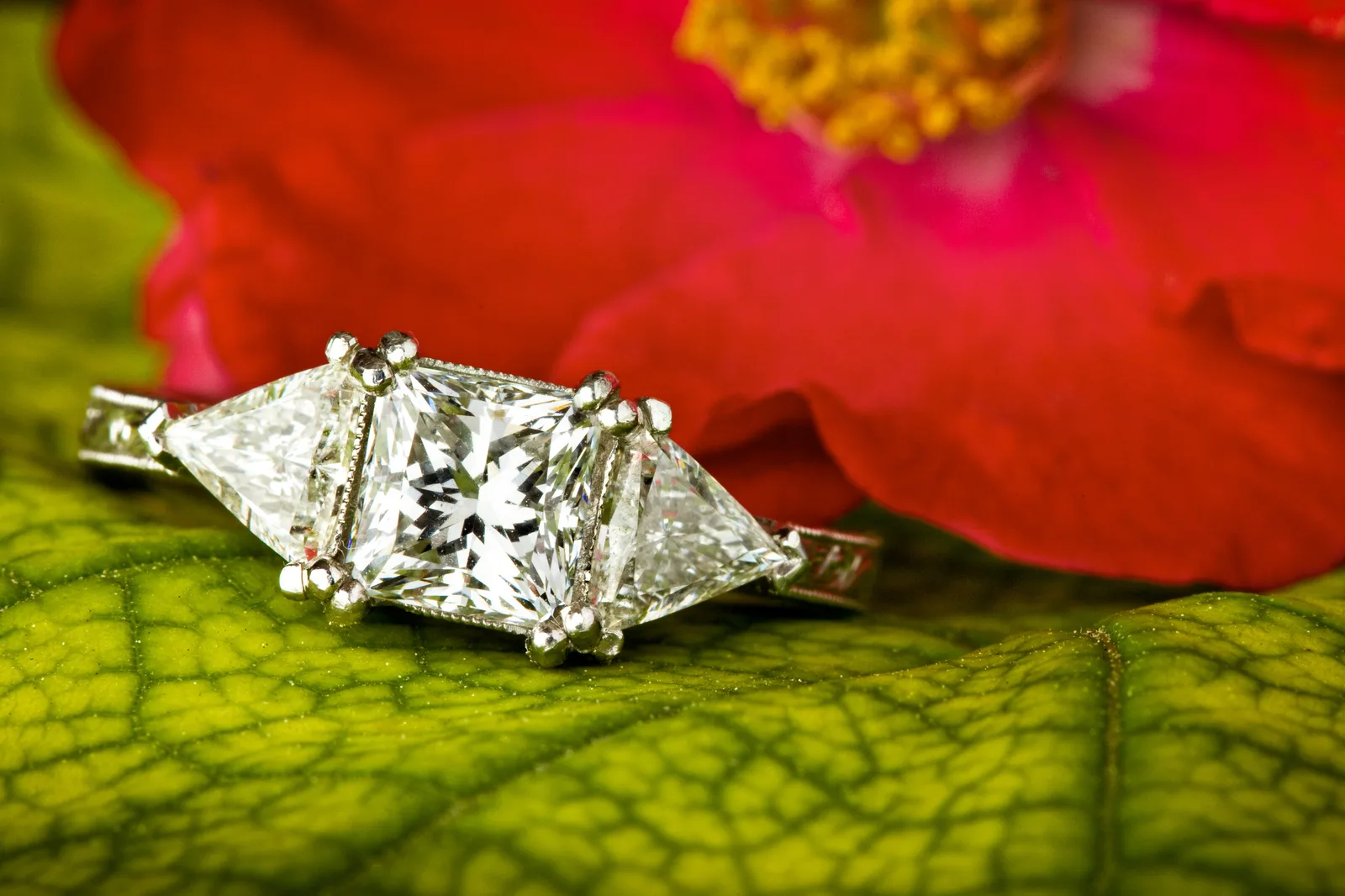
The shoulders are the lesson in use. A trillion beside a center does not have to match the center’s outline. It has to offer three sides and a fire, and to point in a way that leaves the middle stone its room. Here the points of the side stones aim along the ring, and the princess keeps the square. You would cover the gold with a look and still have the cut left over: a triangle, then a square, then a triangle. That rhythm is why the trillion is so often a flank. It is also why a single colored one can stand in the middle when the triangle itself is the jewel.
The diagram shows the face. The ring shows the same outline as a pair of side stones, white diamonds flanking a square. In a colored stone the triangle can take the center instead, and the outline does not change. The trillion keeps either chair. The points, in a setting, prefer a prong or a V-tip. The outline prefers to stay three.
That is the note. A pear is a drop, one end already round. A shield is a crest. A trillion is a triangle — three sides, straight or gently curved, a brilliant’s facets, often shallow so the face looks large, a stone that flanks a center or stands alone.
Educational only · Not jewelry, insurance, or legal advice