A princess is a pointed square
A princess is a pointed square. A square, or a rectangle the eye still calls a square, with the corners left sharp — unclipped — and the pavilion cut in brilliant-style chevrons. Face-up, those chevrons throw an X of sparkle. A radiant is a square with fire too, and the word there is the corner already cropped, the outline having given up its points. An Asscher is a square step, frames inside frames, corners clipped, a hall you look into. The princess keeps the points. The facets under the table are chevrons, and the X is how you know the square still belongs to a brilliant. The literacy is that square: four sharp corners, and a sparkle written as a cross.
Four points, held
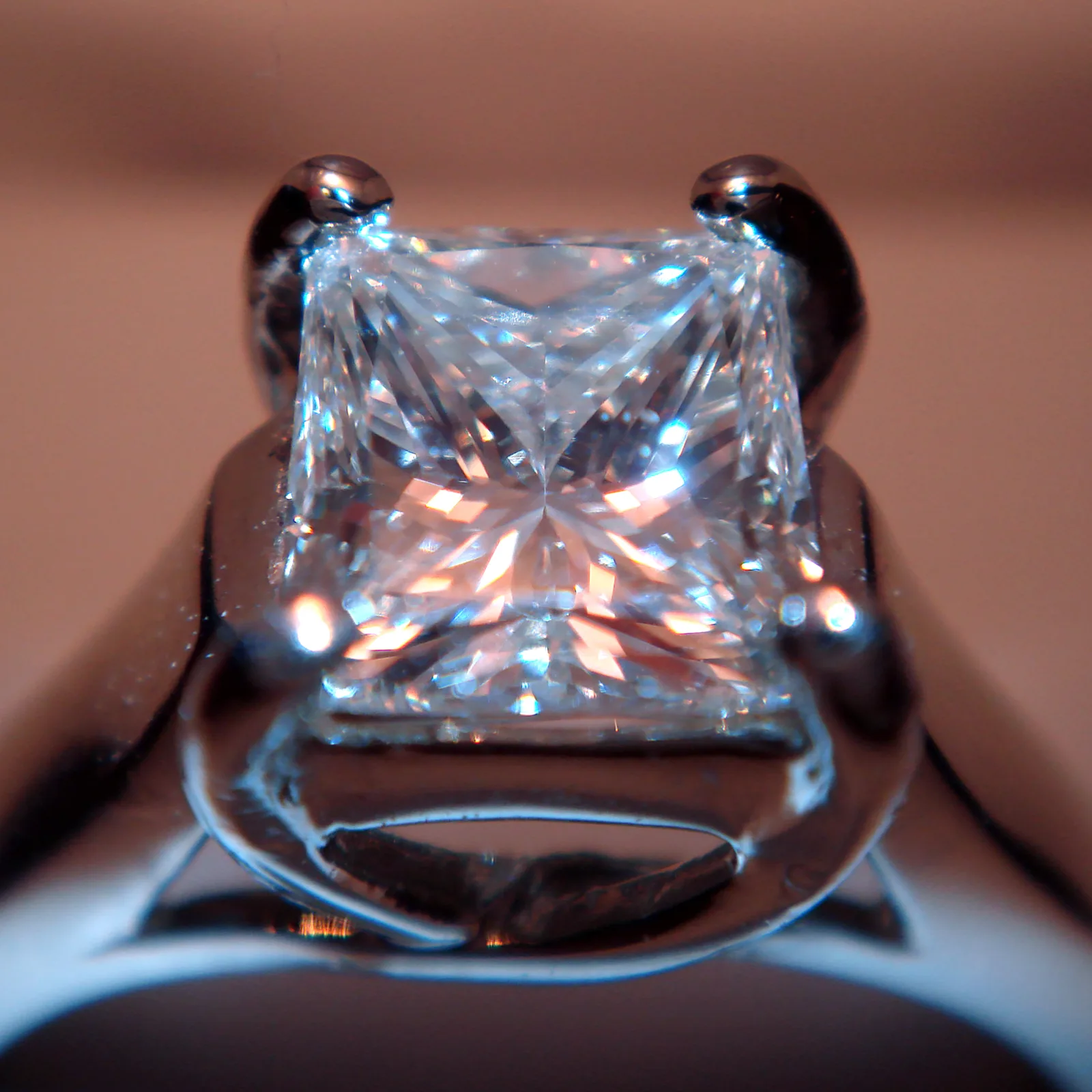
A princess-cut diamond in a four-prong ring keeps the lesson as one stone. Slightly over a carat, the outline a square that comes to points, the face a field of small planes throwing an X toward the middle. You would feel those corners before you named a weight. A radiant in the same chair would have cropped each point, so the square sat with clipped corners and a different edge against the band. An Asscher would have asked the square to become steps, a quiet hall of frames. This stays a princess. The prongs sit at the four tips, one claw to a corner, which is the setting the points prefer.
The X is how the word finishes on top. Chevron facets on the pavilion return the light in a cross, and you can see that cross when you look down, even before you have a diagram. The planes are many. They scatter, rather than stepping down a hall. You would cover the carat with a look and still have the cut left over: a pointed square, an X, four places where the outline is sharpest. If the corners have been clipped, you are in a radiant. If the square is a flight of steps, you are in an Asscher. A princess begins when the stone has already agreed to keep its points, and the pavilion has already agreed to be chevrons.
The points are also a small matter of everyday care. Four corners are the vulnerable spots — the places a knock meets first. V-prongs, or claws set at the corners, hold those tips so the points are protected rather than left to meet the world alone. This ring does that work with a prong at each corner. A soft cloth and a box of their own keep the facets clear. The X is what the cloth is keeping. The points are what the prongs are keeping whole.
The drawing of the square
A diagram of a princess keeps the same lesson as a drawing. Four corners, unclipped, a square outline, a small table, and facets that meet in a pattern you can already call an X. You would feel that shape before any metal arrives. The drawing has no carat and no prong, and it is still the cut. A radiant’s drawing would have taken a little off each corner before it drew the fire. An Asscher’s drawing would have nested squares, step after step. This one lets the corners come to the points of the square itself.
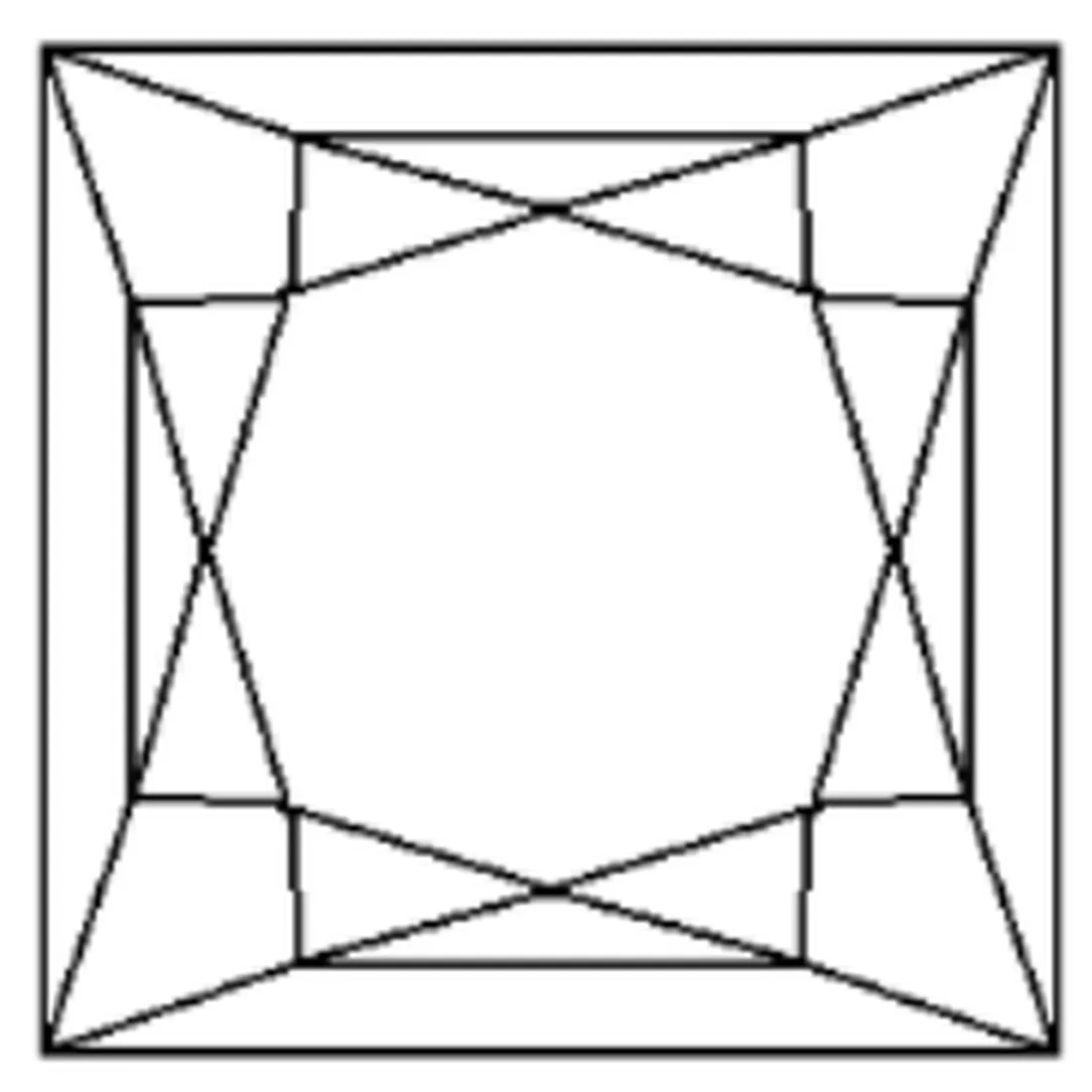
The chevron is the pavilion’s contribution, seen from above as that cross. Brilliant-style facets, arranged so the light returns in a letter. The outline can be a true square or a square eased a little toward a rectangle, and both still read as a princess if the corners stay sharp and the face still throws the X. The slight stretch does not add a clipped corner. It does not turn the stone into a step. If the corners have been planed off and the fire remains, you are speaking about a radiant. If the interior has become frames, you are speaking about an Asscher. The diagram is the boundary, drawn clean. Pointed square. Chevrons. An X.
An X beside a cropped square
A comparison of the chevrons keeps the difference as two drawings on one sheet. The princess shows sharp corners and an X of returning light. The radiant beside it shows cropped corners and a different pattern, the square having given up the points that the princess spent the whole cut protecting. You would meet that X before you asked which label. The two outlines are not the same square. One keeps its tips. One has let them go, so the fire can live inside a softer edge. Both can throw. Only one is a pointed square.
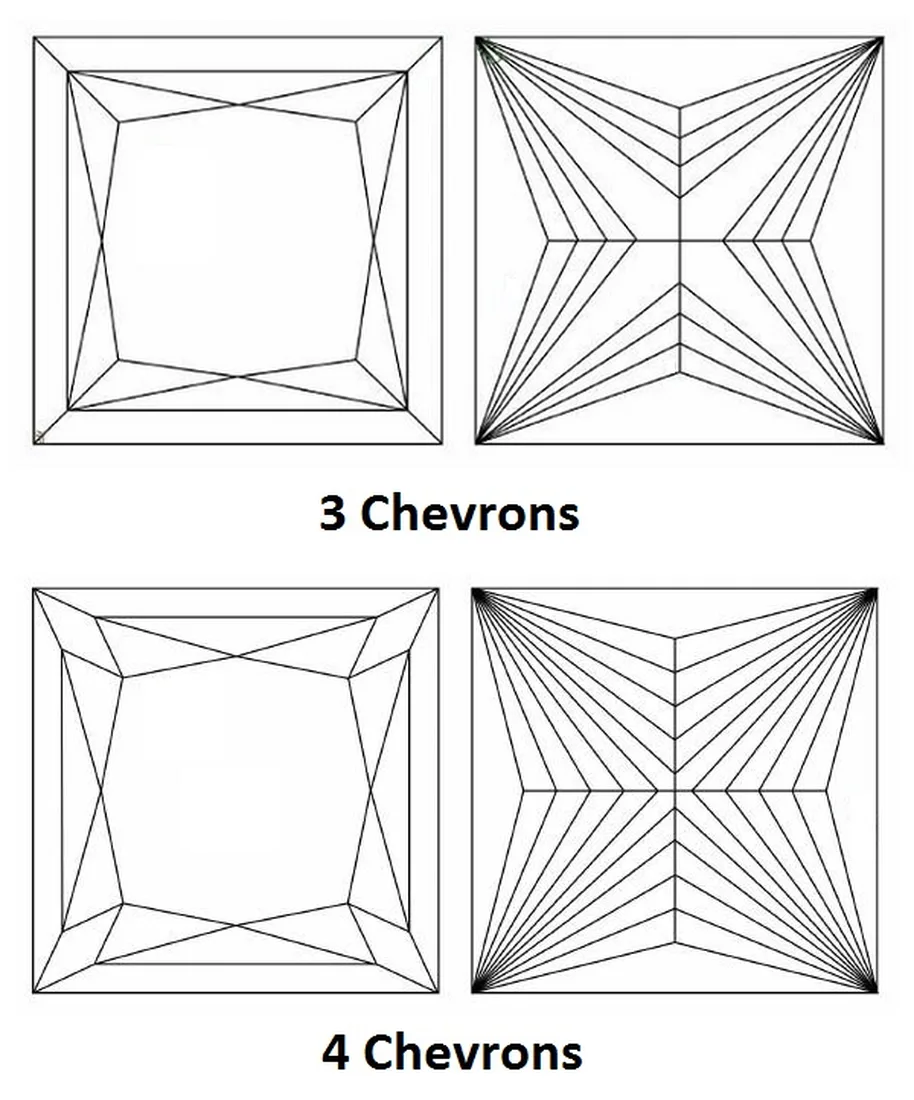
The names sit close in a jeweler’s tray. A square, a fire, then the question of the corner. The princess answers with a point. The radiant answers with a crop. An Asscher, absent from this particular drawing, would have answered with a step, and the face would have gone quiet where these two still scatter. You need the corner, and you need to know whether the pavilion is a chevron or a stair.
A cropped corner sits more quietly against a neighboring band. A pointed corner wants a meeting with metal: a V that brackets the tip, or a claw that takes the point into its hold. The four points are where the cut is sharpest. The prong is what keeps them.
The ring shows the face held at its corners. The diagram shows the face alone. The comparison shows the X beside the cropped square it is so often set next to. In a colored stone the same outline can take a hue and still be a princess: the points do not depend on a diamond’s white. The chevrons do not either. What they depend on is the decision to keep the corners and to cut the pavilion as a brilliant’s cross.
That is the note. A radiant is a square with cropped corners and a brilliant’s fire. An Asscher is a square step. A princess is a pointed square — sharp, unclipped corners, chevron facets, an X when you look down, and a prong or a V at each point.
Educational only · Not jewelry, insurance, or legal advice