A baroque pearl as an irregular light
A baroque pearl is this season’s irregular light. A round pearl holds an even skin, a sphere the nacre agreed to finish. A baroque pearl keeps the shape it grew: a lump, a drop, a body with a bias. The jewel starts there. Gold arrives second, and only to give the accident a head, or a flower, or a small animal to stand over it.
A body the pearl already was
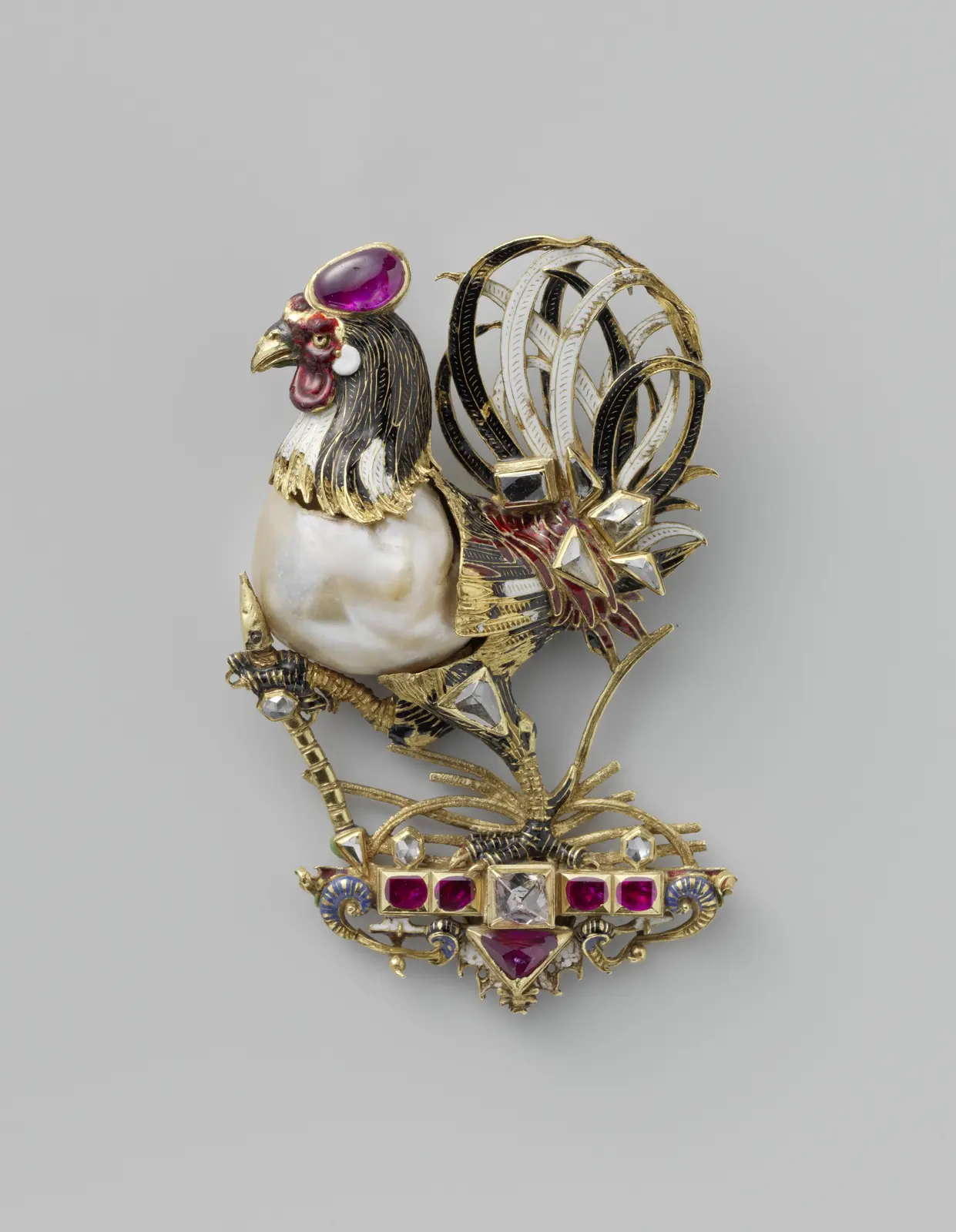
A North German pendant, about 1590 to 1610, keeps the season as one bird. The body is a baroque pearl. The head, the tail, and the feet are partly enamelled gold, set with diamonds and rubies, and the cock steps forward in the Rijksmuseum as if the pearl had been waiting for a direction. The gold is a drawing. The pearl is the volume the drawing agreed to wear.
A round pearl in that place would have given the body a ball, finished before the jeweler began. This one still has a bias. The enamel can be several colors at once. The stones can catch along the wing and the comb. The light that carries the pendant is the pearl’s own unevenness, a cream that refuses a compass. The creature is what the shape suggested. The shape was already the jewel.
The cock holds a small forked arrow in a raised foot, and a tuft of enamelled grass sits under him. Cover the head with a look and the pearl is still a chest. This season’s bold pearl works the same way when a setting starts from an irregular drop and lets the gold confess it. The sixteenth-century jeweler simply said the confession at full scale: a bird whose flesh is the stone, and whose stone never learned to be round.
A torso, centuries later
The Canning Jewel spends the same appetite as a merman. Western Europe, probably 1800 to 1860, a renaissance manner rather than a renaissance survival: enamelled gold, diamonds, rubies, and a baroque pearl for the torso, with blister pearls in the company of the tail. The Victoria and Albert Museum keeps it as a catalog object, off any throat. The body is again the accident. The tail, the head, and the weapon are what gold could add once the pearl had chosen a lean.
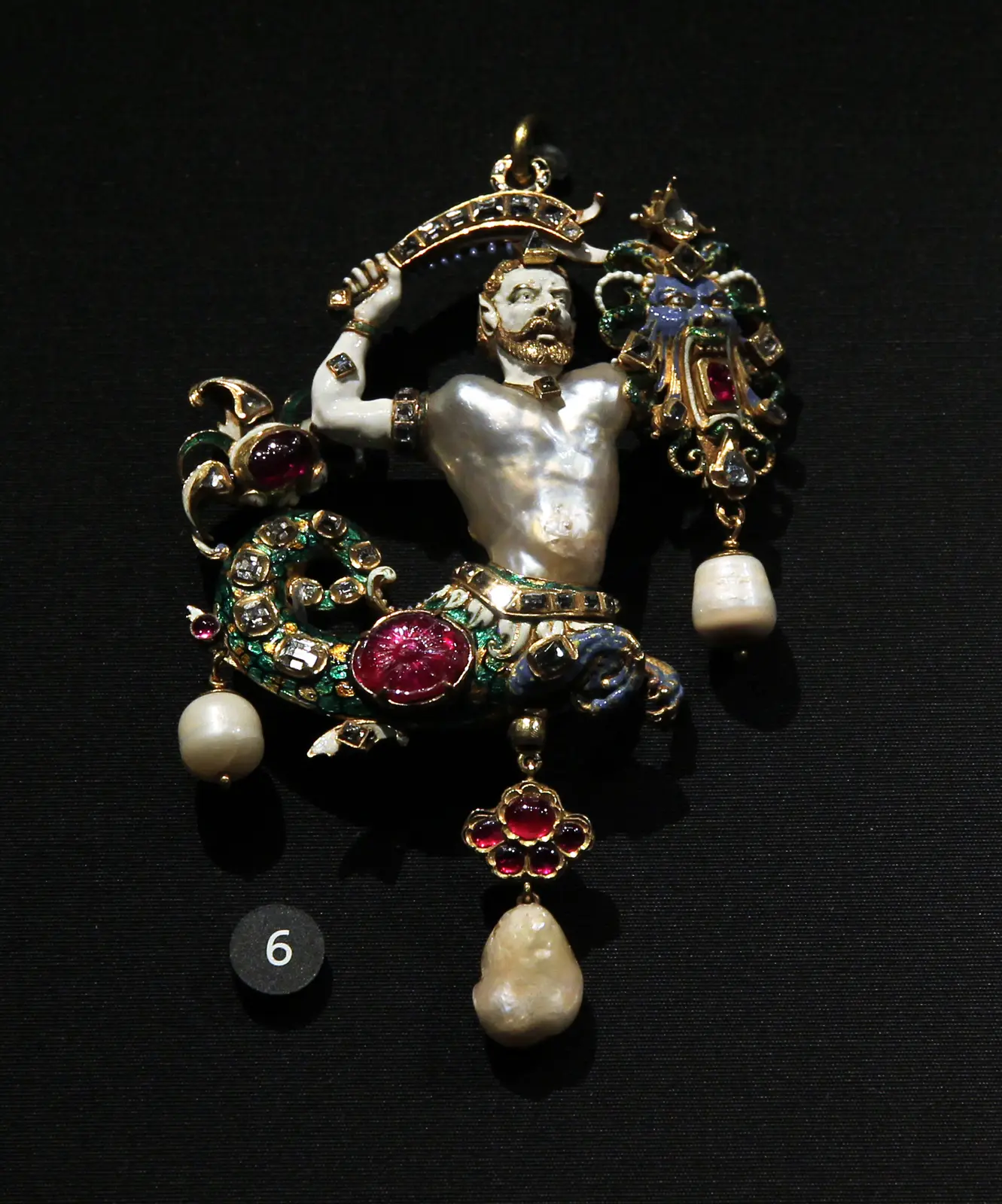
A blister pearl grew against a shell and kept a back. A baroque pearl grew free and kept a whim. Both can share a jewel, and here the torso is the free one. The merman twists. The pearl keeps the twist. A round pearl would have straightened that body into a bead and made the myth stand up straighter than a myth should. This one lets the creature hold its lean, which is the whole pleasure of the piece.
The rubies and the diamonds finish the points: a sparkle at the edges of a light that is otherwise soft and uneven. The century can be the nineteenth. The habit is the older one. Find the pearl that refused a sphere, and draw the person it was already becoming. A revival can do that as cleanly as a first invention. The torso does not need to be ancient to be the center. It needs to be irregular, and to be left that way.
Drops that kept their lumps
A rose brooch in Madrid lets the pearls leave the body and hang. Seventeenth century, gold filigree, a flower head of red stones, four large baroque pearls as drops. The Museo Nacional de Artes Decorativas shows it on a pale ground, a catalog still. The flower is the drawing. The pearls are the irregular light, repeated, each one a different lump under the same bloom.
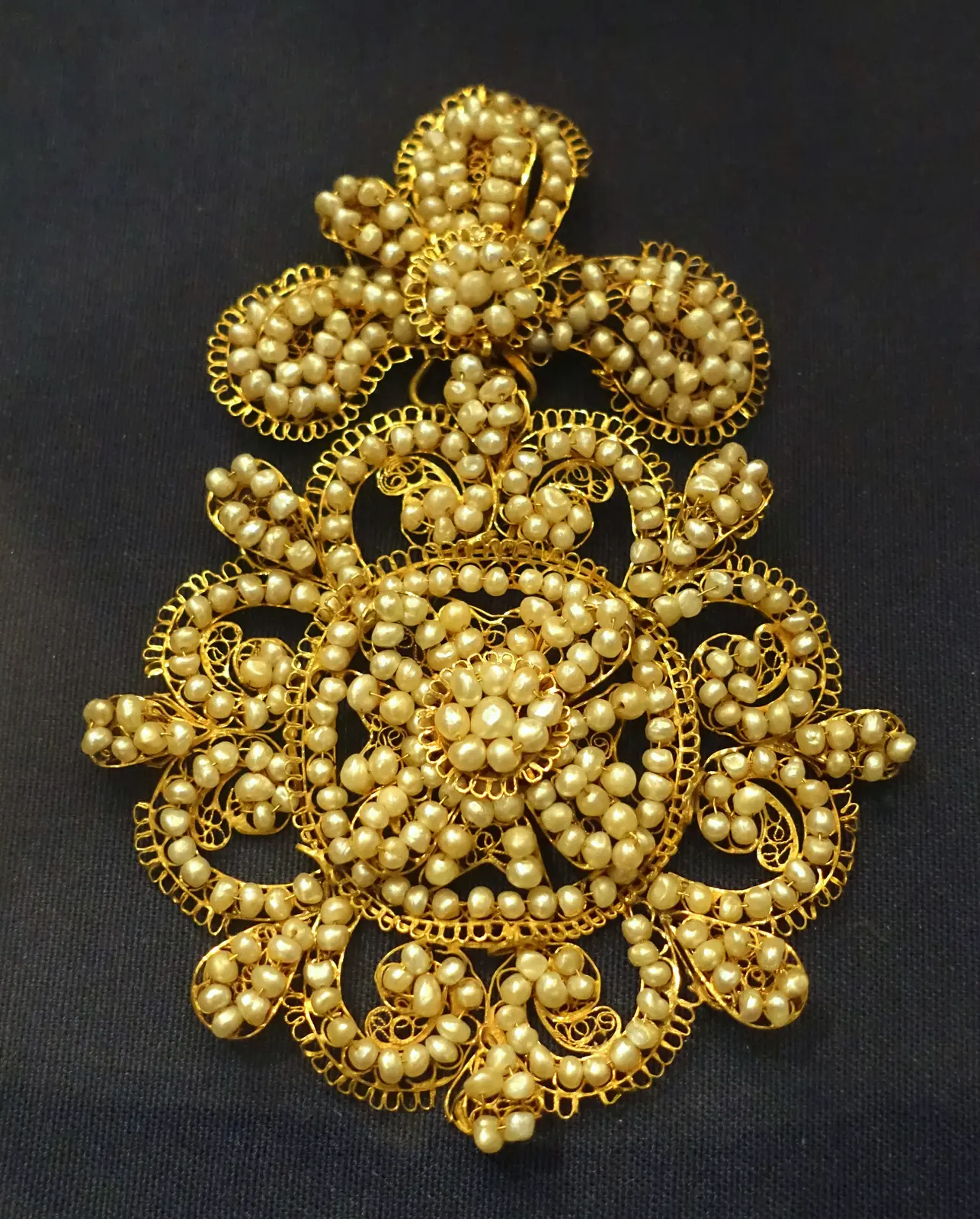
A matched round drop would have agreed with its neighbor and disappeared into a set. These do not agree. One leans. One sits fuller. The filigree can be as fine as a lace. The pearls stay blunt, which is their manners. This season’s baroque pearl often arrives in exactly that role: a finish that refuses to be identical, under a flower that was willing to be precise. The contrast is the wear. Precision above, accident below, and the accident is the part that moves when the brooch is lifted.
The red center holds the eye, and then the eye falls. That fall is the point. Four lights, none of them a sphere, all of them willing to be the flower’s weight. The gold did the petals. The pearls did the rest. A collar of even pearls is another jewel, a skin. This is a cluster of disagreements, hung on purpose.
One pearl, and a serpent over it
A French stick pin, about 1867, reduces the idea to a single ending. Gold, diamonds in a pavé, enamel, and a freshwater pearl of uneven outline, a small serpent coiled above it. The Cooper Hewitt keeps the pin as a tall, quiet catalog object. The pin is a line. The serpent is a signature. The pearl is the light at the end of the line, and it has not settled into a perfect ball.
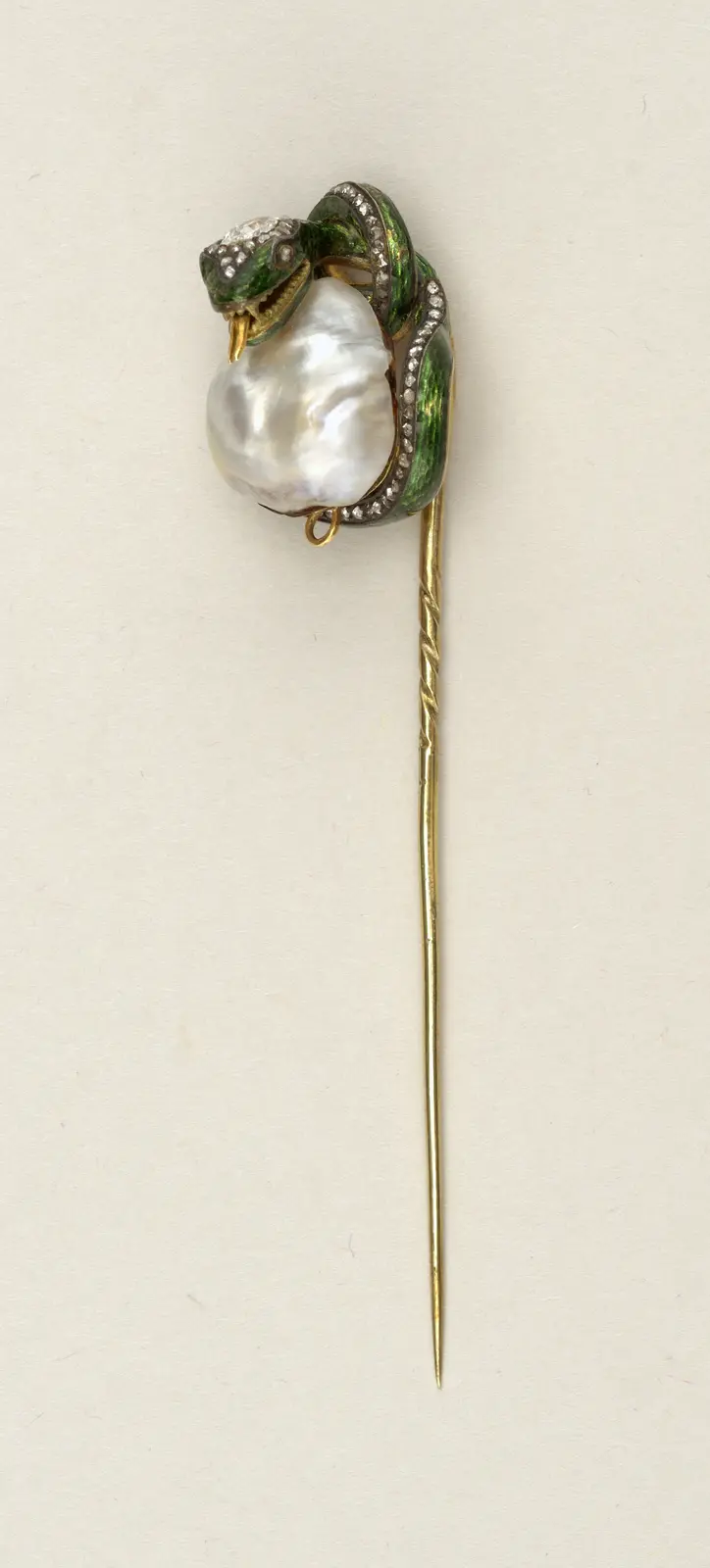
Freshwater pearls often keep this softness, a body with a bias rather than a compass. On a stick the scale is modest. The habit is the one the rooster taught at a larger size. One irregular light. A little gold animal to introduce it. The diamonds are a small weather on the serpent’s back. They glitter. The pearl glows, and the glow is uneven, which is how you know the drop was allowed to stay itself.
Four jewels, one appetite. The rooster gives the pearl a body and lets the body be a bird. The merman gives it a torso and lets the torso lean. The rose gives it four drops and lets them disagree. The stick pin gives it one ending. A round pearl can still be worn as an even skin, calm and matched. This season’s light is the other pearl: the one that kept the shape it grew.
That is the sit. A baroque pearl as an irregular light. A cock whose chest is the stone. A merman whose torso never became a bead. A rose that hangs four disagreements. A pin that ends in one soft, uneven light.
Educational only · Not jewelry, insurance, or legal advice